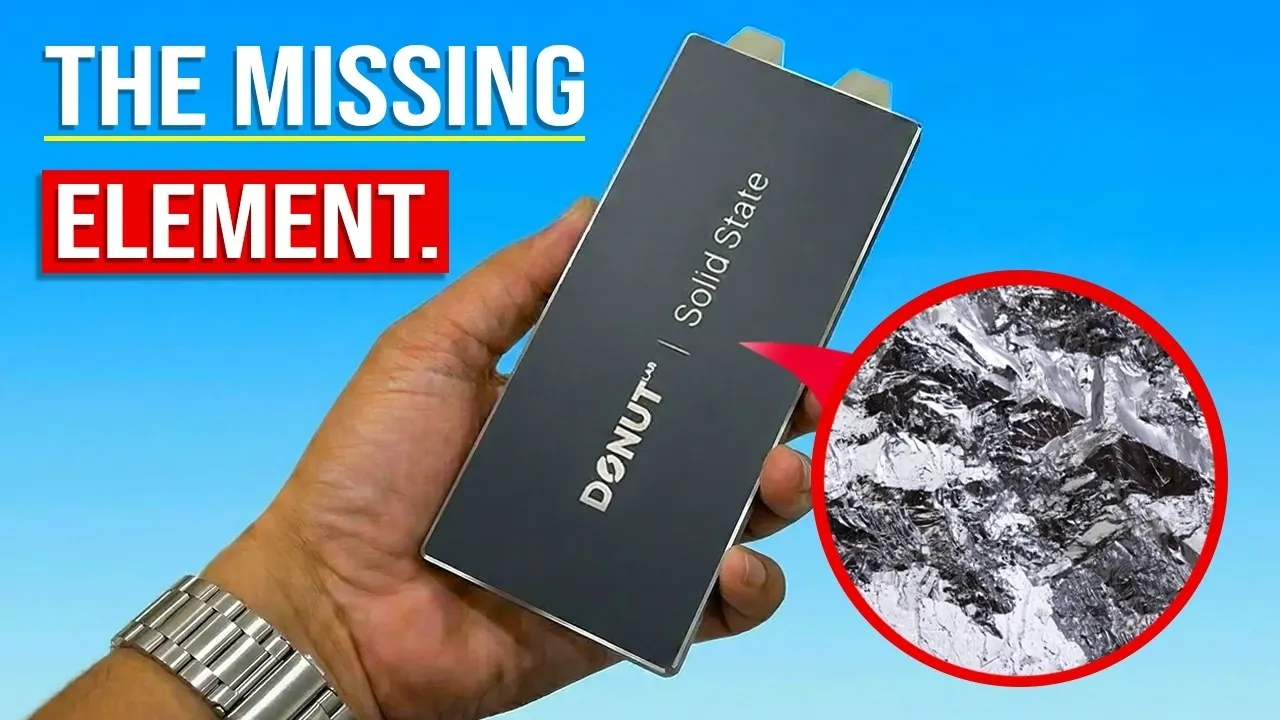
Donut Labs has unveiled what it claims to be the world’s first solid-state battery, promising significant advancements in energy storage with an energy density of 400 Wh/kg, far surpassing the typical 250–300 Wh/kg range of conventional lithium-ion batteries. Ziroth examines the chemistry behind this breakthrough, highlighting the absence of detailed voltage profiles, a key metric for evaluating real-world performance. Without this data, it remains unclear how the battery balances energy output, efficiency and compatibility with existing systems. The feature also explores whether Donut Labs has addressed common trade-offs, such as reduced cycle life and thermal management challenges, that often accompany high-density designs.
In this breakdown, you’ll gain insight into how Donut Labs’ claims compare to existing technologies like silicon-anode batteries and sodium-ion alternatives, each of which faces its own limitations. The analysis also provide more insights into the feasibility of achieving high energy density, thermal stability and fast charging simultaneously without compromise. By the end, you’ll better understand the critical gaps in transparency and the broader implications for both industry adoption and investor confidence.
Understanding the Battery Chemistry
TL;DR Key Takeaways :
- Donut Labs claims to have developed the world’s first solid-state battery with exceptional energy density (400 Wh/kg), thermal stability and fast charging capabilities, but lacks transparency in providing detailed performance data.
- The absence of critical metrics, such as voltage profiles and independent testing, raises doubts about the battery’s real-world performance and commercial feasibility.
- Achieving high energy density, thermal stability and fast charging simultaneously without trade-offs is unprecedented and Donut Labs has not clarified how it addresses known engineering challenges like material degradation and heat management.
- Industry experts remain skeptical due to the lack of third-party validation and concerns about scaling the technology from prototypes to mass production.
- Potential investors are advised to exercise caution, as bold claims without sufficient evidence raise ethical concerns and highlight the risks associated with unproven technologies.
At the heart of Donut Labs’ innovation is a unique chemistry that reportedly achieves an energy density of 400 Wh/kg, a significant leap from the 250–300 Wh/kg range typical of conventional lithium-ion batteries. This figure, if accurate, represents a major advancement in energy storage. However, the absence of detailed voltage profiles, a critical metric for assessing energy output, efficiency and compatibility with existing systems, casts doubt on the practicality of these claims. Without this data, it is difficult to evaluate how the battery performs under real-world conditions.
Theoretical advancements in battery technology, such as lithium-ion batteries with silicon composite anodes or semi-solid-state electrolytes, have demonstrated the potential to achieve similar energy densities. However, these approaches often involve trade-offs, such as reduced cycle life or increased thermal management challenges. Donut Labs has yet to provide evidence of how it has overcome these well-documented limitations while achieving such high performance. This lack of transparency raises questions about whether the battery’s chemistry is as innovative as claimed.
Performance Metrics: A Balancing Act
Donut Labs asserts that its battery combines three critical features: high energy density, thermal stability, and fast charging capabilities. While achieving any one of these metrics is challenging, integrating all three into a single battery without significant trade-offs is unprecedented.
– Energy Density vs. Longevity: Batteries with high energy density, such as those using silicon anodes, often suffer from reduced cycle life due to material degradation during repeated charging cycles. Donut Labs has not clarified how it addresses this issue.
– Thermal Stability at Scale: Solid-state batteries are generally more thermally stable than their liquid electrolyte counterparts. However, maintaining this stability at high energy densities introduces significant engineering challenges, particularly in preventing overheating or thermal runaway.
– Fast Charging and Heat Management: Rapid charging generates heat, which can compromise thermal stability and accelerate degradation. Donut Labs has not provided sufficient data to demonstrate how it mitigates these risks while maintaining performance.
Without independent testing or detailed technical data, the feasibility of achieving these metrics simultaneously remains speculative. The lack of clarity on how these trade-offs are managed further complicates the evaluation of the battery’s true potential.

Here are more detailed guides and articles that you may find helpful on Solid-State Battery.
- Donut Lab Solid-State Battery Test Results from VTT Explained
- Donut Lab Solid State Battery or Pseudo-Capacitor, Experts Weigh In
- Solid-State Battery or Capacitor? Donut Lab’s 100,000-cycle Claim
- Solid-State Battery CES 2026 : Donut Verge TS Pro Plans & Doubts
- Donut Lab Solid-State Battery Test: VTT Finds 110% Capacity at 80C
- Donut Lab Verge Motorcycle Battery Claims : Solid-State or Hype?
- Donut Lab Solid State Battery Claims, 400 Wh/kg and Fast Charge
- Donut Lab Battery Claims vs Test Data: No Energy Density or 100,000-Cycle Proof Yet
- Real-World Donut Lab Solid-State Battery Charging Performance
- New Donut Lab Solid-State Battery Made with Abundant, Non-Rare Materials
Comparing Technologies
To better understand the significance of Donut Labs’ claims, it is essential to compare its battery to existing technologies. Several companies, including Prologium and Amprius, have developed advanced batteries with similar performance goals. However, these technologies often involve well-documented compromises:
- Amprius’ Silicon-Anode Batteries: These batteries achieve high energy densities but face challenges with cycle life and production costs, making them less practical for mass-market applications.
- Sodium-Ion Batteries: While these batteries are less energy-dense than lithium-ion alternatives, they offer advantages in material abundance and cost. However, they are not yet suitable for applications requiring high energy density, such as electric vehicles.
On paper, Donut Labs’ battery appears to outperform these technologies, but without third-party validation or detailed performance data, its superiority remains unproven. The lack of transparency surrounding its design and testing methods further complicates efforts to assess its viability.
Industry Skepticism and Concerns
The ambitious nature of Donut Labs’ claims has drawn skepticism from industry experts. Achieving high energy density, thermal stability and fast charging in a single battery without trade-offs is widely regarded as improbable. Independent testing is critical to validate these metrics, yet Donut Labs has not provided third-party verification of its results.
Scaling the technology from laboratory prototypes to commercial production presents additional challenges. Variations in material quality, manufacturing inconsistencies and engineering hurdles often lead to performance discrepancies. Donut Labs’ lack of transparency regarding its testing methods and results has only heightened doubts about the reliability of its claims.
Investment and Ethical Implications
Reports indicate that Donut Labs is actively seeking investments, particularly from small investors, with promises of high returns. While investing in emerging technologies can be appealing, potential investors should exercise caution and conduct thorough due diligence.
- Risk Factors: Battery technologies often face unforeseen engineering challenges and early performance metrics are frequently overestimated. Investors should be wary of unproven claims.
- Ethical Concerns: Making bold assertions without sufficient evidence can mislead investors and stakeholders, raising questions about the company’s transparency and accountability.
Investors should critically evaluate the available data and seek independent assessments before committing to such ventures. Ethical considerations surrounding the accuracy of Donut Labs’ claims further underscore the need for caution.
Engineering Trade-Offs: The Reality of Battery Design
Battery development is inherently a process of balancing trade-offs. For example, increasing energy density often comes at the expense of cycle life, while enhancing thermal stability can limit fast charging capabilities. Donut Labs’ assertion that it has achieved all these metrics simultaneously, without compromises, is unprecedented and warrants careful scrutiny.
Transparent data and independent testing are essential to address these concerns. Without them, the validity of Donut Labs’ technology remains uncertain. The company’s reluctance to share detailed performance metrics only adds to the skepticism surrounding its claims.
A Promising Yet Unproven Innovation
Donut Labs’ solid-state battery represents a potentially significant advancement in energy storage technology. Its claims of high energy density, thermal stability and fast charging capabilities are undeniably intriguing. However, the lack of transparent data and independent validation raises critical questions about its feasibility and commercial readiness.
While the battery’s potential is exciting, significant skepticism remains regarding its ability to deliver on these promises without trade-offs. Until independent testing confirms its performance and scalability, the technology’s innovative potential remains an open question. For now, cautious optimism is the most prudent approach.
Media Credit: Ziroth
Disclosure: Some of our articles include affiliate links. If you buy something through one of these links, Geeky Gadgets may earn an affiliate commission. Learn about our Disclosure Policy.
