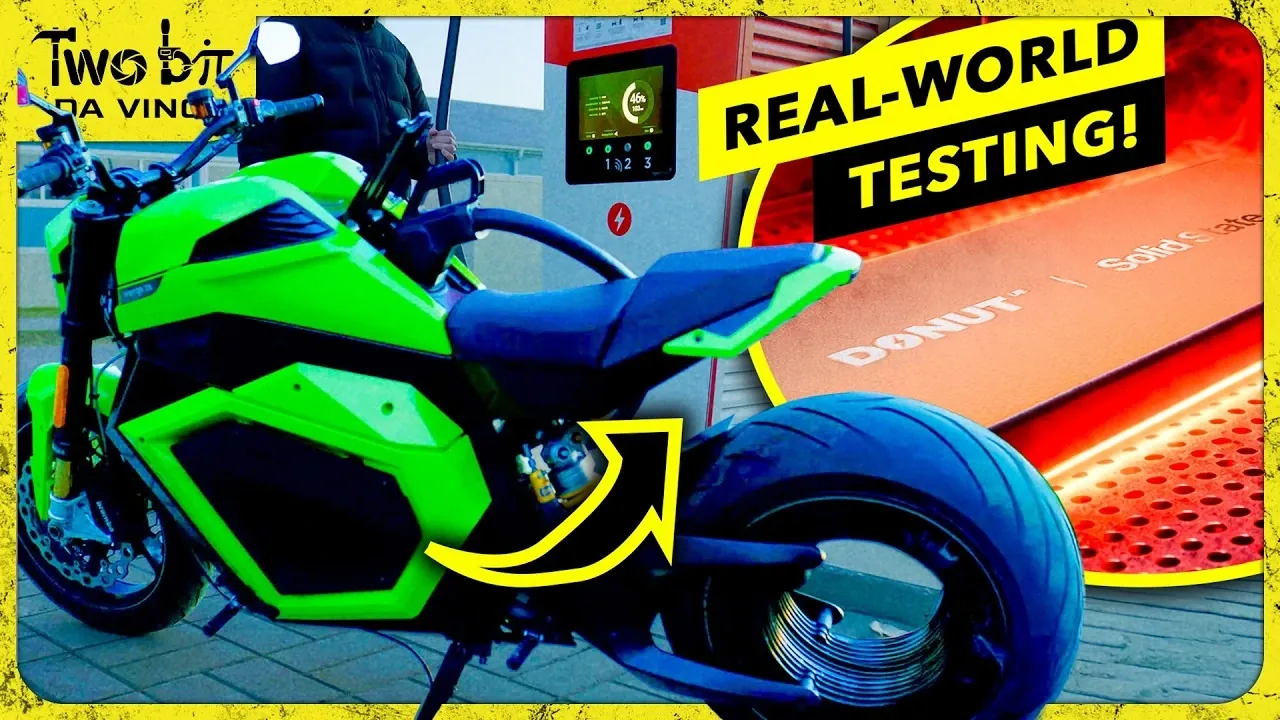
Donut Lab’s recent real-world test of its solid-state battery technology highlights both advancements and challenges in electric vehicle energy storage. As detailed by Two Bit da Vinci, the test involved integrating the battery into a Verge motorcycle, achieving a 5.7C charging rate at a public station. This allowed the motorcycle to charge from 10% to 80% in just 12 minutes, a performance far exceeding the charging speeds of current electric motorcycles like those from Zero and Energica. However, the test also underscored issues with thermal management and the battery’s charge curve, illustrating the complexities of refining this technology for practical use.
Discover how this test informs the potential applications of solid-state batteries across various EV types, including motorcycles, SUVs and trucks. Gain insight into the technical hurdles of scaling this technology, such as thermal regulation and compatibility with existing charging infrastructure. This analysis also evaluates claims about energy density and cycle life, offering a closer look at the steps required to advance solid-state batteries toward broader adoption.
Breakthrough in EV Battery Tech
TL;DR Key Takeaways :
- Donut Lab’s solid-state battery achieved a new 5.7C charging rate, allowing a Verge motorcycle to charge from 10% to 80% in just 12 minutes, far surpassing current EV benchmarks.
- The battery’s rapid charging capabilities could transform EV adoption by significantly reducing recharging downtime, though its performance under broader real-world conditions remains untested.
- Potential applications extend beyond motorcycles to larger EVs, but limitations in thermal management (air cooling) and the Battery Management System (BMS) need refinement for sustained high-rate charging.
- Key claims, including 400 Wh/kg energy density and 100,000 charge cycles, remain unverified, highlighting the need for independent validation and further testing to confirm long-term reliability.
- Scaling the technology faces challenges due to the lack of ultra-high-power charging infrastructure, which is critical for realizing the battery’s full potential in larger EVs and commercial applications.
Transforming Charging Performance
The Verge motorcycle equipped with Donut Lab’s solid-state battery showcased a remarkable leap in charging efficiency. It charged from 10% to 80% in just 12 minutes using a standard public charger. For comparison, most electric motorcycles today, including models from Zero and Energica, charge at significantly slower rates of 12 kW and 20 kW, respectively. This achievement positions Donut Lab’s battery as a potential leader in the EV market, setting a new benchmark for charging speed and efficiency.
By achieving such rapid charging times, the technology could address one of the most persistent challenges in EV adoption: reducing downtime for recharging. However, while this test demonstrates the battery’s capabilities in a controlled scenario, questions remain about its performance under broader real-world conditions.
Performance Beyond Motorcycles: Broader Implications
The test results also highlight the potential for Donut Lab’s battery to outperform larger EVs. For instance, the Lucid Gravity, a premium electric SUV, achieves a charging rate of 3.2C, nearly half the rate demonstrated by Donut Lab’s battery. This suggests that the technology could be adapted for use in a wide range of EVs, from motorcycles to cars and even commercial vehicles.
However, the test also revealed limitations. The battery’s charge curve was influenced by its Battery Management System (BMS), thermal management constraints and electrochemical properties. The use of air cooling as the thermal management method proved to be a bottleneck, limiting the battery’s ability to sustain high-rate charging over extended periods. While air cooling is simpler and more cost-effective than liquid cooling, it struggled to maintain optimal operating temperatures during peak performance. This underscores the need for further refinement of both the BMS and thermal management systems to fully unlock the battery’s potential.

Gain further expertise in Solid-State batteries by checking out these recommendations.
- Donut Lab Solid-State Battery Test Results from VTT Explained
- Donut Lab Solid State Battery or Pseudo-Capacitor, Experts Weigh In
- Solid-State Battery or Capacitor? Donut Lab’s 100,000-cycle Claim
- Solid-State Battery CES 2026 : Donut Verge TS Pro Plans & Doubts
- Donut Lab Solid-State Battery Test: VTT Finds 110% Capacity at 80C
- Donut Lab Solid State Battery Claims, 400 Wh/kg and Fast Charge
- Donut Lab Battery Claims vs Test Data: No Energy Density or 100,000-Cycle Proof Yet
- New Donut Lab Solid-State Battery Made with Abundant, Non-Rare Materials
- CATL Sodium-Ion Battery Uses Water-Based Lines for Cheaper Cells
Unverified Claims and the Path to Validation
Despite the promising results, several of Donut Lab’s claims remain unproven. The company asserts that the battery achieves an energy density of 400 Wh/kg and supports up to 100,000 charge cycles. If accurate, these figures would represent a significant advancement in battery technology. However, independent validation of these claims is essential to establish their credibility.
Additionally, the specific electrochemical properties of the battery have not been disclosed, leaving questions about its long-term reliability and performance unanswered. These gaps in verification highlight the importance of third-party evaluations and further testing to confirm the battery’s capabilities. Without this validation, the technology’s broader adoption and integration into the EV market may face delays.
Challenges in Scaling and Infrastructure Development
Scaling this technology for use in larger EVs presents both opportunities and challenges. If successfully implemented, it could dramatically reduce charging times for vehicles like the Lucid Gravity or even electric buses and trucks. However, the practical application of this technology is constrained by the current state of public charging infrastructure.
Most existing charging stations are not equipped to handle the ultra-high-power chargers required to deliver 700+ kW, which would be necessary to fully use the battery’s capabilities. Until infrastructure catches up with the demands of next-generation batteries, the real-world impact of this technology will remain limited. Addressing these infrastructure gaps will be critical to unlocking the full potential of Donut Lab’s solid-state battery.
Community Insights and Recommendations for Future Testing
The response to Donut Lab’s latest test has been mixed, reflecting both excitement and skepticism. Approximately 30% of observers praised the technology’s potential to transform EV energy storage, while another 30% expressed concerns about the unverified claims. The remaining feedback was divided between neutrality and skepticism, with recurring questions about energy density, cycle life and performance under extreme conditions. To address these concerns and build confidence in the technology, several recommendations for future testing have emerged:
- Expanding testing to include larger EVs, such as cars and commercial vehicles.
- Conducting independent, third-party evaluations to validate the company’s claims.
- Testing the battery under extreme environmental conditions, such as freezing temperatures or high heat.
These steps could provide a clearer picture of the battery’s capabilities and limitations, paving the way for broader acceptance and adoption.
Refining the Technology for the Future
The Battery Management System (BMS) used in this test is still in the early stages of development. With further optimization, it could enhance the battery’s performance and address current limitations in thermal management and charge curve stability. Upcoming tests are expected to focus on refining the BMS, validating the company’s claims and exploring the battery’s long-term potential.
While Donut Lab’s solid-state battery shows significant promise, it is clear that further development and validation are needed. The technology has the potential to reshape the EV landscape, but its journey toward widespread adoption will depend on overcoming technical challenges, verifying performance claims and addressing infrastructure limitations. As these hurdles are addressed, the battery could play a pivotal role in advancing the future of electric vehicles.
Media Credit: Two Bit da Vinci
Disclosure: Some of our articles include affiliate links. If you buy something through one of these links, Geeky Gadgets may earn an affiliate commission. Learn about our Disclosure Policy.
