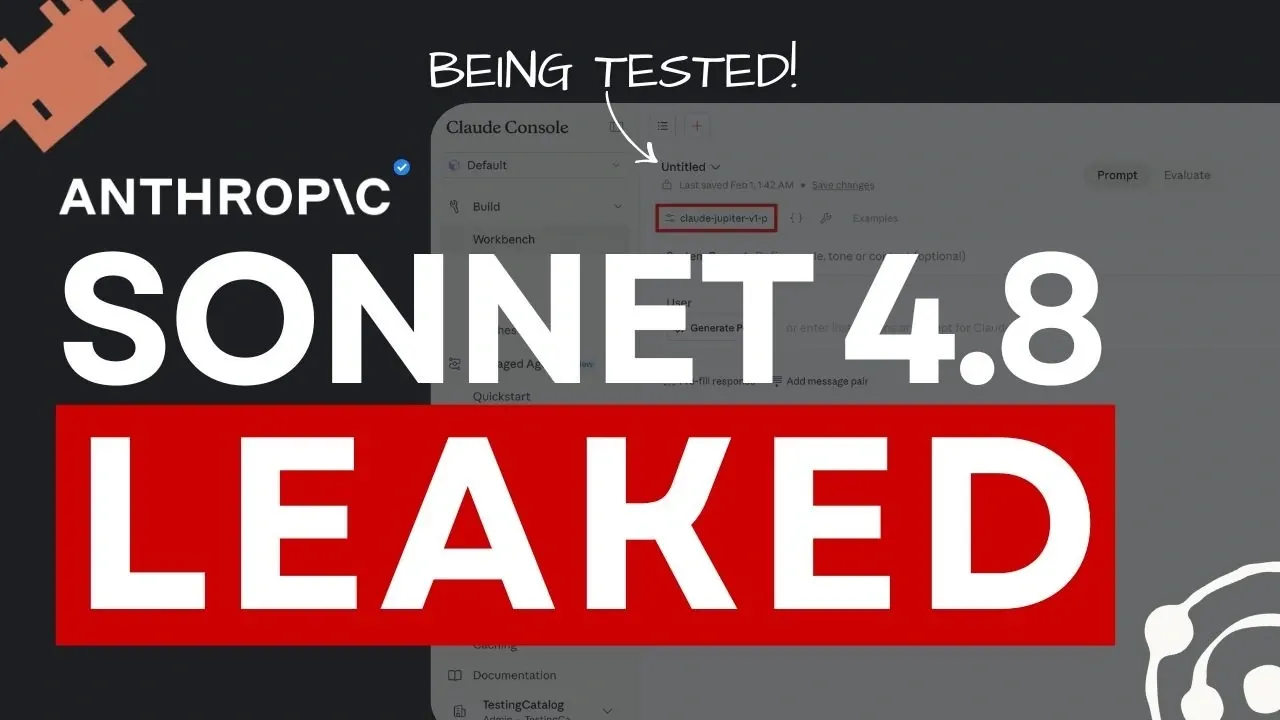
Anthropic’s Claude Sonnet 4.8 has emerged as a key topic in recent AI developments, with leaks suggesting significant progress toward its release. According to Universe of AI, this iteration builds on the Claude Methos framework, focusing on improved performance in long-context processing and agentic reasoning. These enhancements are designed to address challenges in managing complex, layered tasks, which are increasingly critical in sectors like automation and decision-making under high-stakes conditions.
Explore this exposé to understand how Claude Sonnet 4.8 approaches multi-step task execution and its implications for real-world applications. Gain insight into Anthropic’s concurrent work on Claude Jupiter, which is being tested for potential cybersecurity use cases, and examine the ethical considerations tied to deploying such advanced AI systems.
Anthropic’s Sonic 4.8 & Claude Jupiter : What We Know
TL;DR Key Takeaways :
- Anthropic’s Sonic 4.8 is nearing release, focusing on enhanced capabilities for long-context tasks and agentic workloads, while Claude Jupiter is being tested for potential cybersecurity applications.
- OpenAI’s GPT 5.5 excels in cybersecurity, offering efficient solutions for complex tasks and preparing a specialized variant, GPT 5.5 Cyber, to address targeted threats.
- A mysterious AI model called “Alpha” is being tested, showcasing advanced capabilities in agentic workloads, automation and long-context processing, with potential applications in productivity and software development.
- OpenAI’s Codex has evolved into the “Codex Super App,” a versatile productivity tool integrating with platforms like Slack and Google Workspace, allowing research, planning and workflow automation.
- The rapid evolution of AI technologies is driving advancements in cybersecurity, productivity and automation, emphasizing ethical testing, collaboration and accessibility to shape a secure and innovative digital future.
Anthropic is reportedly conducting internal tests on Sonic 4.8, with leaks indicating that the model is close to release. This latest iteration is expected to build upon the Claude Methos line, offering enhanced capabilities for long-context tasks and agentic workloads. While specific technical details remain undisclosed, Sonic 4.8 is anticipated to represent a meaningful step forward in AI performance, particularly in handling complex, multi-layered operations.
In addition to Sonic 4.8, Anthropic is also developing another model known as Claude Jupiter. This model is undergoing rigorous testing by specialized “red teams” tasked with identifying vulnerabilities and making sure its reliability. Industry speculation suggests that Claude Jupiter may focus on cybersecurity applications or serve as an evolution of Anthropic’s existing LLMs. These efforts reflect Anthropic’s dual priorities: advancing AI capabilities while maintaining a strong commitment to responsible and secure development practices.
OpenAI’s GPT 5.5: A Cybersecurity Powerhouse
OpenAI’s GPT 5.5 has emerged as a standout model in the realm of cybersecurity, outperforming competitors like Claude Methos in critical metrics. It has demonstrated the ability to complete complex cybersecurity tasks with greater efficiency and at a lower cost compared to human experts. This positions GPT 5.5 as a valuable tool for organizations aiming to strengthen their digital defenses.
To address specific cybersecurity challenges, OpenAI is preparing to release a specialized variant called GPT 5.5 Cyber. This tailored model is designed to tackle targeted cybersecurity threats and will be made widely accessible to organizations and governments. OpenAI is also fostering collaborations with industries and public institutions to bolster global cybersecurity infrastructure. These initiatives underscore the practical applications of AI in safeguarding digital systems and highlight its potential to address real-world challenges effectively.
Learn more about AI models by reading our previous articles, guides and features :
- Meet Claude Mythos : Anthropic’s Powerful Successor to Opus
- Anthropic Claude Mythos AI World’s Newest Obsession a 10-Trillion Parameter
- MiniMax M2.7 Self-Evolving AI Model Shows Gains in Coding Benchmarks
- Which Claude 3 AI model is best? All three compared and tested
- Why Anthropic is Restricting Its New Mythos AI Model to Tech Giants
- Researchers Warn AI Training on AI Data Drives Model Collapse
- What Makes MiniMax M2.7 So Special? The New AI, Explained
- The 12 Research Papers That Influenced AI Development Over The Last 6 Years
- New AI Models : Deepseek V4, Minimax 2.5 & Seedance 2.0
- LLAMA 5 Meta’s Most Powerful Al Model Just Leaked
The Mystery Model “Alpha” and Its Capabilities
A new AI model, referred to as “Alpha,” is currently being tested on the Open Router platform. This high-performance foundation model is designed to excel in agentic workloads, including tool use, long-context processing, code generation and automated workflows. While the origins of Alpha remain unclear, some experts speculate that it may have been developed by Miniax or Chinese AI labs as part of the global race to advance AI technologies.
Alpha’s capabilities suggest it could play a pivotal role in industries that require complex, multi-step processes. Its ability to handle intricate tasks efficiently positions it as a potential fantastic option in fields such as automation, productivity and software development. The emergence of Alpha highlights the growing diversity of AI models tailored to specific use cases, further driving innovation and competition in the AI sector.
Codex Super App: Redefining Productivity
OpenAI’s Codex platform has undergone a significant transformation, evolving into a comprehensive productivity tool now known as the “Codex Super App.” This reimagined platform extends its functionality far beyond programming assistance, integrating seamlessly with widely used platforms such as Slack, Google Workspace and Microsoft 365.
The Codex Super App enables users to perform a broad range of tasks, including research, planning, document creation and workflow automation. It also functions as a personal assistant, capable of summarizing data, automating repetitive tasks and streamlining operations. By expanding its appeal beyond developers, the Codex Super App positions itself as a direct competitor to platforms like Cloud Co-Work and Cloud Code. This evolution underscores its potential to enhance efficiency and innovation across various industries, offering professionals a powerful tool for managing their workloads effectively.
The Future of AI Integration
The rapid evolution of AI technologies is driving significant advancements in LLMs and their applications. Developments such as Anthropic’s Sonic 4.8, OpenAI’s GPT 5.5, the enigmatic Alpha model and the Codex Super App highlight the sector’s focus on enhancing cybersecurity, productivity and automation. These innovations reflect the increasing integration of AI into diverse workflows, reshaping how individuals and organizations approach complex challenges.
As competition within the AI sector intensifies, the emphasis on ethical testing, collaboration and accessibility will play a crucial role in shaping the future of AI. The result is a more efficient, secure and innovative digital ecosystem, paving the way for advancements that will influence industries worldwide. This ongoing progress underscores the fantastic potential of AI to redefine the boundaries of what is possible in the modern world.
Media Credit: Universe of AI
Disclosure: Some of our articles include affiliate links. If you buy something through one of these links, Geeky Gadgets may earn an affiliate commission. Learn about our Disclosure Policy.
