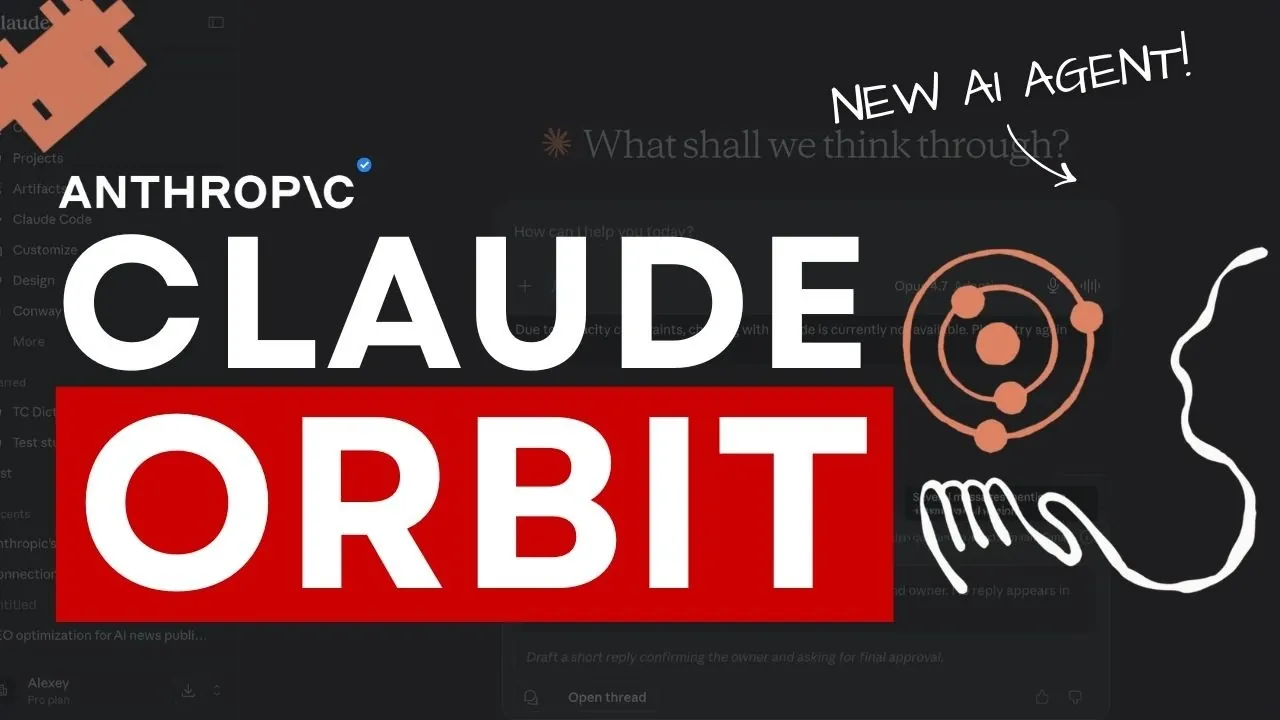
The latest exposé from Universe of AI provide more insights into the recent leak of Claude Orbit, a proactive AI assistant designed to integrate with platforms like Gmail, Slack and GitHub. Unlike traditional AI systems, Claude Orbit focuses on personalized insights and memory-driven interactions, allowing users to streamline workflows and manage complex tasks. This development highlights a growing trend in AI innovation, where systems are tailored to individual needs while maintaining adaptability across various industries. Alongside this, the exposé also touches on other notable updates, including the release of OpenAI’s GPT 5.5 Instant and the leak of Google’s Gemini 3.2 Flash, both of which signal a shift toward faster and more efficient AI solutions.
Explore how Claude Orbit compares to competitors like ChatGPT Pulse and gain insight into its potential to reshape productivity through its memory and task execution capabilities. You’ll also learn about the implications of Google’s Gemini 3.2 Flash leak, particularly regarding its efficiency-focused design and the advancements in GPT 5.5 Instant, which emphasizes accuracy and contextual understanding. Whether you’re interested in AI’s evolving role in professional workflows or its broader industry impact, this breakdown offers a comprehensive look at what these developments mean for the future.
Claude Orbit: Redefining Proactive AI
TL;DR Key Takeaways :
- Claude Orbit introduces a proactive AI assistant designed for seamless integration with tools like Gmail and Slack, emphasizing memory, personalization and productivity enhancement.
- Google’s Gemini 3.2 Flash leak highlights a fast, efficient AI model optimized for diverse tasks with minimal resource consumption, setting a new standard for AI performance.
- OpenAI’s GPT 5.5 Instant improves accuracy, personalization and memory capabilities, reducing errors and delivering tailored responses for a more reliable user experience.
- Anthropic’s specialized AI agents for financial services streamline tasks like KYC screening and financial closings, raising productivity while prompting discussions on workforce adaptation.
- The shift toward proactive AI systems signals fantastic potential across industries, emphasizing personalization, efficiency and ethical considerations in deployment.
Claude Orbit represents a new wave of proactive AI assistants designed to integrate seamlessly with tools you already rely on, such as Gmail, Slack, GitHub and Figma. Its primary function is to provide personalized insights and briefings, helping you stay organized and informed. While currently focused on summarizing and analyzing data, its potential to autonomously execute tasks could redefine productivity tools in the near future.
Positioned as a competitor to ChatGPT Pulse and other proactive AI assistants from Google and Perplexity, Claude Orbit emphasizes memory and personalization. Over time, it could adapt to your unique workflows, making it an invaluable tool for managing complex tasks. This focus on tailored experiences reflects a growing trend in AI development, where systems are increasingly designed to meet individual user needs. As these capabilities evolve, Claude Orbit could become a cornerstone for professionals seeking to streamline their workflows and enhance productivity.
Google Gemini 3.2 Flash: A Leaked Innovation
The leak of Google’s Gemini 3.2 Flash has generated significant interest within the AI community. This model is engineered for speed, versatility and efficiency, making it well-suited for handling everyday tasks with minimal resource consumption. By optimizing computational requirements, Gemini 3.2 Flash aims to reduce reliance on more intensive models, offering faster and more energy-efficient performance.
Expected to officially debut before Google’s May 19 conference, Gemini 3.2 Flash could establish a new benchmark for AI capabilities. Its ability to perform diverse tasks with precision and speed positions it as a strong contender in the competitive AI landscape. For users, this innovation could transform how you interact with AI-driven tools, allowing smoother and more efficient workflows. As the AI field continues to evolve, Gemini 3.2 Flash exemplifies the push toward creating systems that are both powerful and accessible.
Here are more detailed guides and articles that you may find helpful on Claude AI.
- How Claude is Quietly Automating Complex Video Editing Workflows
- Claude’s Most Powerful Features : Beginners Guide 2026
- How Paperclip Turns Claude Code Into an Entire Automated AI Company
- Claude Opus 4.6 vs ChatGPT 5.2 : Benchmarks, Context and Workflow AI Tools
- New Claude Feature Automates Your Tasks While You Sleep
- Meet AutoDream : Claude Code’s Clever New Trick for Memory Management
- ChatGPT vs Gemini vs Claude : Best Uses in 2026
- Claude Opus 4.6 vs GPT 5.2 : Opus Sets New Benchmark Scores But Raises Oversight Concerns
- Claude Opus 4.7 Leaks & Anthropic’s Full-Stack AI Studio
- Get Certified in AI for Free: Anthropic Launches Massive New Academy
OpenAI GPT 5.5 Instant: Smarter, Faster and More Reliable
OpenAI’s GPT 5.5 Instant, now the default model for ChatGPT, introduces significant improvements in accuracy and personalization. By reducing hallucinations by 52.5% and inaccurate claims by 37.3%, it delivers more reliable and trustworthy responses. Enhanced performance on benchmarks such as GPQA and math competitions further underscores its technical advancements.
One of GPT 5.5 Instant’s standout features is its memory and contextual understanding. By using past interactions, uploaded files and even Gmail data, it provides responses tailored to your specific needs. Initially available to Plus and Pro users, these memory features are expected to roll out more broadly, making the model accessible to a wider audience. This evolution highlights the growing emphasis on AI systems that adapt to individual users, offering a more seamless and personalized experience. As AI becomes more integrated into daily life, tools like GPT 5.5 Instant demonstrate the potential for smarter, faster and more reliable interactions.
Anthropic’s AI Agents: Transforming Financial Services
Anthropic has introduced 10 specialized AI agents designed to streamline complex tasks in financial services. These agents are tailored to handle processes such as pitch building, KYC (Know Your Customer) screening and month-end financial closings, significantly reducing the workload for professionals in the industry. By integrating with Microsoft 365 applications like Excel, PowerPoint, Word and Outlook, these agents enable seamless context transfer across tools, enhancing overall efficiency.
What sets these agents apart is their ability to work with real financial data, making them highly relevant for tasks such as research, client management and operational workflows. While these tools promise to transform productivity in the financial sector, they also raise concerns about their potential impact on entry-level job opportunities. This shift underscores the need for upskilling and adaptation as AI continues to reshape traditional roles. For professionals in finance, these agents represent a powerful resource for optimizing workflows, but they also highlight the broader implications of AI adoption in the workforce.
Proactive AI: Broader Implications
The transition from reactive to proactive AI systems marks a pivotal moment in the evolution of artificial intelligence. These tools are becoming more reliable and increasingly tailored to high-stakes industries such as law, medicine and finance. By focusing on personalization and efficiency, AI is poised to disrupt traditional workflows, offering both opportunities and challenges.
In financial services, for example, AI integration could lead to significant productivity gains by automating routine tasks. However, this shift also raises important questions about workforce dynamics, including the future of entry-level roles and the need for continuous learning to stay relevant in an AI-driven environment. Beyond finance, proactive AI systems are being developed to address challenges in healthcare, legal services and education, further demonstrating their potential to transform industries.
As these technologies advance, balancing innovation with ethical considerations will be critical. Issues such as data privacy, algorithmic bias and the potential for job displacement must be addressed to ensure that AI systems are deployed responsibly. For individuals and organizations alike, staying informed and adaptable will be essential to using the benefits of AI while navigating its broader implications.
Media Credit: Universe of AI
Disclosure: Some of our articles include affiliate links. If you buy something through one of these links, Geeky Gadgets may earn an affiliate commission. Learn about our Disclosure Policy.
