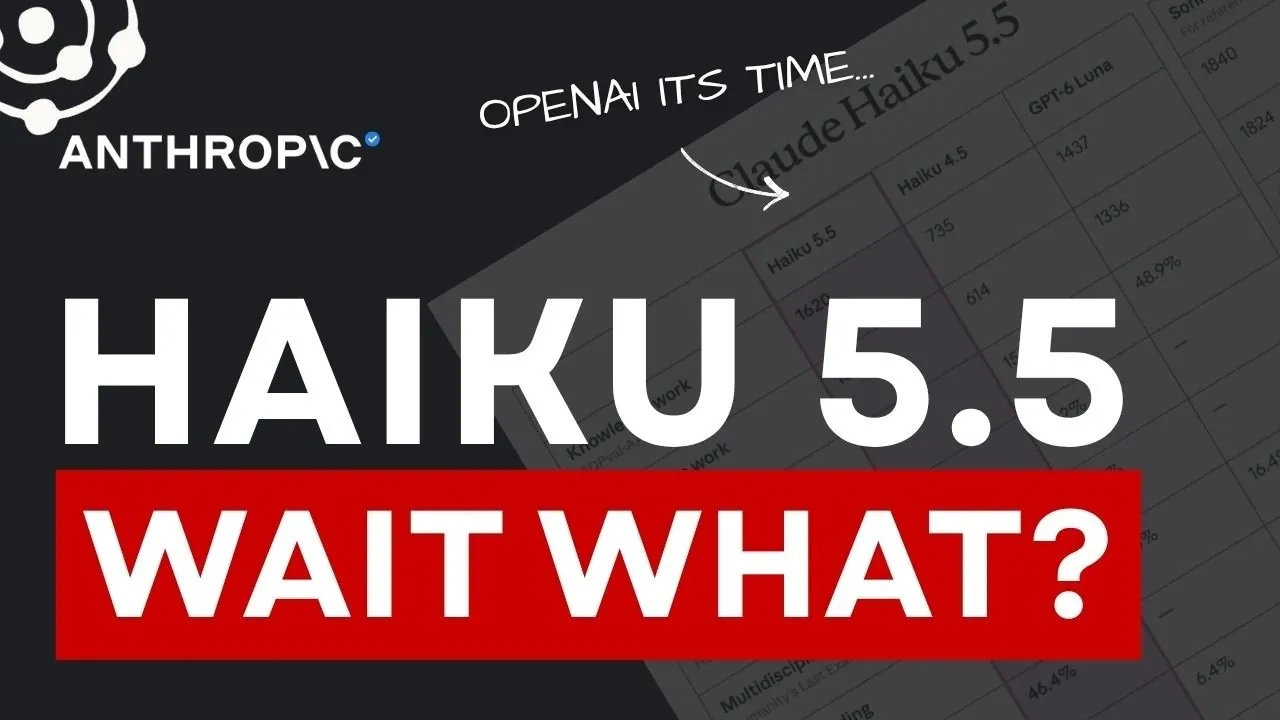
Claude Haiku 5.5 has arrived, promising faster performance and reduced costs compared to its predecessor, Haiku 4.5. According to Universe of AI, this release excels in handling high-volume, cost-sensitive tasks, with benchmark tests like GDP Val confirming its speed and efficiency. However, its high token consumption, up to three times more than GPT6 Luna in some cases, raises concerns for token-heavy workflows. This trade-off makes Haiku 5.5 a compelling but situational choice, particularly for businesses balancing cost and performance in machine learning applications.
In this feature, you’ll explore how Haiku 5.5 stacks up against competitors like GPT6 Luna and Sonnet 5.5, including its strengths in task-specific benchmarks and its struggles with advanced reasoning. Gain insight into its ideal use cases, such as sub-agent roles within multi-model setups and understand the pricing dynamics that impact its viability for large-scale operations. By the end, you’ll have a clear picture of whether Haiku 5.5 aligns with your specific needs and workflows.
Performance Enhancements
TL;DR Key Takeaways :
- Performance Improvements: Claude Haiku 5.5 offers faster processing and better task-specific performance compared to Haiku 4.5 and GPT6 Luna, making it ideal for cost-sensitive, high-volume tasks.
- Cost Efficiency: It is 75% cheaper for tasks under 100,000 tokens but loses its cost advantage for larger-scale operations, where pricing can exceed competitors like GPT6 Luna.
- Token Inefficiency: The model consumes up to three times more tokens than GPT6 Luna, which can offset its cost benefits in token-intensive applications.
- Specialized Use Cases: Best suited for sub-agent roles in multi-model setups, it struggles with advanced reasoning and complex orchestration tasks, where higher-tier models perform better.
- Market Impact: The release highlights Anthropic’s competitive push against OpenAI, though the model’s limitations reflect ongoing challenges in balancing cost, efficiency and capability in AI development.
Claude Haiku 5.5 builds on the foundation of its predecessor, delivering measurable improvements in speed and task-specific capabilities. Benchmark tests, including GDP Val and Terminal Bench 4.0, indicate that it outperforms both Haiku 4.5 and OpenAI’s GPT6 Luna in several key areas.
- Optimized for high-volume tasks: The model is designed to handle rapid processing efficiently, making it particularly suitable for applications where speed and cost sensitivity are paramount.
- Limitations in advanced reasoning: Despite its strengths, Haiku 5.5 struggles with complex orchestration and advanced reasoning tasks. Higher-tier models like GPT6.1 Soul or Sonnet 5.5 remain better equipped for these scenarios.
These enhancements position Haiku 5.5 as a strong contender for specific use cases, though its limitations suggest it is not a universal solution.
Cost Efficiency: A Double-Edged Sword
One of the standout features of Claude Haiku 5.5 is its cost optimization, particularly for smaller-scale tasks. However, this advantage is not without its drawbacks.
- Lower operational costs: For tasks involving fewer than 100,000 tokens, Haiku 5.5 is 75% cheaper to operate than Haiku 4.5. This makes it an appealing choice for businesses seeking to reduce expenses while maintaining performance.
- High-volume pricing concerns: Beyond the 100,000-token threshold, the cost advantage diminishes significantly. In some cases, its pricing can exceed that of GPT6 Luna, reducing its competitiveness for large-scale operations.
This duality in cost efficiency highlights the importance of aligning the model’s capabilities with the specific requirements of your projects.

Below are more guides on Claude Haiku from our extensive range of articles.
- Anthropic Claude Opus 5 Beats ChatGPT 5.6 Sol in ARC AGI 3
- Claude Just Gained an “Infinite” Context Window : Here is What It Means for Your Workflows
- Which Claude 3 AI model is best? All three compared and tested
- Why Haiku 4.5 Is the Must-Have AI for Smarter Coding in 2025
- Claude 3 Haiku vs Sonnet vs Opus writing performance
- The AI Model That’s Changing the Coding Game—Meet Claude Haiku 4.5
- Meet Claude Haiku 4.5 : Budget-Friendly, High-Performance AI Coding Model
Token Usage: A Notable Drawback
While Haiku 5.5 offers cost savings in certain scenarios, its token inefficiency remains a critical limitation that cannot be overlooked.
- High token consumption: In some tasks, the model consumes up to three times more tokens than GPT6 Luna. This inefficiency can offset its lower operational costs, particularly in token-intensive applications.
- Best suited for sub-agent roles: Haiku 5.5 performs best when integrated as a sub-agent within a multi-model setup. By delegating specific tasks to Haiku 5.5 and relying on orchestrator models like Opus 5.5 for complex operations, you can achieve a balance between cost and performance.
This limitation underscores the need for strategic integration to maximize the model’s value while mitigating its drawbacks.
How It Stacks Up Against Competitors
When compared to other models in the market, Claude Haiku 5.5 presents a mixed performance profile. Its strengths and weaknesses make it a specialized tool rather than a universal solution.
- Strengths: The model outperforms GPT6 Luna in speed and task-specific benchmarks, making it a strong choice for cost-sensitive applications.
- Weaknesses: It falls short of higher-tier models like Sonnet 5.5 and GPT6.1 Soul in advanced reasoning and orchestration tasks. This limits its applicability in more complex scenarios.
These comparisons highlight the trade-offs involved in choosing Haiku 5.5 over its competitors, emphasizing the importance of aligning the model’s capabilities with your specific needs.
Recommended Use Cases
To fully use the potential of Claude Haiku 5.5, it is essential to identify the scenarios where it excels and where it may fall short.
- Ideal scenarios: The model is well-suited for sub-agent roles in multi-model setups, where it can efficiently handle specific tasks without incurring excessive costs.
- Not recommended: Haiku 5.5 is less effective as a standalone solution for complex or token-heavy tasks, where more advanced models or orchestrators are better suited.
By understanding these use cases, you can integrate Haiku 5.5 strategically into your workflows to maximize its benefits.
Incentives for Adoption
To encourage adoption, Anthropic is offering API credits ranging from $100 to $500 for Max and Team subscribers. This initiative provides an opportunity to test the model’s capabilities with minimal upfront investment. However, while this incentive is beneficial, it does not address the model’s underlying challenges, such as token inefficiency and high costs for large-scale tasks. Businesses should weigh these factors carefully before committing to the model.
Challenges and Limitations
Despite its advancements, Claude Haiku 5.5 faces several challenges that limit its broader applicability.
- Token inefficiency: The model’s high token consumption can negate its cost savings in certain scenarios, particularly in token-heavy applications.
- Tiered pricing structure: Costs escalate for tasks exceeding 100,000 tokens, making it less viable for high-volume operations.
- Narrow focus: Its design prioritizes cost-sensitive tasks, limiting its utility in more complex use cases.
These limitations highlight the importance of understanding the model’s capabilities and constraints before integrating it into your workflows.
Market Implications
The release of Claude Haiku 5.5 reflects Anthropic’s ambition to compete directly with OpenAI’s GPT6 Luna. Its competitive pricing and performance could pressure OpenAI to accelerate updates to its own models. However, the limitations of Haiku 5.5 underscore the broader challenges of balancing cost, efficiency and capability in machine learning models. These trade-offs are likely to influence the trajectory of AI development in the coming years.
Media Credit: Universe of AI
Disclosure: Some of our articles include affiliate links. If you buy something through one of these links, Geeky Gadgets may earn an affiliate commission. Learn about our Disclosure Policy.
