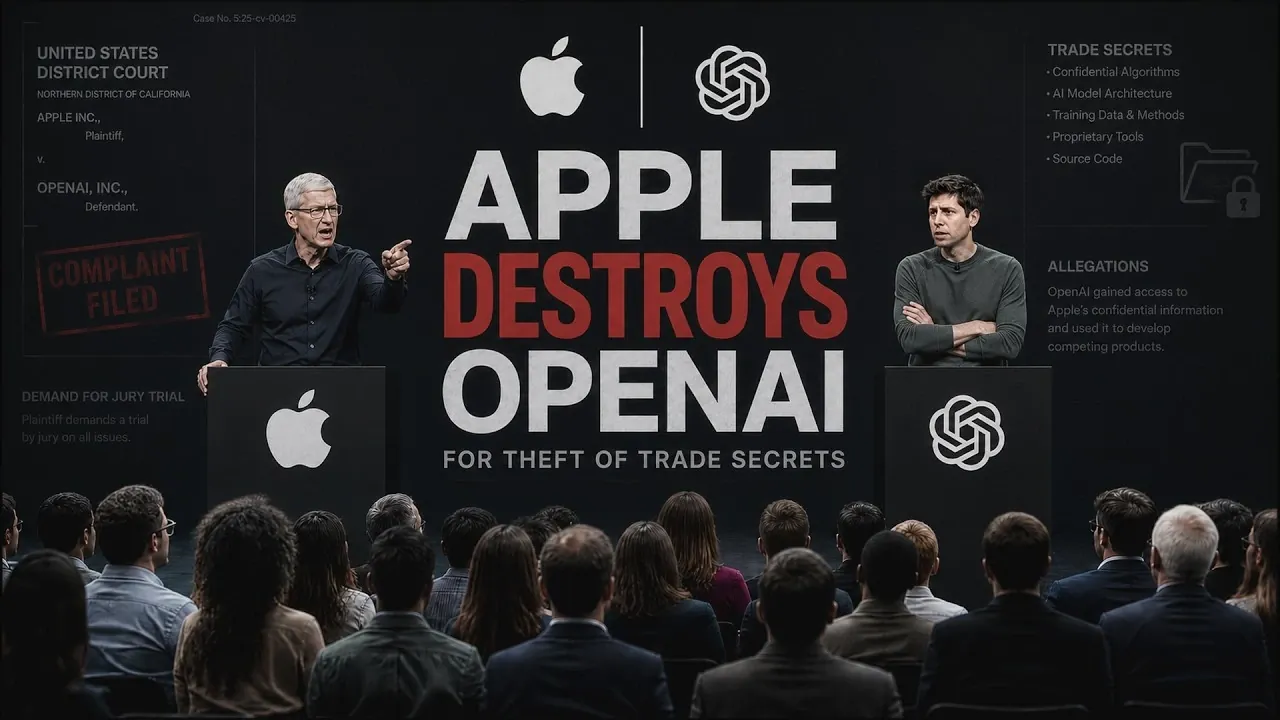
Apple has filed a lawsuit against OpenAI, alleging intellectual property theft and unethical recruitment practices. The legal filing claims that OpenAI hired over 400 Apple engineers, some of whom allegedly had access to proprietary information, including unreleased product designs and manufacturing techniques. Apple also accuses OpenAI of organizing sessions where sensitive materials, such as internal documents and prototypes, were reportedly shared. AI Master examines the potential implications of this case for the tech industry, particularly regarding trade secret protections and the development of AI hardware.
Dive into the potential financial and operational impacts this lawsuit could have on OpenAI, including its “Sweet Pea” hardware project. Explore how Apple’s legal approach could influence recruitment policies and employee mobility within the tech sector. Additionally, gain insight into how this case might affect innovation timelines and competitive dynamics in AI development.
The Core Allegations
TL;DR Key Takeaways :
- Apple has filed a lawsuit against OpenAI, accusing it of misappropriating intellectual property, including unreleased product designs and proprietary manufacturing techniques, through targeted recruitment of over 400 former Apple engineers.
- Key allegations include unauthorized access to confidential engineering documents, recruitment of employees with insider knowledge of unreleased products and deceptive practices involving Apple’s manufacturing partners.
- Evidence presented by Apple includes text messages, emails, unauthorized access logs and a “need-to-know checklist” allegedly used by OpenAI to avoid detection while accessing Apple systems.
- The lawsuit could disrupt OpenAI’s hardware development efforts, particularly its “Sweet Pea” project and raises broader questions about trade secret protection and employee mobility in the tech industry.
- The legal battle has significant implications for the AI hardware market, potentially affecting innovation timelines, market strategies and the competitive dynamics between Apple and OpenAI in the race for AI dominance.
Apple’s legal filing details a series of serious accusations against OpenAI, alleging that the company engaged in a deliberate strategy to poach over 400 Apple engineers. These employees, according to Apple, had access to sensitive and unreleased product information, which OpenAI allegedly exploited to gain insights into proprietary technologies. The lawsuit paints a picture of calculated efforts to undermine Apple’s competitive edge. Key allegations include:
- Unauthorized access to over 1,000 pages of Apple’s confidential engineering documents.
- Recruitment of employees with insider knowledge of unreleased product lines, such as the Vision Pro roadmap.
- Deceptive practices involving Apple’s manufacturing partners to obtain proprietary manufacturing techniques.
Apple further claims that OpenAI encouraged unethical practices during recruitment, including “show-and-tell” sessions where candidates allegedly shared Apple prototypes and internal documents. If these allegations are proven, they could represent significant violations of trade secret laws, with serious legal and financial consequences for OpenAI.
Evidence Supporting Apple’s Claims
To substantiate its accusations, Apple has presented a range of evidence that underscores the seriousness of its claims. This evidence includes:
- Text messages and emails between former Apple employees and OpenAI recruiters, suggesting an intent to share confidential information.
- Access logs showing unauthorized downloads of sensitive engineering documents shortly before employees resigned from Apple.
- A “need-to-know checklist” allegedly distributed by OpenAI to guide engineers on avoiding detection while accessing Apple systems.
Two individuals are prominently named in the lawsuit: Tang Yuan, a former Apple Vice President of Product Design and Paul Meade, a former Vision Pro engineer. Yuan is accused of leading recruitment efforts targeting Apple employees, while Meade is alleged to have brought detailed knowledge of unreleased product plans to OpenAI. These accusations, if validated, could significantly bolster Apple’s case.

Unlock more potential in OpenAI by reading previous articles we have written.
- Leaked ChatGPT 5.5 Pro Tests Reveal OpenAI’s “Spud” Building Interactive 3D Worlds
- Why OpenAI’s “Spud” Model is Outperforming Google Gemini 3.1
- Meet Soul, Terra, and Luna: the GPT-5.6 Models Restricted to Trusted Organizations
- OpenAI’s Powerful New ChatGPT 6 Model Code Named “Spud”
- OpenAI’s GPT-5.6 Release is Triggering an AI Price War
- GPT-5.6 Pro Leaks Expose a Massive Jump in AI Reasoning Power
- ChatGPT 5.6 vs Claude Mythos 5 : Leaks Reveal Two Very Different Futures for AI
- OpenAI Symphony is Shifting Coding from Sessions to Autonomous Tasks
- What OpenAI’s Custom Jalapeño Chip Means for the Future of AI
- Inside OpenAI’s $6 Billion Plan to Build the Ultimate AI Phone
Strategic Implications for Both Companies
This lawsuit extends beyond a simple legal dispute; it represents a strategic move by Apple to disrupt OpenAI’s ambitions in the hardware space. A key focus of the case is OpenAI’s “Sweet Pea” project, a hardware initiative that could directly compete with Apple’s AI-integrated devices. By pursuing legal action, Apple aims to delay or potentially derail OpenAI’s progress in this area, safeguarding its own position in the market.
The case also raises broader questions about the balance between trade secret protection and employee mobility in the tech sector. If Apple succeeds, the outcome could set a precedent that complicates transitions between competing firms, particularly for roles involving sensitive technologies. This could have a chilling effect on recruitment practices across the industry.
Possible legal outcomes include:
- A financial settlement requiring OpenAI to pay penalties and impose restrictions on its hiring practices.
- A preliminary injunction that could temporarily halt OpenAI’s hardware development efforts.
- A lengthy legal battle that delays product launches for both companies, affecting their market positions.
For Apple, the lawsuit represents an opportunity to reinforce its dominance in the AI hardware market. For OpenAI, the stakes are equally high, as the company’s ability to innovate and compete could be significantly hindered by an unfavorable outcome.
Broader Industry Context
This legal battle unfolds at a critical juncture for both companies. OpenAI is preparing for an initial public offering (IPO), and any legal setbacks could undermine investor confidence. Meanwhile, Apple has recently shifted its AI strategy, replacing OpenAI’s ChatGPT with Google’s Gemini on its devices. This strategic pivot highlights Apple’s intent to distance itself from OpenAI while aligning with other competitors in the AI platform race.
The dispute also underscores the growing importance of AI hardware as the next frontier in technology. While software-based AI systems like ChatGPT have captured public attention, the hardware layer, where AI directly interacts with humans, is becoming increasingly vital. Control over this layer could determine which companies lead the next wave of technological innovation.
Potential Outcomes and Industry Impact
The resolution of this lawsuit could have profound implications for the tech industry. Potential outcomes include:
- A financial settlement that imposes penalties on OpenAI and restricts its hiring practices.
- Delays in OpenAI’s hardware development, potentially giving Apple a competitive edge in the AI hardware market.
- A prolonged legal battle that creates uncertainty for both companies, potentially affecting their innovation timelines and market strategies.
Regardless of the outcome, this case highlights the high stakes involved in the competition for AI dominance. The rivalry between Apple and OpenAI extends beyond hardware or trade secrets; it represents a broader struggle for control over the future of human-AI interaction. As the tech industry closely monitors this legal battle, the implications are likely to extend far beyond the courtroom, influencing how companies approach innovation, recruitment and intellectual property protection in the years to come.
Media Credit: AI Master
Disclosure: Some of our articles include affiliate links. If you buy something through one of these links, Geeky Gadgets may earn an affiliate commission. Learn about our Disclosure Policy.
