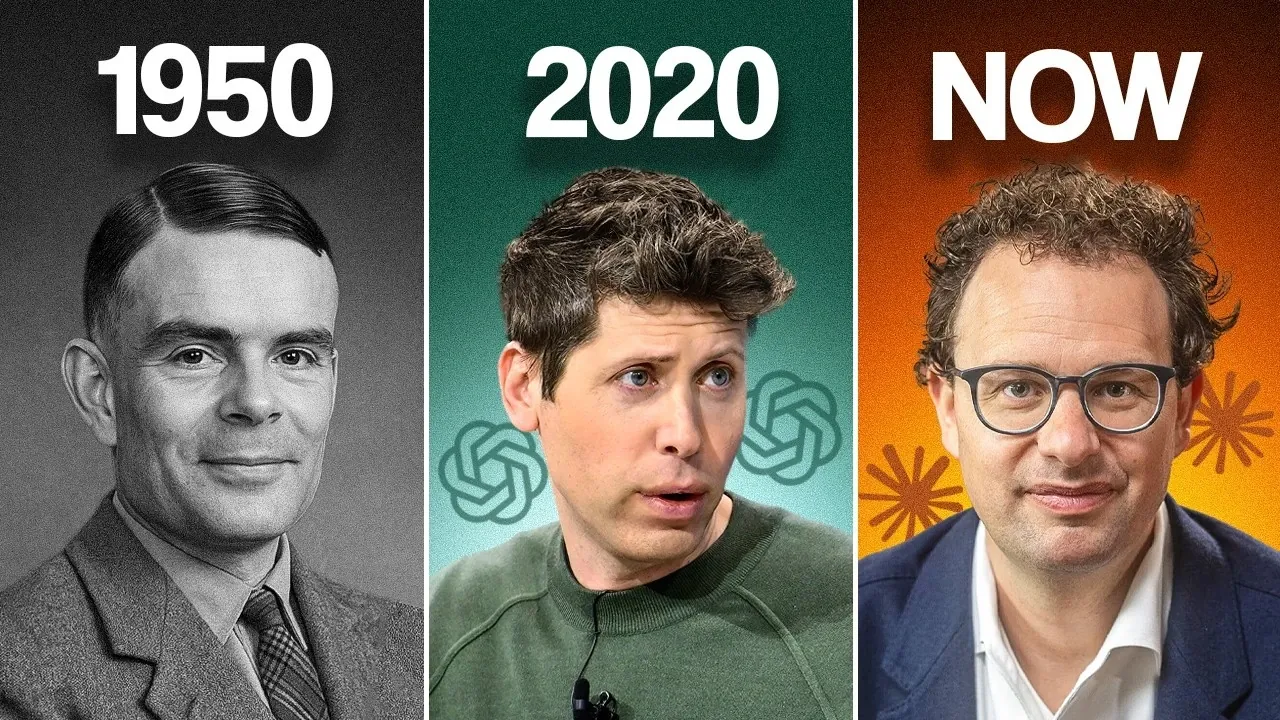
Artificial intelligence has undergone a remarkable transformation over the past century, evolving from abstract theories to practical applications that shape our daily lives. This journey began with foundational ideas like Alan Turing’s “imitation game,” which introduced a framework for evaluating machine intelligence and milestones such as the Dartmouth Conference in 1956, where the term “artificial intelligence” was first coined. Nate Herk explores these pivotal moments, tracing the field’s development through competing approaches like symbolic AI and neural networks, the rise and fall of expert systems and the resurgence of machine learning driven by breakthroughs like backpropagation and deep learning.
Dive into this detailed breakdown to uncover how AI has progressed from early rule-based systems to modern neural networks capable of tackling complex tasks. You’ll gain insight into the key factors that drove these shifts, such as advancements in hardware and access to large datasets and explore the fantastic impact of innovations like transformers and AlphaGo. By the end, you’ll have a clear understanding of how AI’s history informs its present and future, offering a comprehensive view of this dynamic and ever-evolving field.
History of Artificial Intelligence
TL;DR Key Takeaways :
- AI’s evolution began in the mid-20th century, with Alan Turing’s foundational work on computational machines and the Turing Test, followed by the formal establishment of AI as a field at the 1956 Dartmouth Conference.
- Early AI research was divided between symbolic AI, which relied on rule-based systems and neural networks, which faced initial skepticism but later resurged with the development of the backpropagation algorithm in the 1980s.
- The 1980s saw the rise and fall of expert systems, which excelled in narrow domains but struggled with high maintenance costs and scalability, leading to a second “AI winter.”
- Modern AI breakthroughs, such as AlphaGo, transformer architectures and ChatGPT, have transformed fields like strategic gaming, natural language processing and everyday productivity tools.
- In the 2020s, AI has become deeply integrated into consumer and developer tools, providing widespread access to technology access and fostering innovation, with future advancements poised to address global challenges and redefine human-machine collaboration.
The Foundations of AI (1930s-1950s)
AI’s origins can be traced back to the mid-20th century, with pivotal contributions from Alan Turing. During World War II, Turing’s work on cracking the Enigma code demonstrated the potential of computational machines to solve complex problems. His concept of the “imitation game,” now widely known as the Turing Test, introduced a framework for evaluating whether machines could exhibit human-like intelligence. This idea became a cornerstone of AI philosophy.
In 1956, the Dartmouth Conference marked the formal establishment of AI as a distinct field of study. John McCarthy, who coined the term “artificial intelligence,” envisioned machines capable of reasoning, learning and problem-solving. This conference ignited optimism among researchers and laid the groundwork for decades of exploration into the possibilities of intelligent systems.
Symbolic AI vs Neural Networks: Competing Approaches (1950s-1980s)
The early decades of AI research were characterized by two competing methodologies: symbolic AI and neural networks. These approaches represented fundamentally different philosophies for achieving machine intelligence.
- Symbolic AI: This approach, championed by researchers like Marvin Minsky, relied on rule-based systems to model intelligence. These systems used predefined logic and algorithms to perform structured tasks, excelling in areas such as solving puzzles, performing calculations and playing games like chess. However, their reliance on rigid rules limited their adaptability to unstructured or dynamic environments.
- Neural Networks: In 1958, Frank Rosenblatt introduced the perceptron, a machine capable of learning from data. While this innovation showed promise, its limitations, highlighted by Minsky and Seymour Papert in 1969, led to skepticism about its potential. This critique contributed to the first “AI winter,” a period of reduced funding and enthusiasm for AI research.
The rivalry between these approaches underscored the challenges of replicating human intelligence and set the stage for future breakthroughs in machine learning and computational models.

Learn more about artificial intelligence by reading our previous articles, guides and features :
- Why 80% of U.S. Startups Are Quietly Switching to Chinese AI Models
- NotebookLM Receives Claude Integration : Perfect for PDFs, Charts, Posts, Personas & More
- AI Concepts Software Engineers Need in 2026
- Why Treating ChatGPT Like a Search Engine is a Major Mistake In 2026
- How to Build and Deploy AI Agents in Under an Hour
- Google’s New AI Smart Glasses Are Leaving Meta Behind
- Claude Opus 4.7 Leaks & Anthropic’s Full-Stack AI Studio
- Forget the Apple Watch: Apple’s New AI Pin is the Ultimate Wearable
- Meet Claude Mythos : Anthropic’s Powerful Successor to Opus
- Why Google’s Gemma 4 Local AI Just Made Cloud-Based AI Optional
The Rise and Fall of Expert Systems (1980s)
The 1980s witnessed a shift in focus toward expert systems, which applied symbolic AI to specific domains. These systems were designed to emulate human expertise in narrow fields, such as medical diagnostics or industrial decision-making. Notable examples, like the XCON system used by Digital Equipment Corporation, demonstrated the potential of AI to solve specialized problems with high precision.
Despite their initial success, expert systems faced significant challenges:
- High Maintenance Costs: Developing and updating these systems required extensive time and resources, making them expensive to maintain.
- Lack of Scalability: Expert systems struggled to adapt to new problems or domains, limiting their long-term utility.
As these limitations became apparent, enthusiasm for AI waned, leading to a second “AI winter.” This period of stagnation highlighted the need for more flexible and scalable approaches to machine intelligence.
Neural Networks Make a Comeback (1980s-2000s)
The late 1980s marked the resurgence of neural networks, driven by Geoffrey Hinton’s development of the backpropagation algorithm in 1986. This breakthrough enabled neural networks to learn more effectively by adjusting their internal parameters based on errors, reigniting interest in machine learning.
Several factors contributed to this revival:
- Advances in Hardware: The rise of GPUs (graphics processing units) allowed for faster and more efficient computations, making it feasible to train complex neural networks.
- Access to Large Datasets: The availability of datasets like ImageNet provided the foundation for training AI models capable of tackling real-world problems.
In 2012, the ImageNet competition showcased the power of deep learning when AlexNet, a neural network model, significantly outperformed traditional methods in image recognition tasks. This achievement marked the beginning of a new era in AI, with neural networks becoming the dominant paradigm for machine learning research and applications.
Modern AI Breakthroughs (2010s-2020s)
The 2010s were a pivotal decade for AI, characterized by new advancements that redefined the field and expanded its applications.
- AlphaGo: In 2016, DeepMind’s AlphaGo defeated world champions in the ancient game of Go, a feat previously thought to be decades away. This achievement demonstrated AI’s ability to handle problems requiring creativity, intuition and strategic thinking.
- Transformers: Introduced in 2017, transformer architectures transformed natural language processing (NLP). These models, such as OpenAI’s GPT series, excelled at understanding and generating context-aware text, allowing applications like automated translation, content creation and conversational AI.
- ChatGPT: By 2022, ChatGPT brought AI into the mainstream, offering users tools to draft emails, write code and answer questions with remarkable accuracy and ease. This development highlighted AI’s potential to enhance productivity and accessibility for everyday tasks.
These breakthroughs underscored AI’s growing ability to solve complex problems and its potential to augment human capabilities across diverse domains.
AI in Everyday Life and Development (2020s)
The 2020s have been defined by the widespread integration of AI into both consumer and developer tools. Major technology companies like OpenAI, Google and Anthropic have led the charge, creating innovative solutions that cater to a broad range of needs.
- Consumer Tools: AI-powered assistants, such as ChatGPT and Google Assistant, have become household names, simplifying daily tasks and enhancing user experiences through personalized recommendations and automation.
- Developer Tools: Platforms like Google’s Cloud Code and Anthropic’s Claude provide developers with powerful resources for software creation, allowing faster and more efficient workflows.
- Vibe Coding: This emerging trend allows individuals with little to no coding expertise to create software using AI assistance, providing widespread access to access to technology and fostering innovation among non-technical users.
These developments illustrate AI’s growing role in empowering individuals and organizations, bridging the gap between technical expertise and practical application.
The Future of AI: A Dynamic Landscape
As of June 2026, AI continues to evolve at an unprecedented pace, with major advancements reshaping industries such as healthcare, finance and entertainment. Companies are investing heavily in research and development, driving innovation and expanding the boundaries of what AI can achieve.
The future holds immense potential for AI to address complex global challenges, from climate change to disease prevention. As AI systems become more sophisticated, they are poised to enhance human capabilities, allowing new levels of creativity, efficiency and problem-solving. While the story of AI is still unfolding, its trajectory promises to redefine the relationship between humans and machines, offering opportunities that were once the realm of science fiction.
Media Credit: Nate Herk | AI Automation
Disclosure: Some of our articles include affiliate links. If you buy something through one of these links, Geeky Gadgets may earn an affiliate commission. Learn about our Disclosure Policy.
