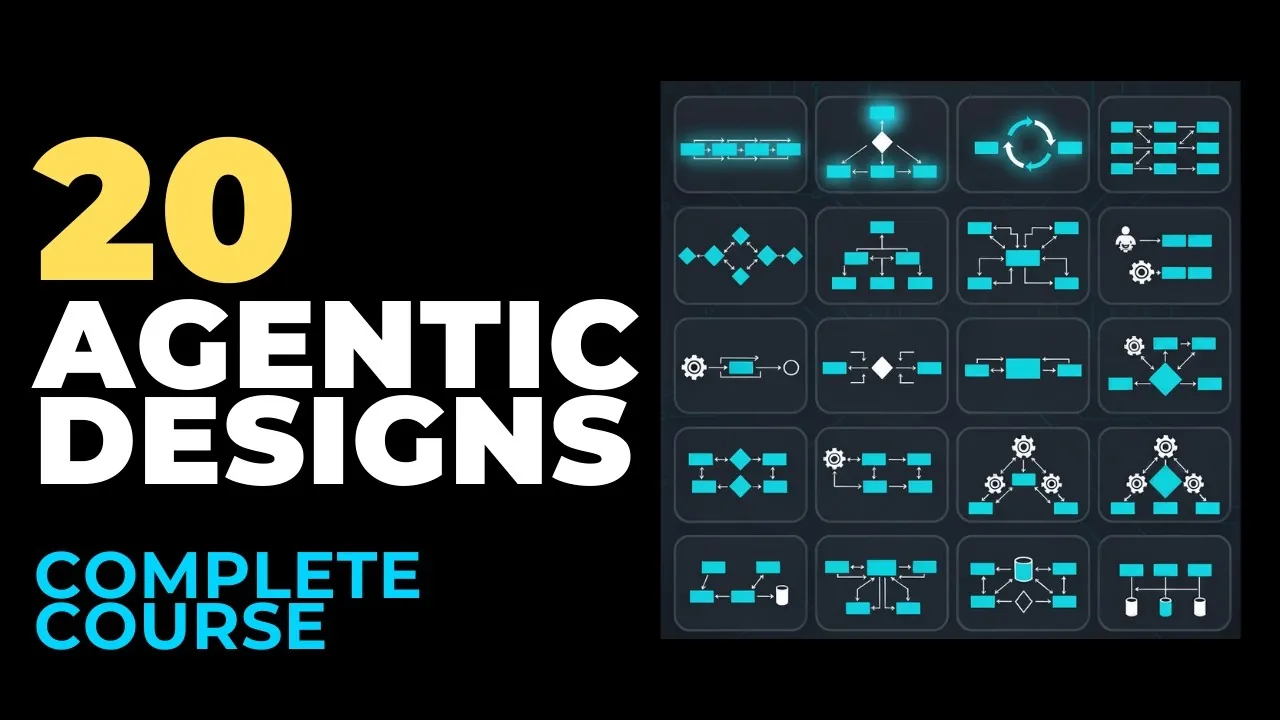
What if the key to building AI systems that are not only powerful but also trustworthy lies in a set of repeatable design principles? As artificial intelligence continues to shape industries and redefine possibilities, the challenge isn’t just creating smarter systems, it’s making sure they are resilient, adaptable, and aligned with human needs. Enter the world of agentic AI design patterns, a collection of proven strategies that address the complexities of AI development. From automating tedious tasks to allowing multi-agent collaboration, these patterns provide a roadmap for navigating the intricate balance between innovation and reliability. Whether you’re an AI developer, a product designer, or simply curious about the mechanics behind innovative systems, understanding these patterns can unlock new dimensions of what AI can achieve.
Mark Kashef explains 20 foundational design patterns that form the backbone of robust AI systems. You’ll discover how techniques like error handling, prompt chaining, and adaptive learning can transform AI from a functional tool into a dynamic, problem-solving partner. We’ll also delve into advanced strategies like multi-agent collaboration and safety guardrails, revealing how they ensure efficiency and ethical alignment in high-stakes applications. Each pattern offers a lens into the challenges and opportunities of building AI that doesn’t just react but actively contributes to its environment. By the end, you’ll not only gain a deeper appreciation for the architecture of agentic AI but also see how these patterns can drive innovation in ways that are both practical and visionary. After all, the future of AI isn’t just about intelligence, it’s about intention.
Agentic AI Design Patterns
TL;DR Key Takeaways :
- Agentic AI design patterns provide a structured framework for creating efficient, reliable, and scalable AI systems, addressing challenges like task automation, error handling, and multi-agent collaboration.
- Key patterns include task automation, error handling, memory management, collaborative agent systems, and prompt chaining, which enhance productivity, resilience, and adaptability in AI solutions.
- Advanced techniques such as reflection, iterative improvement, workflow planning, and adaptive learning ensure continuous optimization and relevance in dynamic environments.
- Safety and efficiency are prioritized through goal setting, human oversight, resource optimization, and safety guardrails, making sure ethical and effective AI operations.
- Exploration, inter-agent communication, and continuous evaluation drive innovation, uncover insights, and maintain robust system performance across various applications.
Key Patterns and Their Practical Applications
Task Automation
Task automation is a foundational principle in AI design, allowing systems to perform repetitive or time-intensive tasks without human intervention. This reduces operational costs, minimizes errors, and enhances productivity. For example:
- Automating data entry reduces manual errors and allows personnel to focus on strategic initiatives.
- Automatically generating reports accelerates decision-making by providing timely insights.
By integrating task automation, organizations can streamline workflows and allocate resources more effectively.
Error Handling and Exception Recovery
Error handling ensures that AI systems remain reliable by detecting and recovering from failures. This involves implementing safety checks, fallback mechanisms, and redundancy protocols. For instance:
- In natural language processing (NLP), fallback responses prevent misinterpretation of ambiguous queries, maintaining user trust.
- In autonomous systems, error recovery protocols mitigate disruptions caused by unexpected events, making sure continuity.
Incorporating robust error-handling mechanisms enhances the resilience and dependability of AI systems.
Memory Management
Effective memory management organizes data into short-term, episodic, and long-term memory, optimizing both processing and storage. For example:
- A chatbot may use short-term memory to maintain context during a conversation and long-term memory to store user preferences for future interactions.
- In healthcare, AI systems can store episodic data for patient histories while analyzing long-term trends for research purposes.
By structuring memory effectively, AI systems can deliver more personalized and context-aware responses.
Collaborative Agent Systems
Collaborative agent systems involve multiple specialized agents working together to achieve a shared objective. These systems often rely on shared memory and centralized coordination. For example:
- In e-commerce, one agent might manage inventory while another handles customer interactions, making sure seamless operations.
- In logistics, agents collaborate to optimize delivery routes and schedules, improving efficiency.
This pattern enables complex workflows to be managed more effectively through distributed expertise.
Prompt Chaining
Prompt chaining breaks down complex tasks into smaller, manageable steps, improving error validation and iterative refinement. For example:
- In customer support, prompt chaining can guide AI through diagnostic questions to resolve issues efficiently.
- In creative applications, it can help generate structured outputs, such as multi-step content creation or design processes.
This approach enhances the system’s ability to handle intricate tasks with greater accuracy and precision.
Advanced Techniques for Enhanced AI Systems
Reflection and Iterative Improvement
Reflection involves analyzing feedback to refine processes and improve outcomes. By setting quality benchmarks and evaluating performance, AI systems can achieve continuous improvement. For example:
- A machine translation model can incorporate user feedback to enhance linguistic accuracy over time.
- Predictive analytics systems can adjust algorithms based on real-world outcomes to improve reliability.
This iterative approach ensures that AI systems remain effective and relevant in dynamic environments.
Tool Use and Workflow Planning
Selecting appropriate tools and planning workflows are critical for achieving efficiency and precision in AI systems. For instance:
- In data analysis, specialized statistical tools can streamline processes and improve the accuracy of insights.
- In robotics, workflow planning ensures tasks are executed in the optimal sequence, reducing errors and delays.
Proper tool selection and workflow design maximize the potential of AI systems in diverse applications.
Learning and Adaptation
Adaptive learning enables AI systems to evolve by incorporating feedback and adjusting to changing conditions. For example:
- Recommendation systems refine suggestions based on user preferences and behavior over time.
- Fraud detection systems adapt to new patterns of fraudulent activity, staying ahead of emerging threats.
This capability ensures that AI systems remain effective in dynamic and unpredictable environments.
Multi-Agent Collaboration
Multi-agent collaboration uses the strengths of specialized agents to handle complex workflows. For example:
- In autonomous vehicles, one agent may focus on navigation while another manages obstacle detection, making sure safety and efficiency.
- In manufacturing, agents coordinate to optimize production lines and reduce downtime.
This pattern enhances the scalability and functionality of AI systems in multi-faceted tasks.
Agentic AI Design Patterns Tutorial 2025

Browse through more resources below from our in-depth content covering more areas on Agentic AI.
- How Manus AI is Transforming Enterprise Workflows with Agentic AI
- Understanding Agentic AI : The Future of Autonomous Workflows
- Cloud Code by Anthropic: The Future of AI Agentic Coding
- Understanding Multi-Agent AI Systems and Their Role in the Future
- Agentic Coding: The Future of Software Engineering with AI
- NVIDIA AI Agents: Your New Digital Coworkers : Agentic AI 2025
- RAR vs RAG: Understanding Oxford’s Advanced AI Framework
- Ilya Sutskever Reveals How AI Will Change the World Forever
- Kimi K2 0905: The AI Toolkit Transforming Software Development
- 7 Essential AI Terms You Need to Know in 2025
Making sure Safety and Efficiency
Goal Setting and Monitoring
Defining clear, measurable goals and tracking progress ensures that AI systems remain aligned with their objectives. For example:
- In healthcare, monitoring patient outcomes helps evaluate the effectiveness of treatments and interventions.
- In finance, tracking key performance indicators ensures compliance with regulations and profitability targets.
This approach provides a structured framework for evaluating success and making data-driven adjustments.
Human in the Loop
Involving humans in high-stakes decisions or edge cases adds a critical layer of accountability and safety. For instance:
- In financial systems, human oversight can prevent costly errors in large transactions.
- In autonomous systems, human intervention can address unexpected scenarios, making sure ethical and practical outcomes.
This pattern combines the strengths of human judgment with the efficiency of AI systems.
Knowledge Retrieval
Knowledge retrieval focuses on indexing and retrieving information efficiently, making it invaluable in research and legal applications. For example:
- AI systems can quickly locate relevant case law in legal databases, saving time and resources.
- Researchers can use AI to sift through vast datasets, uncovering actionable insights for innovation.
This capability enhances the accessibility and utility of information in complex domains.
Resource Optimization
Resource-aware optimization ensures tasks are allocated based on complexity and cost, maximizing computational efficiency. For example:
- Lightweight models can handle simple queries, reserving advanced models for more complex tasks.
- Cloud-based systems can dynamically scale resources to meet fluctuating demand, reducing waste.
This pattern ensures that AI systems operate efficiently, even under resource constraints.
Safety Guardrails and Prioritization
Safety guardrails protect against risky inputs and outputs, while prioritization focuses on high-impact tasks. These patterns are essential for maintaining system integrity. For instance:
- In medical AI, guardrails can prevent incorrect diagnoses, safeguarding patient health.
- In project management, prioritization ensures that critical tasks are addressed first, optimizing outcomes.
These measures enhance the reliability and effectiveness of AI systems in sensitive applications.
Driving Innovation Through Exploration
Exploration and Discovery
Exploration enables AI systems to research broadly and cluster knowledge into actionable insights. This is particularly valuable in fields like:
- Scientific research, where uncovering new patterns can lead to new discoveries.
- Market analysis, where identifying trends can inform strategic business decisions.
This pattern fosters innovation by allowing AI systems to uncover hidden opportunities and insights.
Inter-Agent Communication
Structured messaging systems assist seamless communication between agents, making sure efficient collaboration. For example:
- In logistics, agents can coordinate to optimize delivery routes and schedules, reducing delays.
- In multi-agent simulations, communication ensures synchronized actions, improving overall system performance.
Effective inter-agent communication enhances the coordination and functionality of collaborative systems.
Evaluation and Monitoring
Continuous evaluation and monitoring maintain system performance and identify areas for improvement. For instance:
- In predictive analytics, monitoring model accuracy ensures reliable forecasts and actionable insights.
- In cybersecurity, constant evaluation helps detect and mitigate emerging threats, protecting sensitive data.
This pattern ensures that AI systems remain robust and effective over time.
Media Credit: Mark Kashef
Disclosure: Some of our articles include affiliate links. If you buy something through one of these links, Geeky Gadgets may earn an affiliate commission. Learn about our Disclosure Policy.
