Google has released its latest Android distribution figures, revealing that Android Jelly Bean is now on more devices than Gingerbread, with a total of 37.9 percent on all devices.
Android Gingerbread is on 34 percent of Android devices, which is then followed by Android 4.0 Ice Cream Sandwich, now on 23.3 percent of devices.
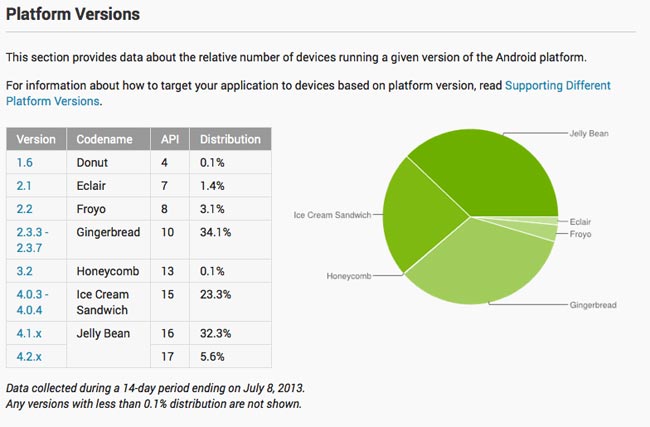
The remaining Android distribution is split between Android 2.2 Froyo, which is on 3.1 percent of devices, Android 2.1 Eclair which is on 1.4 percent of devices, and Android 1.6 Donut which is on just 0.1 percent of Android devices.
Understanding the Popularity of Android Jelly Bean
Android Jelly Bean’s rise to the top can be attributed to several factors. Firstly, it introduced significant performance improvements over its predecessors, including Project Butter, which made the user interface smoother and more responsive. Additionally, Jelly Bean brought Google Now, an intelligent personal assistant that provided users with timely information based on their habits and preferences. These features made Jelly Bean a more attractive option for both users and manufacturers, leading to its widespread adoption.
Moreover, the fragmentation of the Android ecosystem means that many devices are still running older versions of the operating system. However, manufacturers and carriers have been more proactive in updating devices to Jelly Bean, contributing to its higher distribution percentage. The introduction of affordable devices running Jelly Bean also played a crucial role in its increased market share.
The Decline of Older Android Versions
The decline of older Android versions like Gingerbread, Froyo, Eclair, and Donut is a natural progression as technology advances. Gingerbread, which once dominated the Android landscape, is now on 34 percent of devices. This version, released in December 2010, brought several enhancements, including improved copy-paste functionality, better power management, and support for larger screen sizes. However, as newer versions with more advanced features and better performance were released, Gingerbread’s popularity waned.
Ice Cream Sandwich, which followed Gingerbread, is now on 23.3 percent of devices. Released in October 2011, it was a significant update that unified the smartphone and tablet user experiences. It introduced a more refined user interface, improved multitasking, and better app management. Despite these improvements, it couldn’t keep up with the rapid pace of innovation in the Android ecosystem.
Froyo, Eclair, and Donut, which are on 3.1 percent, 1.4 percent, and 0.1 percent of devices respectively, are now considered obsolete. These versions lack the features and security enhancements found in newer releases, making them less appealing to users and developers alike. As a result, they are gradually being phased out in favor of more modern versions.
The Android ecosystem’s fragmentation poses challenges for developers who need to ensure their apps are compatible with multiple versions. However, it also highlights the platform’s flexibility and ability to cater to a wide range of devices and user needs.
The latest Android distribution figures reflect the ongoing evolution of the platform. Android Jelly Bean’s rise to prominence is a testament to its improved performance and features, while the decline of older versions underscores the rapid pace of technological advancement. As the Android ecosystem continues to grow and evolve, it will be interesting to see how future versions fare in the ever-competitive mobile operating system market.
Source Android Developers
Disclosure: Some of our articles include affiliate links. If you buy something through one of these links, Geeky Gadgets may earn an affiliate commission. Learn about our Disclosure Policy.
