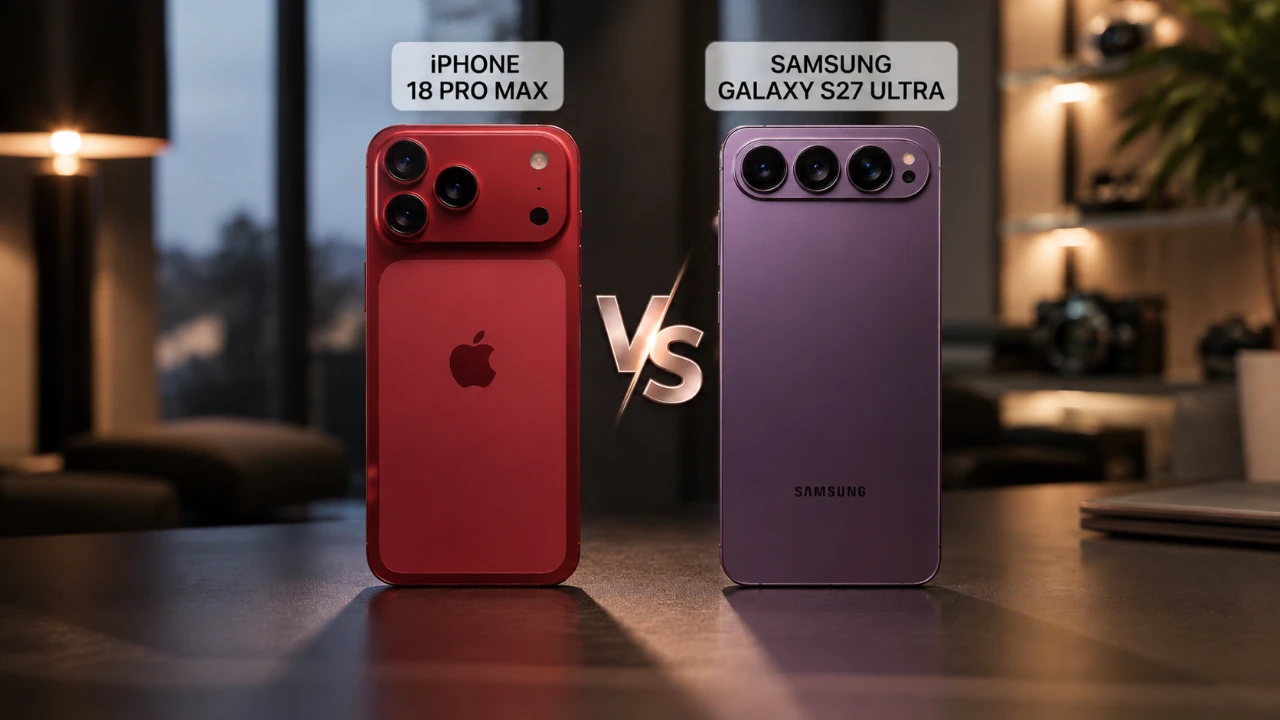
The premium smartphone landscape is gearing up for its most significant technological shift in years. Driven by the transition to cutting-edge 2-nanometer (2nm) processor architectures and radical leaps in battery chemistry, the upcoming showdown between Apple’s iPhone 18 Pro Max and Samsung’s Galaxy S27 Ultra promises to be an absolute powerhouse battle.
Leaked factory CADs, supply chain breaches, and component ordering data have given us an incredibly clear picture of how these two 2026/2027 heavyweights stack up. Here is the ultimate analytical breakdown of the rumored specifications and design philosophies defining the next generation of mobile computing.
Side-by-Side: The Leaked Specifications
| Category | Component | Apple iPhone 18 Pro Max (Rumored) | Samsung Galaxy S27 Ultra (Rumored) |
| Performance | Processor | Apple A20 Pro (TSMC 2nm Node) | Qualcomm Snapdragon 8 Elite Gen 6 Pro (2nm) |
| Packaging Tech | WMCM (Wafer-Level Multi-Chip Module) | Advanced Vapor Chamber / Liquid Cooling Structure | |
| RAM | 12GB LPDDR6 | 16GB LPDDR6 Standard (Optimized for Heavy Local AI) | |
| Storage Tiers | 256GB / 512GB / 1TB / 2TB (NVMe) | 256GB / 512GB / 1TB (Next-Gen UFS 5.0) | |
| Display & Design | Screen Size | 6.9-inch LTPO+ Super Retina XDR OLED | 6.9-inch Dynamic AMOLED 2X (M16 Panel) |
| Refresh Rate | 120Hz | 120Hz (Some leaks point to 144Hz for gaming) | |
| Design Quirks | ~35% Smaller Dynamic Island (Under-display Face ID components) | Shift to a unified horizontal camera bar layout | |
| Camera System | Main (Wide) | 48MP (Samsung 3-layer stacked sensor + Variable Aperture) | 200MP (ISOCELL HPA with LOFIC + Variable Aperture) |
| Telephoto | 48MP Periscope (Larger aperture, 4x/5x optical) | 50MP Periscope (5x optical with lossless 3x sensor crop) | |
| Ultra-Wide | 48MP Sensor | 50MP Sensor (Wider aperture for low-light) | |
| Power & Juice | Battery Tech | High-Density Lithium-Ion | Silicon-Carbon (Si-C) Tech |
| Capacity | ~5,425 mAh (eSIM Only) / ~5,235 mAh (Physical SIM) | 6,000mAh to 7,000mAh (Massive capacity surge) | |
| Charging Speed | 40W Wired / 25W MagSafe & Qi2 | 60W or 65W Fast Wired / 25W Magnetic Qi2 |
Silicon Supremacy: The 2nm Architecture
For the first time, both Apple and Qualcomm are meeting on the exact same structural playing field: the 2nm fabrication node.
- Apple’s A20 Pro: Apple is utilizing TSMC’s 2nm process paired with Wafer-Level Multi-Chip Module (WMCM) packaging. This technology packs the CPU, GPU, and memory closer together, promising a 15% raw speed boost and a massive 30% reduction in power consumption compared to the previous generation.
- Snapdragon 8 Elite Gen 6 Pro: Qualcomm is splitting its next-gen silicon into a standard and “Pro” variant. The Pro chip, destined for the Galaxy S27 Ultra, reportedly aims for a blistering 5GHz clock speed. To sustain this without thermal throttling, Samsung is actively testing advanced liquid-cooling or direct-to-die air circulation systems.
While Apple relies on structural efficiency via WMCM, Samsung is brute-forcing multitasking power by making 16GB of LPDDR6 RAM the baseline standard on the S27 Ultra to aggressively handle on-device AI tasks. Apple is sticking to 12GB of RAM, relying heavily on its deeply integrated software-hardware optimization.
The Battery Revolution: Silicon-Carbon vs. Raw Scale
For seven generations, Samsung kept its Ultra line locked at 5,000mAh. The Galaxy S27 Ultra is finally shattering that constraint. By shifting to dense Silicon-Carbon (Si-C) battery chemistry, Samsung is rumored to fit a massive 6,000mAh to 7,000mAh cell inside the chassis without increasing the physical thickness of the device.
Apple isn’t sitting quietly, though. The iPhone 18 Pro Max is expected to debut the largest battery ever seen in a non-folding iPhone—pushing up to 5,425 mAh in the eSIM-only variant. Coupled with the hyper-efficient 2nm A20 Pro chip, the iPhone 18 Pro Max will likely maintain its crown for pure operational longevity, even if Samsung wins the raw capacity numbers.
Camera War: The Battle of Variable Apertures
The days of static smartphone lenses are ending. Both the iPhone 18 Pro Max and the Galaxy S27 Ultra are heavily rumored to introduce physical variable aperture mechanisms on their primary sensors. This allows the lenses to physically expand or contract, offering authentic optical background blur (bokeh) and vastly superior exposure control in low-light environments.
Samsung is bringing its new ISOCELL HPA sensor with LOFIC technology, designed to prevent highlight clipping in high-contrast scenes. However, leaks suggest the S27 Ultra might streamline its layout by dropping the dedicated 3x lens, instead using a high-resolution 50MP 5x periscope crop to capture lossless intermediate zoom. Apple is countering by using a custom Samsung-built 3-layer stacked 48MP sensor for its main shooter, guaranteeing blazing-fast readout speeds and significantly reduced image noise.
Design & Display Refinements
The display front is a battle of millimeter trims. The iPhone 18 Pro Max keeps its 6.9-inch footprint but finally shrinks the intrusive Dynamic Island by up to 35%, thanks to burying secondary Face ID components underneath the panel glass.
The Galaxy S27 Ultra matches the 6.9-inch scale but utilizes Samsung’s latest M16 AMOLED panel, pushing outdoor peak brightness to an eye-searing 3,000 nits. Visually, the S27 Ultra may undergo the biggest aesthetic refresh of the two, with CAD leaks pointing to a unified horizontal camera bar that echoes the sleek design language of modern pixel flagships, abandoning the classic individual floating lens rings.
Launch Windows and Market Availability
The starkest contrast between these two titans lies in their release schedules, splitting the flagship year right down the middle. Apple is highly expected to maintain its strict autumnal tradition, with prominent tech insiders pointing to an official September 2026 launch event for the iPhone 18 Pro Max. Interestingly, rumors suggest Apple will split its release cycle this generation—prioritizing the premium Pro Max and its highly anticipated foldable “iPhone Ultra” in September, while delaying the entry-level iPhone 18 models to Spring 2027. Conversely, Samsung plans to claim the early-year spotlight. Following a slightly delayed rollout for the previous generation, supply chain orders indicate that Samsung intends to snap back to its traditional winter press cycle, positioning a massive Galaxy Unpacked event in January or February 2027 to officially debut the Galaxy S27 Ultra. This gives Apple a multi-month head start in sales, while allowing Samsung the advantage of fine-tuning its 2nm hardware against real-world iPhone performance metrics.
Have a look at some of our previous articles on the iPhone 18 Pro Max and the Samsung Galaxy S27 Ultra
- First Look at the iPhone 18 Pro’s Major Display Redesign
- The Latest iPhone 18 Pro Max Leak Solves One Mystery
- iPhone 18 Pro Max: Our Best Look Yet at Apple’s 2026 Flagship
- Samsung’s Boldest Move: Why the Galaxy S27 Ultra is Getting a Radical Rear Redesign
- Why the Galaxy S27 Ultra is a Complete Reset for Samsung
- Samsung Galaxy S27 Ultra Leaks Point to a Massive Upgrade
Disclosure: Some of our articles include affiliate links. If you buy something through one of these links, Geeky Gadgets may earn an affiliate commission. Learn about our Disclosure Policy.
