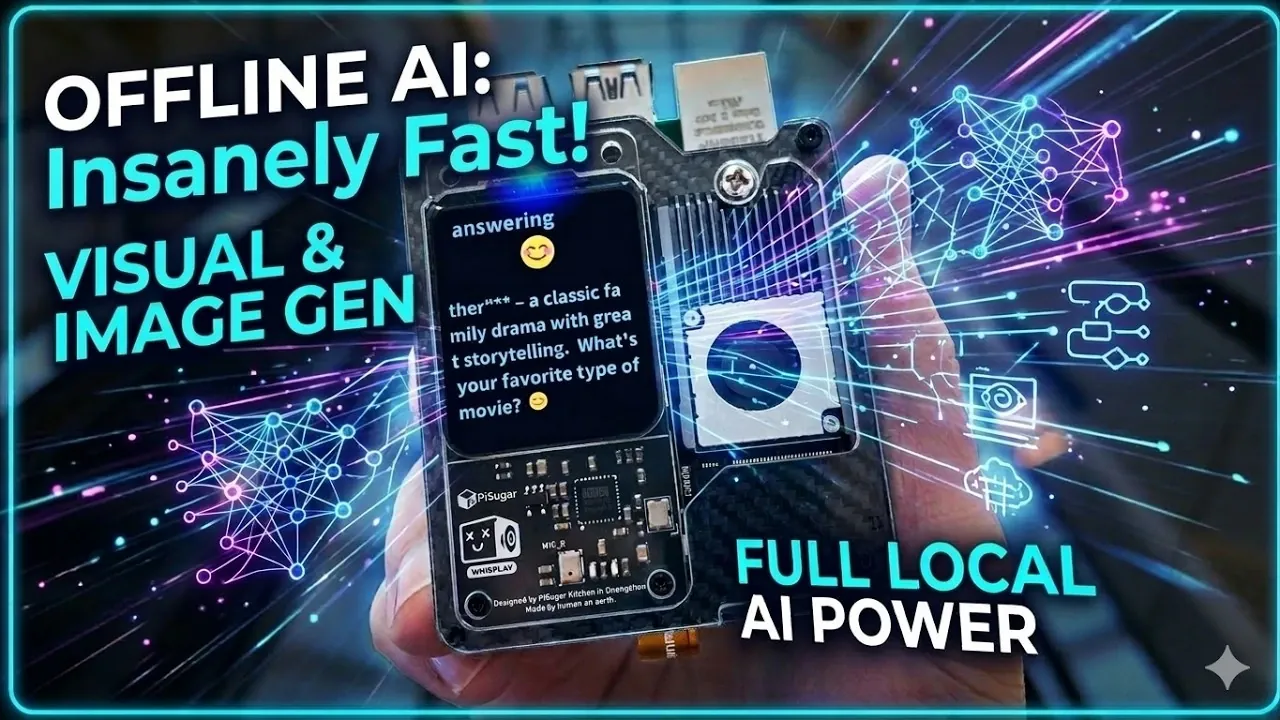
The Raspberry Pi 5 introduces a new era of offline artificial intelligence, combining advanced hardware and software to enable local AI systems that can both perceive and create. At the heart of this innovation is the CR3VL vision-language model, a 2-billion-parameter system capable of analyzing and describing images with impressive accuracy. Paired with a latent consistency model, the device can generate detailed visuals from text or voice prompts in just a few seconds. Jdaie Lin explores how these features, powered by the LM AA50 accelerator and Raspberry Pi AI Hat Plus 2, allow users to perform tasks like image-to-image transformations and voice-to-image generation entirely offline, making sure enhanced privacy and reduced latency.
This local AI project highlights several key takeaways for those interested in edge AI. You’ll learn how the Raspberry Pi 5’s hardware integration supports efficient local processing, even within the constraints of its memory and multitasking capabilities. Additionally, the guide examines practical applications, such as creating visuals from spoken descriptions or developing privacy-focused AI assistants. Whether you’re a developer or an educator, this breakdown offers valuable insights into using the Raspberry Pi 5 for creative and functional offline AI projects.
Raspberry Pi 5 Offline Local AI
TL;DR Key Takeaways :
- The Raspberry Pi 5 introduces advanced offline AI capabilities, including visual perception, image generation and image-to-image transformation, powered by the LM AA50 accelerator and Raspberry Pi AI Hat Plus 2.
- Key features include the CR3VL vision-language model for image interpretation and a latent consistency model for generating visuals from text or voice prompts, all processed locally for enhanced privacy and reduced latency.
- The hardware setup integrates the LM AA50 accelerator and Halo 10H chip in a compact design, with pre-configured software allowing seamless functionality like voice-to-image generation and wake word detection.
- Practical applications range from voice-to-image generation and offline AI assistants to privacy-focused edge AI solutions, making it ideal for developers, educators and creative professionals.
- While the device excels in offline AI tasks, limitations such as memory constraints and multitasking challenges highlight areas for improvement, with future updates expected to enhance its capabilities further.
Advancements in Offline AI
The Raspberry Pi 5 introduces new offline AI capabilities, powered by state-of-the-art technologies that allow it to process and generate visual data independently. Central to this innovation is the CR3VL vision-language model, a sophisticated 2-billion-parameter system capable of interpreting and describing images with remarkable precision. Complementing this is a latent consistency model, which can generate high-quality visuals from text or voice prompts in as little as three seconds. Additionally, the device supports image-to-image transformations, allowing users to modify existing visuals based on descriptive input.
These offline features eliminate the dependency on cloud connectivity, making sure faster processing and enhanced privacy. For instance, you can describe a scene or object and the Raspberry Pi 5 will generate or modify an image entirely within your local setup. This capability is particularly valuable for applications where data security and low latency are critical.
Hardware Integration and Setup
The Raspberry Pi 5’s hardware design combines innovation with ease of use, making it accessible for both beginners and experienced developers. The device integrates the LM AA50 accelerator with the Raspberry Pi AI Hat Plus 2, which is equipped with the Halo 10H chip to provide additional computational power. These components are housed in a custom 3D-printed enclosure, resulting in a compact and functional design that is both portable and efficient.
Setting up the Raspberry Pi 5 is straightforward. Once the hardware is assembled, pre-configured software packages enable key features such as visual perception, image generation and wake word detection. The inclusion of hands-free interaction allows users to activate the AI assistant with a simple voice command, streamlining tasks like voice-to-image generation or conversational queries. This seamless integration of hardware and software ensures that users can quickly harness the device’s full potential.
Here are additional guides from our expansive article library that you may find useful on local AI.
- Best GPUs for Local AI, VRAM Needs and Price Tiers Explained
- How to Build a Local AI Web Search Assistant with Ollama
- Run Local AI Models on Your PC or Mac for Coding, Study & More
- Mistral Local Coding AI Tested : 3B to 24B Compared on One Task
- Agent Zero : Private Local AI Agent with Docker & Terminal Access
- Best Local AI Models for the Base Mac Mini M4, Speed & Limits
- Local AI Coding Workflow 2026: LM Studio Linking and Claude Code Setup
- Olares One Portable AI Box for Private, Local AI Computing
- Jetson Thor vs DJX Spark vs Apple M4 Pro Mac Mini : Local AI Hardware Compared
- BMO Local AI Agent Voice Upgrade: Piper Setup & Ethics
Performance: Strengths and Constraints
The LM AA50 accelerator serves as the cornerstone of the Raspberry Pi 5’s AI capabilities, allowing it to perform a variety of tasks such as speech recognition, language modeling and text-to-speech conversion, all in offline mode. This ensures that the device can operate independently of external servers, offering both speed and privacy. However, the accelerator’s memory limitations restrict the number of AI models that can run simultaneously, which may impact performance during complex or resource-intensive operations.
Similarly, the Raspberry Pi AI Hat Plus 2, powered by the Halo 10H chip, excels at running individual AI models efficiently. However, its inability to multitask limits its utility for projects requiring simultaneous processing. For example, while the device performs exceptionally well in generating images or recognizing speech, it struggles to handle both tasks concurrently. These constraints highlight the need for careful planning when designing projects to ensure optimal performance.
Practical Applications and Use Cases
The enhanced AI capabilities of the Raspberry Pi 5 open up a wide range of practical and creative applications. Some of the key features and their potential uses include:
- Voice-to-Image Generation: Transform spoken descriptions into visuals, making it an invaluable tool for graphic designers, educators and concept artists.
- Offline AI Assistant: Combine visual and conversational capabilities to create a more interactive and responsive user experience.
- Privacy-Focused Edge AI: Operate entirely offline, making sure data security and low latency for applications in sensitive environments such as healthcare or finance.
- Custom AI Development: Build and experiment with local knowledge bases, chatbots, or other AI-driven tools without relying on cloud infrastructure.
These features make the Raspberry Pi 5 an ideal platform for edge AI enthusiasts, educators and developers looking to explore the possibilities of offline computing. Whether you’re working on a creative project or developing a practical solution, the device offers the tools and flexibility needed to innovate.
Challenges and Future Prospects
While the Raspberry Pi 5 delivers impressive capabilities, it is not without its limitations. The memory constraints of the LM AA50 accelerator and the multitasking limitations of the Halo 10H chip can pose challenges for more demanding projects. These issues may restrict the device’s effectiveness in scenarios requiring parallel processing or the simultaneous execution of multiple AI models.
However, the future of the Raspberry Pi 5 looks promising. Planned updates aim to address these challenges by enhancing wake word detection, expanding support for local knowledge bases and improving the integration of AI models. These developments are expected to make the device even more versatile, allowing it to handle a broader range of applications with greater efficiency.
As edge AI continues to evolve, the Raspberry Pi 5 is poised to remain at the forefront of this exciting field. Its combination of affordability, portability and advanced offline capabilities makes it a valuable tool for anyone looking to explore the potential of AI without relying on cloud-based solutions.
Media Credit: Jdaie Lin
Disclosure: Some of our articles include affiliate links. If you buy something through one of these links, Geeky Gadgets may earn an affiliate commission. Learn about our Disclosure Policy.
