
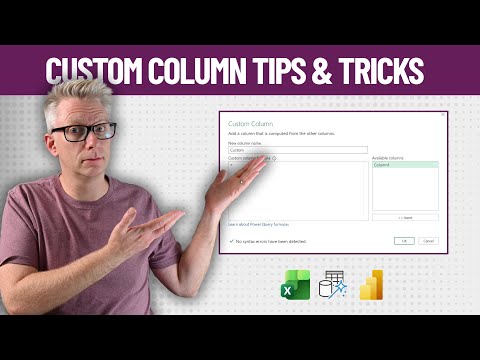
Ever feel like creating custom columns in Power Query is more frustrating than it should be? The process can often feel overwhelming, especially when you’re juggling null values, complex calculations, or unexpected errors. In this walkthrough, Excel Off The Grid shows how a few simple yet powerful techniques can transform the way you approach data transformations. From managing tricky null values to simplifying intricate formulas, these methods aren’t just about saving time, they’re about making your workflow smoother and your results more reliable. If you’ve ever struggled to make sense of messy datasets, this guide might just be the fantastic option you’ve been looking for.
Throughout this breakdown, you’ll uncover five practical strategies that take the guesswork out of custom column creation. Learn how to handle null values with ease, manage errors gracefully, and even reference external data for advanced calculations. You’ll also discover how to simplify complex formulas using the “let” and “in” structure, and why assigning the correct data types upfront can save you headaches later. Each technique is designed to help you work smarter, not harder, so you can focus on what really matters: delivering accurate, actionable insights. By the end, you’ll see how small adjustments can lead to big improvements in your Power Query workflow.
Power Query Custom Column Tips
TL;DR Key Takeaways :
- Use the Coalesce operator (`??`) to handle null values by replacing them with default values, making sure uninterrupted calculations and improving data reliability.
- Manage errors effectively with `try` and `otherwise` functions to catch issues like invalid operations and define fallback values, enhancing query resilience.
- Reference external data in Power Query to perform advanced calculations, such as percentages or growth rates, without duplicating data or creating unnecessary steps.
- Simplify complex calculations using `let` and `in` statements to break down formulas into manageable components, improving readability and reducing errors.
- Assign correct data types during custom column creation to ensure accuracy, prevent errors, and streamline downstream processes like sorting and analysis.
1. Handle Null Values with the Coalesce Operator
Null values are a common obstacle in data transformation, often causing errors or incomplete results. The Coalesce operator (`??`) offers a straightforward solution by returning the first non-null value in a sequence. For example, if a column contains null entries, you can replace them with a default value such as `0` or a placeholder string.
This approach ensures that calculations involving nulls, such as summing or averaging, proceed without interruptions or unexpected outcomes. For instance, when calculating total revenue, substituting nulls with zeros prevents disruptions in the overall computation. By incorporating the Coalesce operator into your workflow, you can make your formulas more robust and improve the reliability of your data transformations, particularly when dealing with incomplete or inconsistent datasets. This technique is especially useful in scenarios where missing data might otherwise compromise the accuracy of your analysis.
2. Manage Errors with `try` and `otherwise`
Errors in Power Query often arise from incompatible data types, unexpected values, or invalid operations such as dividing by zero. The `try` and `otherwise` functions provide a structured method for managing these issues. By wrapping your formula in a `try` block, you can catch errors and define fallback values using `otherwise`. For example, if a formula attempts to divide by zero, you can specify a default value to prevent the query from breaking.
This technique is particularly valuable when working with user-generated data or external sources, where errors are more likely to occur. By proactively managing errors, you ensure that your queries remain functional and produce meaningful results, even when dealing with unpredictable inputs. Additionally, this method enhances the resilience of your data transformation process, allowing you to handle unexpected scenarios without compromising the integrity of your analysis.
Custom Column Tricks to Make Power Query Easier
Discover other guides from our vast content that could be of interest on Power Query.
- How to combine Excel tables using Power Query vs VSTACK
- Using Excel Power Query Copilot for Smarter Data Management
- Power Query Approximate Match Lookup: Fastest Method Guide
- Excel Skills for Analysts Guide 2026: Power Query, Copilot & More
- How to Use Power Pivot in Excel to Master Complex Data Analysis
- Using Excel Power BI Desktop to build Interactive Dashboards
- Excel LAMBDA Guide for Dynamic Tables and BYROW Processing
- How to model data with Power BI – Star vs Snowflake schema
- Automate Actual vs Budget in Excel with One-Click Refresh Setup
- Why You Should Stop Using Excel’s INDIRECT Function Today
3. Reference External Data for Advanced Calculations
Power Query enables you to reference data outside the immediate column list, unlocking the potential for more advanced calculations. For example, you can calculate percentages by dividing a column’s value by the sum of another column in the source table. This capability is particularly useful for creating metrics such as contribution percentages, growth rates, or other comparative analyses.
To implement this, you can use M code expressions to reference the required data directly. This eliminates the need for duplicating data or creating unnecessary intermediate steps, streamlining your transformation process. By using external data references, you can perform complex calculations more efficiently and maintain a cleaner, more organized workflow. This technique is ideal for scenarios where your calculations depend on aggregated or external data points, making it a powerful tool for advanced data modeling.
4. Simplify Complex Calculations with `let` and `in`
Complex formulas can quickly become difficult to read, debug, and maintain, especially when they involve multiple steps or nested calculations. The `let` and `in` statements in M code allow you to break down these formulas into smaller, more manageable components. By defining intermediate variables, you can simplify your calculations and improve the readability of your code.
For example, when calculating a weighted average, you can use `let` to define the total weight and weighted sum as separate variables. This not only makes the formula easier to understand but also reduces the likelihood of errors during implementation. The `let` and `in` structure is particularly valuable for advanced transformations that require multiple steps, allowing you to maintain clarity and precision in your calculations. By adopting this approach, you can create more maintainable and error-resistant formulas, even in complex scenarios.
5. Assign Data Types in Custom Columns
Assigning the correct data type is a critical step in making sure the accuracy and reliability of your transformations. Power Query allows you to define data types directly within the custom column creation process, eliminating the need for additional steps later. For example, you can specify whether a column should be treated as a date, number, or text during its creation.
Using the correct data type prevents errors in subsequent operations, such as sorting, filtering, or aggregating, and ensures compatibility with downstream processes like visualization or analysis. By incorporating data type assignment into your workflow, you save time and reduce the risk of potential issues. This practice ensures that your data is ready for further use, whether in dashboards, overviews, or other analytical tools. Proper data type assignment is a foundational step that enhances the overall quality and usability of your transformed data.
Streamline Your Power Query Workflow
These five techniques, handling null values with the Coalesce operator, managing errors with `try` and `otherwise`, referencing external data, simplifying calculations with `let` and `in`, and assigning data types, are essential for creating custom columns in Power Query. By applying these methods, you can streamline your workflows, minimize errors, and enhance the overall efficiency of your data transformation processes. Whether you’re working with straightforward datasets or tackling complex transformations, these strategies empower you to achieve more reliable and accurate results, making your data preparation tasks more effective and manageable.
Media Credit: Excel Off The Grid
Disclosure: Some of our articles include affiliate links. If you buy something through one of these links, Geeky Gadgets may earn an affiliate commission. Learn about our Disclosure Policy.
