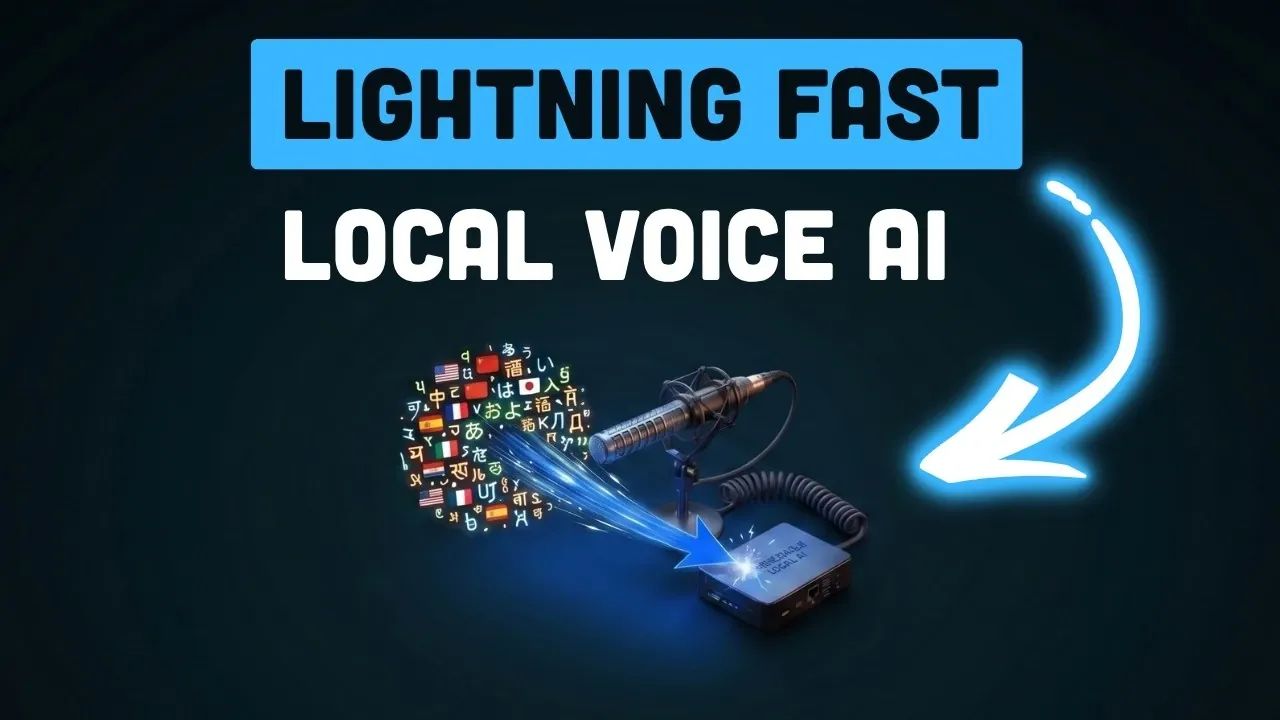
Supertonic 3, introduced by Better Stack, is a local text-to-speech (TTS) model designed to prioritize privacy and offline functionality. Operating entirely on your device, it eliminates the need for internet connectivity or cloud-based services, making it a secure and cost-efficient option for developers. The model supports 31 languages and runs efficiently on CPUs using the ONNX runtime, removing the requirement for GPUs or API keys. While it excels in speed and lightweight deployment, it has some limitations, such as difficulty processing complex text formats and limited support for expressive narration.
Explore how Supertonic 3 can fit into your workflows with practical insights into its deployment options, including a Python SDK and local HTTP server integration. You’ll also gain an understanding of its ideal use cases, such as real-time applications or secure environments and learn how it compares to cloud-based alternatives. This guide provides a clear breakdown of its strengths and trade-offs, helping you assess whether it aligns with your specific development needs.
Supertonic 3
TL;DR Key Takeaways :
- Supertonic 3 is a local text-to-speech (TTS) model prioritizing privacy, offline functionality and cost-efficiency, making it ideal for secure and resource-constrained applications.
- Key features include efficient CPU operation via ONNX runtime, support for 31 languages and a compact design suitable for embedding in desktop applications.
- Strengths include fast processing, a privacy-first approach with no reliance on external servers and flexible deployment options like Python SDK, CLI and local HTTP server.
- Limitations include difficulty handling complex text formats, limited expressive narration capabilities and lack of high-quality voice synthesis for advanced applications like audiobooks.
- Best suited for projects requiring privacy, offline functionality and low latency, such as local voice agents, chatbots and real-time systems, but less ideal for expressive or polished voice outputs.
Supertonic 3 is engineered for local deployment, eliminating reliance on internet connectivity or cloud-based services. Its standout features include:
- Efficient CPU operation using the ONNX runtime, removing the need for GPUs or API keys.
- Support for 31 languages, allowing seamless multilingual text-to-speech conversion.
- Offline functionality, making sure complete data privacy and independence from external servers.
- A compact design, making it ideal for embedding in desktop applications or controlled environments.
These features make Supertonic 3 a practical choice for developers who prioritize simplicity, control and privacy in their TTS workflows.
Strengths
Supertonic 3 offers several advantages over traditional cloud-based TTS solutions, making it a strong contender for developers with specific priorities:
- Fast processing with low latency, allowing real-time text-to-speech conversion.
- A privacy-first approach, as no data is transmitted to external servers, making sure secure operations.
- Flexible deployment options, including a Python SDK, command-line interface (CLI), and local HTTP server.
- Compatibility with OpenAI APIs, allowing seamless integration into existing systems and workflows.
These strengths position Supertonic 3 as a reliable option for developers who value speed, security and cost-effectiveness in their TTS solutions.

Advance your skills in local AI by reading more of our detailed content.
- Olares One : All-in-One AI Mini PC Specifically Designed to Run Local AI Models
- Forget the Cloud: This Tiiny Pocket PC Packs 80GB RAM for Local AI
- Build Your Own Local AI Search Assistant with Ollama in 5 Easy Steps
- Build A Local Private AI Rig on a Budget : Learn Which GPUs Run AI Most Effectively
- How to Turn Your Smartphone Into a Local AI Powerhouse
- Why Google’s Gemma 4 Local AI Just Made Cloud-Based AI Optional
- Local AI Models That Run Perfectly on Apple’s $599 M4 Mac Mini?
- Build Your Own AI Assistant an Local AI Agent Quickly with Cursor AI (No Code)
- Local AI Coding Workflow for 2026 : Links Devices for Shared Local AI Coding
- Install Fooocus AI art generator locally for private AI art creation
Limitations
Despite its many benefits, Supertonic 3 has certain limitations that may affect its suitability for specific applications:
- Difficulty in processing complex text formats, such as numbers, dates and mathematical expressions.
- Limited support for expressive narration (e.g., laughter, sighs), which requires a paid API key for access.
- Inability to produce high-quality narration or perform voice cloning, making it less ideal for applications like audiobooks or advanced voice synthesis.
These trade-offs reflect the balance between its lightweight design and the advanced features offered by more resource-intensive, cloud-based alternatives.
Ideal Use Cases
Supertonic 3 is particularly well-suited for applications where privacy, offline functionality and cost-efficiency are critical. Some examples include:
- Local voice agents and chatbots designed for secure or restricted environments, such as healthcare or financial services.
- Desktop applications requiring embedded TTS capabilities without reliance on external servers or internet connectivity.
- Projects where speed and low latency are essential, such as real-time systems or interactive applications.
However, it may not be the best choice for projects requiring expressive or highly polished voice outputs, such as professional-grade audiobooks or advanced voice cloning.
Comparison with Cloud-Based TTS
Supertonic 3 provides a distinct alternative to cloud-based TTS solutions like OpenAI or Eleven Labs. Here’s how they compare:
- Cloud TTS services offer superior voice quality, emotional expression and ease of use but often come with higher costs, latency and potential privacy concerns.
- Supertonic 3 prioritizes privacy, cost-efficiency and local control, sacrificing advanced features for a more lightweight and secure approach.
The choice between the two depends on your project’s specific requirements. If privacy and offline functionality are paramount, Supertonic 3 is an excellent choice. However, for projects demanding high-quality narration or expressive voice synthesis, cloud-based solutions may be more appropriate.
Developer-Friendly Tools
Supertonic 3 is designed with developers in mind, offering a range of tools to simplify integration and deployment:
- Support for multiple programming languages, including Python, Java and C++, making sure compatibility with diverse development environments.
- Comprehensive documentation and examples to streamline the setup process and reduce the learning curve.
- Flexible deployment options, such as CLI and local HTTP server integration, to accommodate various project requirements.
These tools make Supertonic 3 accessible to developers with varying levels of expertise, allowing efficient implementation across a wide range of applications.
Final Thoughts
Supertonic 3 is a practical and lightweight TTS model tailored for developers who value privacy, speed and offline functionality. Its local processing capabilities and cost-efficient design make it an excellent choice for secure and resource-constrained applications. However, its limitations in handling complex text and producing expressive narration mean it may not be suitable for projects requiring advanced voice features or high-quality narration. By carefully evaluating its strengths and trade-offs, you can determine whether Supertonic 3 aligns with your development goals and project priorities.
Media Credit: Better Stack
Disclosure: Some of our articles include affiliate links. If you buy something through one of these links, Geeky Gadgets may earn an affiliate commission. Learn about our Disclosure Policy.
