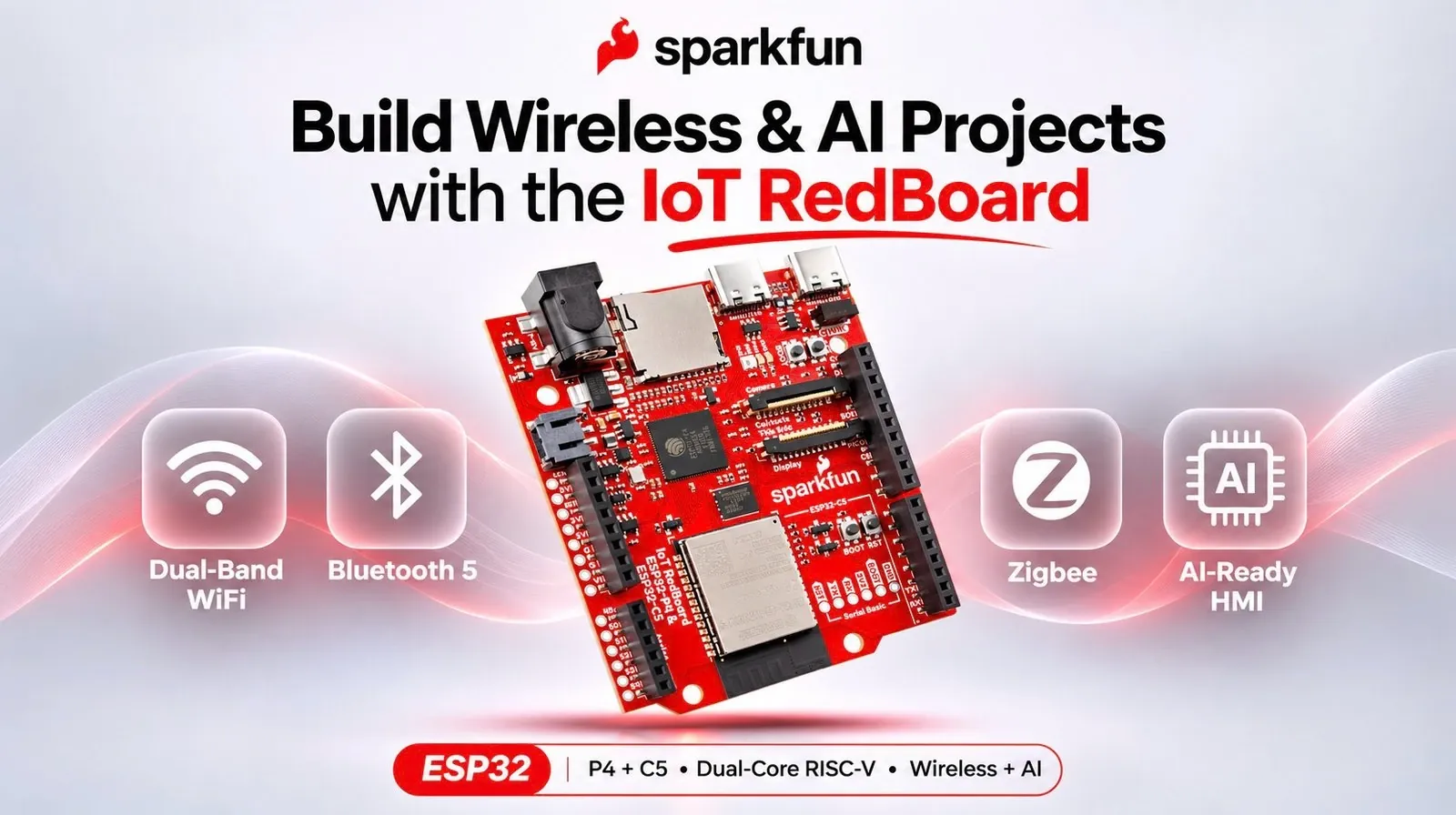
The IoT RedBoard ESP32-P4 and ESP32-C5 boards have officially launched, offering developers a choice between wired Ethernet with Power over Ethernet (PoE) or wireless connectivity via dual-band Wi-Fi and Bluetooth 5. The ESP32-P4 features a dual-core RISC-V processor running at up to 400 MHz, 16MB flash memory, and 32MB PSRAM, making it ideal for resource-intensive tasks like AI and image processing. These details come from SparkFun Electronics.
Explore how these boards enable advanced multimedia applications with MIPI DSI and CSI interfaces for displays and cameras, or how preloaded MicroPython firmware simplifies development for users of all levels. You’ll also gain insight into their compatibility with modern IoT protocols like Zigbee and Thread, as well as practical examples like running AI-powered face detection or interactive applications.
Introducing the IoT RedBoard ESP32-P4 & ESP32-C5
TL;DR Key Takeaways :
- The IoT RedBoard ESP32-P4 features dual-core RISC-V CPUs running at up to 400 MHz, 16MB flash memory, 32MB PSRAM, and AI instruction extensions, making it the most powerful ESP32 microcontroller to date and ideal for edge AI and HMI applications.
- The boards are available in two configurations: a wired version with Ethernet and Power over Ethernet (PoE) and a wireless version with the ESP32-C5 coprocessor, which supports dual-band Wi-Fi, Bluetooth 5 (LE), Zigbee, Thread, and IEEE 802.15.4.
- Multimedia capabilities include MIPI DSI and CSI interfaces for display and camera integration, along with six analog I/O pins, 16 digital I/O pins, and multiple communication interfaces such as UART, SPI, I2C, I3C, and TWAI™.
- Preloaded MicroPython firmware simplifies development, allowing users to run scripts directly via the USB serial/JTAG port, with examples including internet-connected applications and real-time data display on connected devices.
- Demonstrations of the ESP32-P4 include running DOOM with touchscreen and joystick controls and AI-powered face detection, showcasing its suitability for interactive HMI and edge AI projects.
The IoT RedBoard ESP32-P4 and ESP32-C5 boards have been launched as powerful tools for IoT, robotics, and edge AI development. These boards combine advanced processing power with flexible connectivity options, making them suitable for demanding projects. They are available in two configurations: one with wired Ethernet and Power over Ethernet (PoE) and another with wireless connectivity via the ESP32-C5 coprocessor. Both are priced at $49.95 under SKU DEV-30909.
Processing Power and Memory
The IoT RedBoard ESP32-P4 features the ESP32-P4NRW32X processor, equipped with dual-core RISC-V CPUs running at up to 400 MHz. A low-power RISC-V core, operating at up to 40 MHz, efficiently handles standby tasks. With 16MB flash memory and 32MB PSRAM, the board supports resource-intensive workloads like image processing, voice recognition, and neural network computations. AI instruction extensions further enhance its ability to accelerate edge AI applications, while Direct Memory Access (DMA) controllers improve data transfer efficiency for high-performance tasks.
As the most powerful ESP32 microcontroller to date, the ESP32-P4 stands out with its dual-core 400 MHz RISC-V processor, 16MB flash memory, 32MB RAM, and AI-focused instruction extensions. These features make it particularly well-suited for edge computing and human-machine interface (HMI) applications.

Explore further guides and articles from our vast library that you may find relevant to your interests in ESP32 boards and projects.
- WaveShare ESP32-C5 Offers 32MB Flash and Sensors For $20
- ESP32 Lineup Compared: S3 Handles AI While C6 Tackles Matter
- 5 ESP32 Projects Worth Building in 2026: Such as an Apple HomeKit Controller
Connectivity Options
The wired version of the IoT RedBoard ESP32-P4 supports Ethernet with PoE, allowing a single cable to provide both power and network connectivity. A PoE network switch or injector is required to use this feature. For wireless projects, the ESP32-C5 coprocessor offers dual-band 2.4 GHz and 5 GHz Wi-Fi, Bluetooth 5 (LE), Zigbee, and Thread networking.
It also includes an IEEE 802.15.4 subsystem, ensuring compatibility with modern IoT and smart home software stacks. A 0.1″-spaced serial header connected to the UART interface simplifies reprogramming for developers.
Multimedia and I/O Features
The IoT RedBoard ESP32-P4 includes advanced multimedia capabilities, such as MIPI DSI and CSI interfaces for display and camera integration. Displays connect via the MIPI DSI interface, while MIPI cameras use the CSI interface, making the board ideal for multimedia and vision-based applications.
For input and output, the board supports:
- Six analog I/O pins
- 16 digital I/O pins
- UART, SPI, I2C, I3C, and TWAI™ interfaces
It also features two USB-C ports, one for high-speed OTG USB and another for USB serial/JTAG connections. Additional features include a µSD card port for expandable storage and a 2-pin JST connector for LiPo battery power, complete with onboard charging and monitoring circuits.
Preloaded MicroPython for Easy Setup
Both versions of the IoT RedBoard ESP32-P4 come preloaded with MicroPython firmware, simplifying the development process for users of all experience levels. By connecting through the serial/JTAG USB port, scripts can be run in any editor, such as Thonny. For example, a MicroPython script can connect to the internet, retrieve real-time data about astronauts in space, and display the results on a Qwiic Serial LCD or another connected display.
This script works with both the wired and wireless board versions and can be configured for the Qwiic Serial LCD at the top of the script.
Applications and Demonstrations
The ESP32-P4’s capabilities extend to interactive demonstrations and applications. In testing, the board successfully ran DOOM with touchscreen and joystick controls, showcasing its processing power. It also supported AI-powered face detection using a connected camera, using its AI instruction extensions for rapid neural network computations. These examples highlight the board’s suitability for human-machine interfacing (HMI) and edge AI projects.
The board’s processing power and multimedia capabilities make it a versatile choice for developers, as demonstrated by its ability to run interactive applications like DOOM or AI-driven face detection.
Chip Revision Compatibility
All IoT RedBoard ESP32-P4 boards are built with the latest V3 chip revision, eliminating potential firmware incompatibilities between earlier V1 and V3 revisions. However, firmware designed for one ESP32-P4 chip revision is not compatible with the other, which developers should consider during their projects.
SparkFun Electronics highlights the IoT RedBoard ESP32-P4 and ESP32-C5 as powerful platforms for IoT, robotics, and edge AI development, supported by features like preloaded MicroPython firmware and advanced connectivity options. The boards are built with the latest V3 chip revision, addressing firmware compatibility concerns seen in earlier revisions. While their capabilities make them well-suited for demanding applications such as HMI and edge computing, SparkFun Electronics emphasizes their accessibility for beginners, thanks to the straightforward setup process and included development tools.
Media Credit: SparkFun Electronics
Disclosure: Some of our articles include affiliate links. If you buy something through one of these links, Geeky Gadgets may earn an affiliate commission. Learn about our Disclosure Policy.
