Robotic lawn mowers are becoming increasingly capable of dealing with gardens that are more complicated than a simple rectangle of grass. Instead of relying solely on fixed boundaries and basic navigation, newer machines are combining satellite positioning, computer vision, and digital mapping to work more independently.
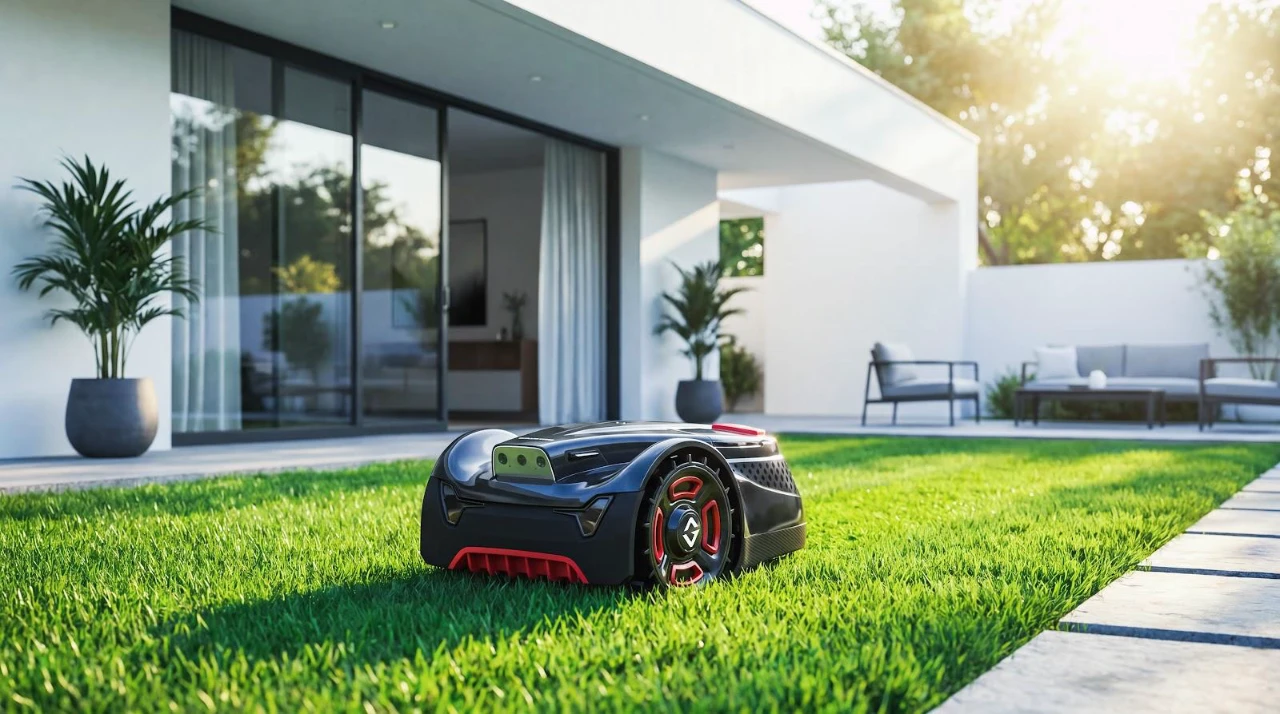
That shift is reflected in Goalker‘s H3 Pro, a wire-free robotic lawn mower designed for residential gardens of up to 1,200㎡. Rather than focusing on a single feature, the machine combines RTK positioning, VSLAM visual navigation, AI-based obstacle detection, intelligent path planning, and a cutting system designed to work closer to lawn edges.
For homeowners, the appeal of these technologies is less about the terminology itself and more about how well a mower can deal with the small complications that make maintaining a garden time-consuming.
Moving Beyond Boundary Wires
One of the biggest changes in robotic mowing has been the move away from physical boundary wires.
Traditional wire-based systems can work reliably once installed, but changing the layout of a garden or defining additional areas may require more physical preparation. Wire-free systems take a different approach by using positioning and mapping technologies to define where the mower should operate.
Goalker combines Real-Time Kinematic (RTK) positioning with VSLAM, or visual simultaneous localization and mapping. RTK provides precise positioning information, while visual navigation adds another source of environmental information. The combination is intended to help maintain positioning across different garden layouts, including narrow passages and areas where trees or other surroundings can affect satellite signals.
This kind of sensor fusion is becoming increasingly relevant to outdoor robotics. A garden is rarely an ideal environment for single positioning technology. Trees, buildings, walls, and changing surroundings can all influence how a machine perceives its location.
By combining satellite-based positioning with visual information, the navigation system has more than one source of information to work with.
Mapping a Garden as Multiple Spaces
The practical benefit of improved navigation becomes clearer in gardens with more than one lawn.
A front garden and backyard, for example, may be separated by a narrow passage rather than forming one continuous mowing area. Multi-zone management allows different sections to be mapped and managed individually, while intelligent path planning determines how the mower moves through its working areas.
The system also supports digital boundaries, reducing the need for physical perimeter wire installation. Through the accompanying app, users can manage mowing areas and settings, create schedules and keep track of the machine.
For homeowners, this can make a difference beyond the initial setup. Gardens often change over time, whether a flower bed is added, outdoor furniture is moved or a previously unused section of lawn becomes part of the mowing area. Digital mapping provides a way of managing those changes without having to physically reinstall a boundary around the garden.
The mower supports cutting heights from 25mm to 60mm and has an 18cm cutting width. Its recommended mowing area is 1,200㎡, with a maximum operating area of 1,500 ㎡ according to the product specifications.
Why Lawn Edges Are Still Difficult to Automate
Even with better navigation, one familiar problem remains: the lawn edge.
A robotic mower needs to avoid hitting walls, flower beds, fences, and other obstacles, which can leave a narrow strip of grass that still requires a conventional trimmer. For some gardens, finishing work can be one of the less convenient parts of using an autonomous mower.
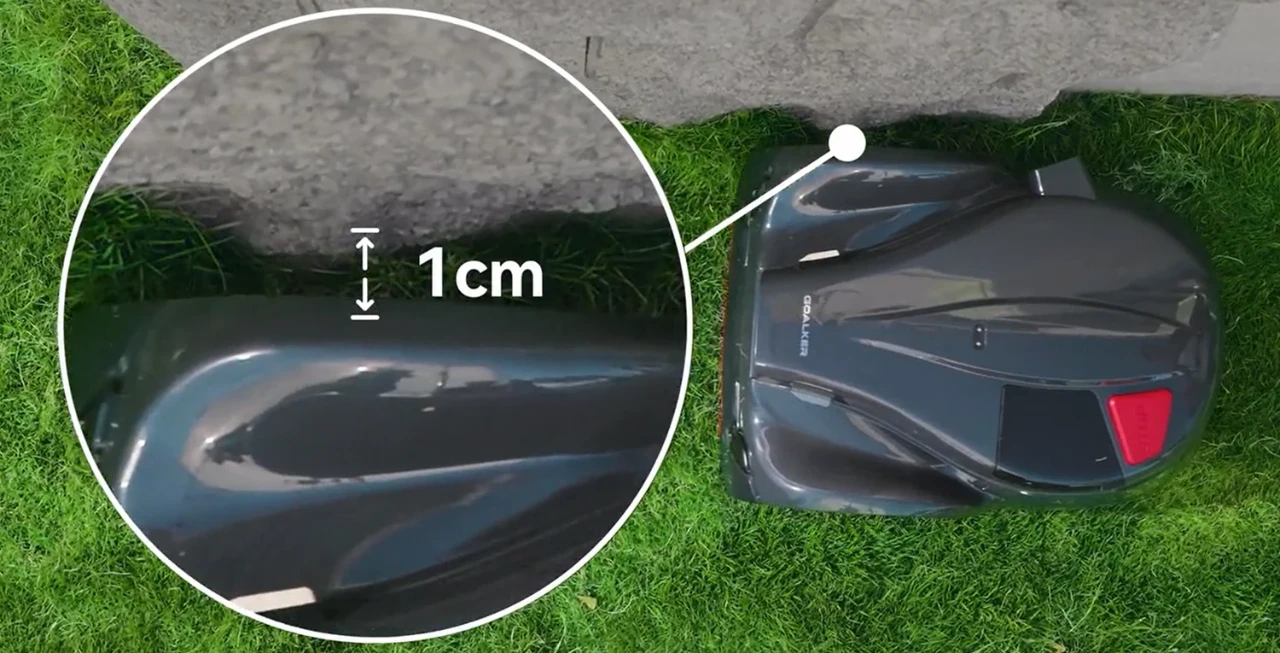
Goalker addresses this with a motorized, laterally adjustable cutting deck. The cutting module can move toward the side of the mower, allowing the blades to work closer to obstacles. The manufacturer specifies cutting down to 1cm from an edge under the relevant conditions.
The design is particularly relevant around areas that cannot easily be driven over, such as flower beds or raised borders. Instead of relying entirely on the mower’s wheels to approach an edge, the cutting mechanism itself can extend toward it.
That does not mean every garden edge will require no manual finishing. The actual result depends on the shape and construction of the boundary. However, reducing the amount of grass left around difficult edges addresses a practical limitation that has remained common across robotic mowing systems.
Vision Adds Another Layer of Awareness
Positioning tells a mower where it is, but it does not necessarily tell it what is in front of it.
That is where computer vision becomes useful. The system uses a dual-camera system together with a side-facing ToF sensor to detect objects and estimate their distance. Goalker says its vision system can recognize more than 200 types of objects, ranging from garden tools and toys to pets and wildlife.
For a mower operating autonomously, this type of perception can be important because gardens are constantly changing. A children’s toy may be left on the lawn one day, while a garden hose or tool could appear in another part of the yard.
Instead of treating every object as a simple physical obstruction, visual detection allows the machine to identify objects before reaching them and adjust its route accordingly.
The approach also illustrates where robotic lawn care is heading more generally. Cameras and AI are increasingly being used not simply to navigate, but to interpret the environment around an autonomous machine.
That does not eliminate the need for sensible preparation. Owners should still remove small objects and potential hazards from the lawn before mowing. Obstacle detection is intended to reduce unexpected interruptions, rather than replace basic garden maintenance.
A Floating Cutting System for Uneven Lawns
Navigation is only part of the equation. Once the mower reaches the grass, the cutting system has to cope with the surface underneath it.
The H3 Pro uses a floating cutting deck that can follow changes in the terrain. This is intended to maintain a more consistent cutting height over uneven areas and reduce the risk of scalping, where blades cut too deeply into dips in the lawn.
That can be particularly useful for residential gardens that include gentle slopes or uneven sections rather than perfectly level turf.
The mower uses front-wheel drive and is rated for slopes of up to 35 percent, equivalent to approximately 19 degrees. A rotating rear wheel is used as part of the chassis design, while independently suspended wheels are intended to help the machine adapt to changes in the ground.
The result is a system that approaches mowing as a combination of navigation, traction and cutting rather than treating the cutting deck as an isolated component.
Automation Continues After the Mowing Starts
Once a mowing schedule has been configured, much of the routine work can happen without direct supervision.
The machine can return to its charging station automatically when its battery needs replenishing. With a stated runtime of up to 120 minutes per charge and a charging time of approximately 120 minutes, the mower is designed to resume an unfinished mowing task after recharging.
The relatively modest operating speed of a robotic mower is less important when the machine is working independently. Instead of requiring an owner to spend an hour pushing a conventional mower around the garden, autonomous operation allows the task to take place in the background.
Noise can also become relevant when a mower operates regularly. The system is rated at up to 59dB and includes a night mode, allowing homeowners to schedule mowing outside traditional daytime periods.
Automatic rain detection adds another layer of everyday automation. When wet weather is detected, mowing can be interrupted rather than continuing in conditions that may be less suitable for cutting grass.
The machine also supports IPX6 water protection, while app-based controls provide access to mowing management and related alerts.
What This Means for the Smart Garden
The development of robotic lawn mowers is increasingly tied to a broader smart-garden trend. The objective is not simply to automate the physical act of cutting grass, but to reduce the number of decisions and manual interventions required from the homeowner.
Goalker’s approach combines several technologies to address different parts of that problem. RTK and VSLAM handle positioning and navigation, binocular vision and ToF sensing provide environmental awareness, digital mapping manages different lawn areas, while the floating and edge-focused cutting systems deal with the physical characteristics of the grass itself.
None of these technologies removes every limitation associated with outdoor robotics. Gardens remain unpredictable environments, and factors such as landscaping, obstacles, and boundary design can affect how any autonomous mower performs.
What is changing is the level of information available to the machine.
For homeowners looking at wire-free robotic mowing, that may ultimately be more significant than any single specification. A mower that can understand its position, recognize objects around it, manage several areas, and adjust its cutting approach to the shape of the garden moves closer to the broader idea of an autonomous garden system – a transition the Goalker H3 Pro represents in practice, bringing satellite positioning, visual navigation, and AI-assisted perception together in a system designed for everyday residential lawn care.
Disclosure: Some of our articles include affiliate links. If you buy something through one of these links, Geeky Gadgets may earn an affiliate commission. Learn about our Disclosure Policy.
