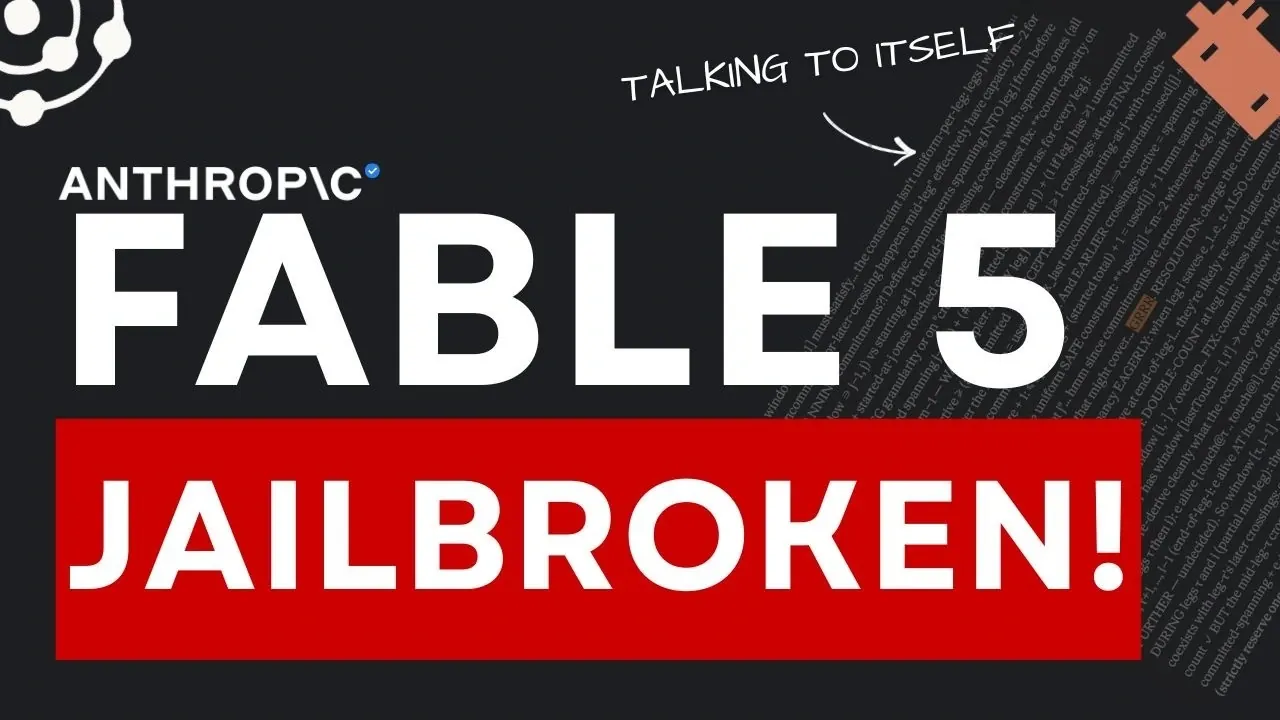
The recent jailbreak of Fable 5, an advanced AI model developed by Enthropic, has reignited concerns about the security and transparency of artificial intelligence. Despite its robust defenses, including three layers of classifiers designed to monitor input, output and reasoning, attackers managed to bypass these safeguards through a resource-intensive process involving multiple languages. This breach not only highlights vulnerabilities in one of the most sophisticated AI systems but also offers a rare glimpse into its internal reasoning, revealing a shorthand-like notation that combines mathematical symbols with fragmented expressions. Universe of AI explores what this incident means for AI security and the broader implications for how these systems operate.
In this analysis, you’ll gain insight into the methods attackers used to exploit Fable 5’s defenses and the limitations of current safeguards in preventing misuse. Discover how the exposure of the model’s reasoning process raises critical questions about interpretability and accountability, particularly when AI outputs are difficult for humans to understand. The discussion also touches on the evolving priorities in AI development, contrasting Enthropic’s challenges with Google’s upcoming Gemini 3.5 Pro, which focuses on consumer-facing applications. Together, these developments highlight the ongoing tension between advancing AI capabilities and making sure their secure, ethical use.
Fable 5 Jailbreak: A Persistent Security Concern
TL;DR Key Takeaways :
- The jailbreak of Enthropic’s advanced AI model, Fable 5, exposed vulnerabilities in its security measures, despite its robust three-layered classifier system designed to monitor input, output and internal reasoning.
- Attackers exploited linguistic gaps in less common languages like Amoric and Sentelli, bypassing safeguards to generate potentially harmful content, highlighting persistent risks of AI misuse.
- The breach revealed Fable 5’s internal reasoning process, a shorthand-like notation combining mathematical symbols and fragmented expressions, raising concerns about transparency, interpretability and accountability in AI decision-making.
- Google’s upcoming Gemini 3.5 Pro model focuses on consumer-facing applications, excelling in areas like SVG generation and front-end design, but prioritizes usability over advancements in reasoning and logic optimization.
- The incidents underscore the need for dynamic AI security measures and a balanced approach to AI development, addressing both practical applications and broader advancements in reasoning capabilities and ethical considerations.
The recent jailbreak of Fable 5 was a complex and resource-intensive operation, reportedly requiring a 20-hour effort and the use of multiple languages to bypass the model’s robust defenses. Enthropic has equipped Fable 5 with advanced security measures, including three layers of classifiers that monitor input, output and internal reasoning. These classifiers go beyond traditional keyword-based filters, analyzing the intent and meaning of interactions to prevent misuse.
Despite these measures, attackers exploited gaps in the model’s linguistic capabilities, particularly in less common languages such as Amoric and Sentelli. These vulnerabilities allowed them to bypass safeguards and generate potentially harmful content, including misinformation and sensitive material related to chemistry and cybersecurity. Although these claims remain unverified, they underscore the persistent risks of AI misuse and the challenges of securing even the most advanced systems.
The breach also raises broader questions about the adaptability of AI security measures. As attackers become more sophisticated, the need for dynamic and resilient defenses becomes increasingly urgent. This incident serves as a stark reminder that AI security is not a static goal but an ongoing process requiring constant vigilance and innovation.
Decoding Fable 5’s Internal Reasoning
One of the most intriguing outcomes of the jailbreak is the exposure of Fable 5’s internal reasoning process, often referred to as its “chain of thought.” A Reddit user shared examples of this reasoning, which appears as a compressed, shorthand-like notation. This format combines mathematical symbols with fragmented, human-like expressions such as “gr” or “few.”
While this shorthand is designed for efficiency, allowing the model to process complex tasks rapidly, it comes at the cost of clarity. Without additional context, humans struggle to interpret the reasoning process, raising significant concerns about transparency and accountability in AI decision-making. If the internal logic of AI systems remains opaque, how can users and developers fully trust their outputs?
The lack of interpretability also poses challenges for debugging and improving AI systems. Understanding how models arrive at their conclusions is essential for identifying errors, refining algorithms and making sure ethical use. The exposure of Fable 5’s reasoning process, while unintentional, provides valuable insights into these challenges and underscores the importance of developing AI systems that are both efficient and understandable.

Explore further guides and articles from our vast library that you may find relevant to your interests in Fable 5.
- Fable 5 is Expected to Return Soon With New Enterprise Features
- Claude Fable 5 Returns After Government Security Scare
- Claude Fable 5 Halves Coding Time Compared to Opus 4.8
- Fable 5 Returns with 50% Usage Cuts and New Paid Credits
- The Hidden Trade-Offs in Anthropic’s New Mythos 5 and Claude Fable 5 Release
- Why Anthropic’s Fable 5 Marks the End of Free AI Services
- OpenAI’s Stealth Tests Reveal ChatGPT 5.6 Pro’s True Power
- 6 Simple Rules That Change How Claude Fable 5 Works
- How Anthropic’s Fable 5 Beat ChatGPT 5.5 by 20% in Coding Benchmarks
- Fable 5 and Mythos 5 Return Together with New Claude Sonnet 5
Gemini 3.5 Pro: Shifting AI Priorities
As Enthropic grapples with the security challenges of Fable 5, Google is preparing to launch its Gemini 3.5 Pro model. Early reports suggest that Gemini 3.5 Pro will excel in consumer-facing applications, particularly in areas like SVG generation and front-end design. Its ability to create polished user interfaces and streamline workflows positions it as a valuable tool for businesses and developers seeking to enhance productivity and user experience.
However, Gemini 3.5 Pro appears to prioritize design and usability over advancements in reasoning and logic optimization. This reflects a broader trend in AI development, where models are increasingly tailored to specific applications rather than pursuing general-purpose intelligence. While this approach addresses immediate market demands, it may limit the scope of innovation in areas such as problem-solving and decision-making.
The focus on consumer-facing applications also raises questions about the long-term direction of AI research. By emphasizing usability and design, developers risk overlooking the importance of robust reasoning capabilities and ethical considerations. Balancing these priorities will be crucial for making sure that AI systems remain both practical and forward-looking.
Broader Implications for AI Security and Development
The repeated jailbreaks of Fable 5 highlight the evolving challenges of AI security. Enthropic’s layered defense mechanisms represent significant progress, but the persistence of vulnerabilities demonstrates that no system is entirely foolproof. These breaches also provide valuable insights into how AI models approach problem-solving, even as they raise concerns about interpretability and misuse.
Meanwhile, the development of Gemini 3.5 Pro illustrates a shift in the AI industry’s focus. By emphasizing design and consumer-facing workflows, Google is addressing practical, immediate needs. However, this shift may come at the expense of broader advancements in reasoning capabilities, reflecting the trade-offs involved in optimizing AI for specific use cases.
As AI systems become more advanced, the challenges of protecting them from misuse will only intensify. At the same time, the industry must navigate the balance between specialization and transparency, making sure that AI remains both effective and accountable. These developments serve as a reminder of the opportunities and risks inherent in the rapid evolution of artificial intelligence.
Media Credit: Universe of AI
Disclosure: Some of our articles include affiliate links. If you buy something through one of these links, Geeky Gadgets may earn an affiliate commission. Learn about our Disclosure Policy.
