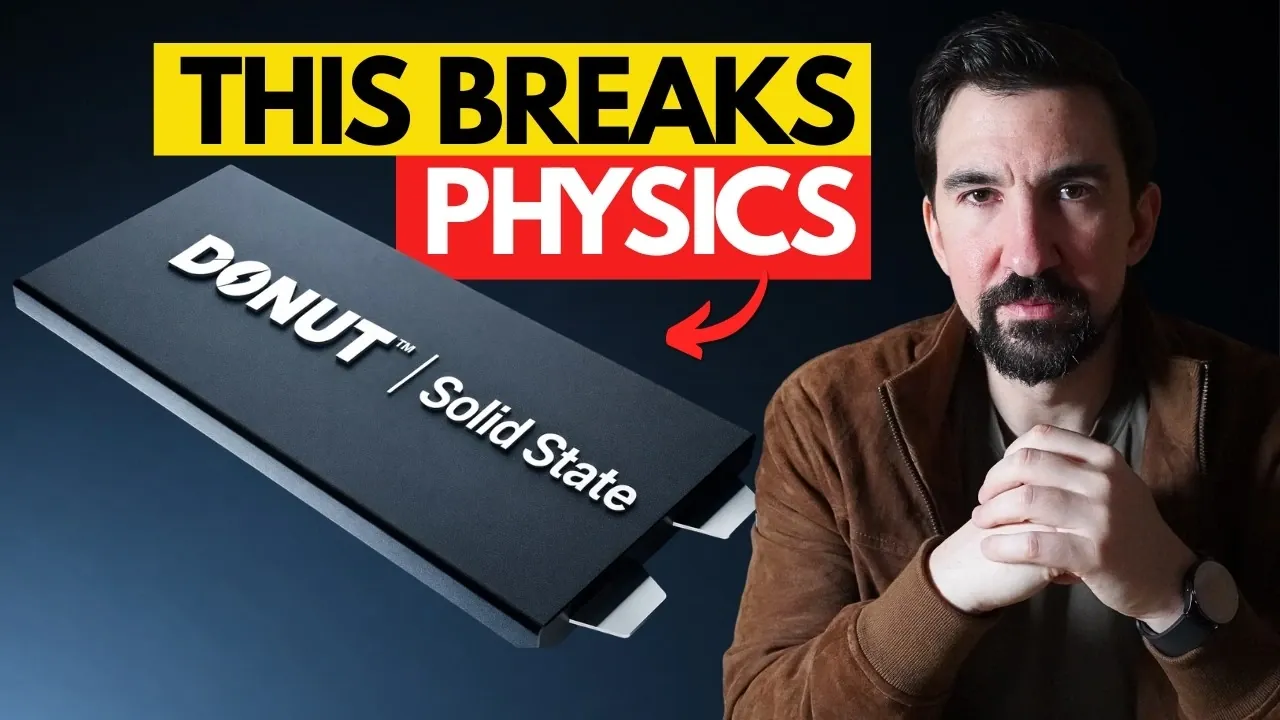
Donut Labs, a Finnish startup, has made headlines with its bold claims about a new solid-state battery technology. According to Dr Ben Miles, the company asserts that their battery can achieve an energy density of 400 Wh/kg, supports 5-minute charging, and features a 100,000-cycle lifespan—all without relying on lithium or rare earth metals. These features, if validated, could address critical challenges in electric vehicle (EV) adoption, such as long charging times and resource sustainability. However, the absence of peer-reviewed evidence and the company’s limited track record have raised skepticism about whether these claims can hold up under scrutiny.
Explore the key features that Donut Labs claims to have achieved, including their potential impact on EV performance and environmental sustainability. Gain insight into the challenges of combining high energy density with durability and rapid charging and understand why independent validation is essential for assessing the feasibility of this technology. This overview also examines the industry’s mixed reactions, from cautious optimism to concerns about transparency, offering a balanced look at what might lie ahead for Donut Labs and their ambitious battery project.
Features That Could Reshape Energy Storage
TL;DR Key Takeaways :
- Donut Labs claims to have developed a solid-state battery with 5-minute charging, a 100,000-cycle lifespan, and no reliance on lithium or rare earth metals, potentially transforming EV performance and sustainability.
- The battery features an energy density of 400 Wh/kg, which could enable longer driving ranges and lighter vehicle designs.
- Despite being labeled as “production-ready,” the lack of peer-reviewed validation and limited third-party testing data has raised skepticism about the feasibility of these claims.
- Industry experts question the combination of rapid charging, high energy density and extreme durability, citing the absence of robust evidence and Donut Labs’ limited track record in solid-state battery development.
- Donut Labs has partnered with Finland’s VTT Technical Research Center for testing, but results remain inconclusive, leaving the battery’s real-world potential speculative.
Donut Labs’ battery introduces a range of features that, if proven, could set a new benchmark for energy storage technology. These include:
- 5-Minute Charging: This addresses one of the most significant barriers to EV adoption, long charging times, potentially making EVs more convenient for consumers.
- 100,000-Cycle Lifespan: Far exceeding the durability of current lithium-ion batteries, this could provide near-unlimited use over a vehicle’s lifetime, reducing replacement costs and waste.
- No Lithium or Rare Earth Metals: By eliminating these materials, the battery could mitigate environmental and geopolitical challenges tied to resource extraction, offering a more sustainable solution.
- Energy Density of 400 Wh/kg: This figure surpasses most commercial EV batteries, potentially allowing longer driving ranges and lighter vehicle designs.
- Production-Ready Technology: Donut Labs claims their battery is ready for commercial deployment, signaling an intent to disrupt the market and accelerate EV adoption.
While these features are impressive on paper, their feasibility in real-world applications remains unverified, leaving room for both optimism and skepticism.
Challenges & Industry Skepticism
Despite the ambitious claims, industry experts have expressed significant doubts. Combining high energy density, rapid charging and extreme durability is a formidable challenge, even under ideal laboratory conditions. The absence of independent, peer-reviewed validation has only deepened skepticism within the scientific and industrial communities.
Donut Labs has shared limited third-party testing data, but critics argue that the information provided is insufficient to substantiate their assertions. Adding to the uncertainty is the company’s lack of prior experience in solid-state battery development, raising questions about how they achieved such rapid progress. Without robust evidence, the claims risk being dismissed as overly ambitious or exaggerated.

Here are more guides from our previous articles and guides related to Solid-State batteries that you may find helpful.
- Donut Lab Solid-State Battery Test Results from VTT Explained
- Solid-State Battery Energy Density: Donut Labs Scrutiny
- Donut Lab Solid State Battery or Pseudo-Capacitor, Experts Weigh In
- Solid-State Battery or Capacitor? Donut Lab’s 100,000-cycle Claim
- Are Donut Lab’s Solid-State Battery Claims Actually Real?
- Solid-State Battery CES 2026 : Donut Verge TS Pro Plans & Doubts
- Donut Lab Solid-State Battery Test: VTT Finds 110% Capacity at 80C
- Donut Lab Solid State Battery Claims, 400 Wh/kg and Fast Charge
- Donut Lab Battery Claims vs Test Data: No Energy Density or 100,000-Cycle Proof Yet
- Donut Lab Verge Motorcycle Battery Claims : Solid-State or Hype?
Testing & Validation Efforts
To address these concerns, Donut Labs has partnered with the VTT Technical Research Center in Finland for testing. While VTT is a respected institution, it is not a certification authority and the results released thus far remain inconclusive.
Preliminary findings suggest that the battery employs a sodium-based chemistry, which could explain the absence of lithium and rare earth metals. However, critical factors such as temperature stability, long-term reliability, and performance under real-world conditions have yet to be thoroughly evaluated. Until comprehensive validation is achieved, the battery’s true potential remains speculative.
Reactions from the Industry & Public
The announcement has elicited a wide range of reactions. Some view it as a potential breakthrough that could reshape the energy storage landscape, while others draw parallels to past controversies where bold claims failed to materialize.
Competitors have raised concerns about the lack of transparency and industry experts caution against overhyping unverified technologies. These mixed reactions underscore the importance of rigorous testing and validation in maintaining trust and credibility within the tech sector.
Possible Scenarios Behind the Claims
Several plausible scenarios could explain the current situation surrounding Donut Labs’ claims:
- Genuine Innovation: The company may have achieved a legitimate breakthrough but has yet to complete the rigorous testing required to validate their claims.
- Exaggerated Capabilities: Donut Labs might be overstating their progress to attract funding and media attention, a common strategy among startups seeking to gain traction.
- Mismanaged Public Relations: The technology could be real, but the company’s unconventional approach to publicizing their work has created unnecessary skepticism and confusion.
Regardless of the outcome, the situation highlights the challenges of introducing disruptive technologies in a highly scrutinized industry. Transparency and evidence-based claims are essential to gaining trust and making sure long-term success.
The Importance of Transparency
One of the most significant criticisms directed at Donut Labs is their perceived lack of transparency. By releasing selective data without comprehensive testing results, the company risks undermining its credibility. Critics argue that prioritizing publicity over scientific rigor sets a dangerous precedent for other startups in the field.
Transparency and peer-reviewed validation are critical to making sure that bold claims are supported by robust evidence. Without these, even the most promising innovations can struggle to gain acceptance from both the industry and the public. Donut Labs’ ability to provide clear, verifiable data will be crucial in determining whether their battery represents a genuine advancement or an overhyped concept.
What Lies Ahead?
Donut Labs’ claims have sparked both excitement and skepticism, reflecting the high stakes involved in energy storage innovation. While the potential benefits of their solid-state battery are undeniable, the lack of independent validation and comprehensive data leaves many questions unanswered.
As the company continues to release incremental updates and seek funding, their credibility will depend on providing transparent, peer-reviewed evidence. Until such proof is available, the industry and public remain cautiously optimistic, waiting to see whether this technology can truly deliver on its promises and transform the future of energy storage.
Media Credit: Dr Ben Miles
Disclosure: Some of our articles include affiliate links. If you buy something through one of these links, Geeky Gadgets may earn an affiliate commission. Learn about our Disclosure Policy.
