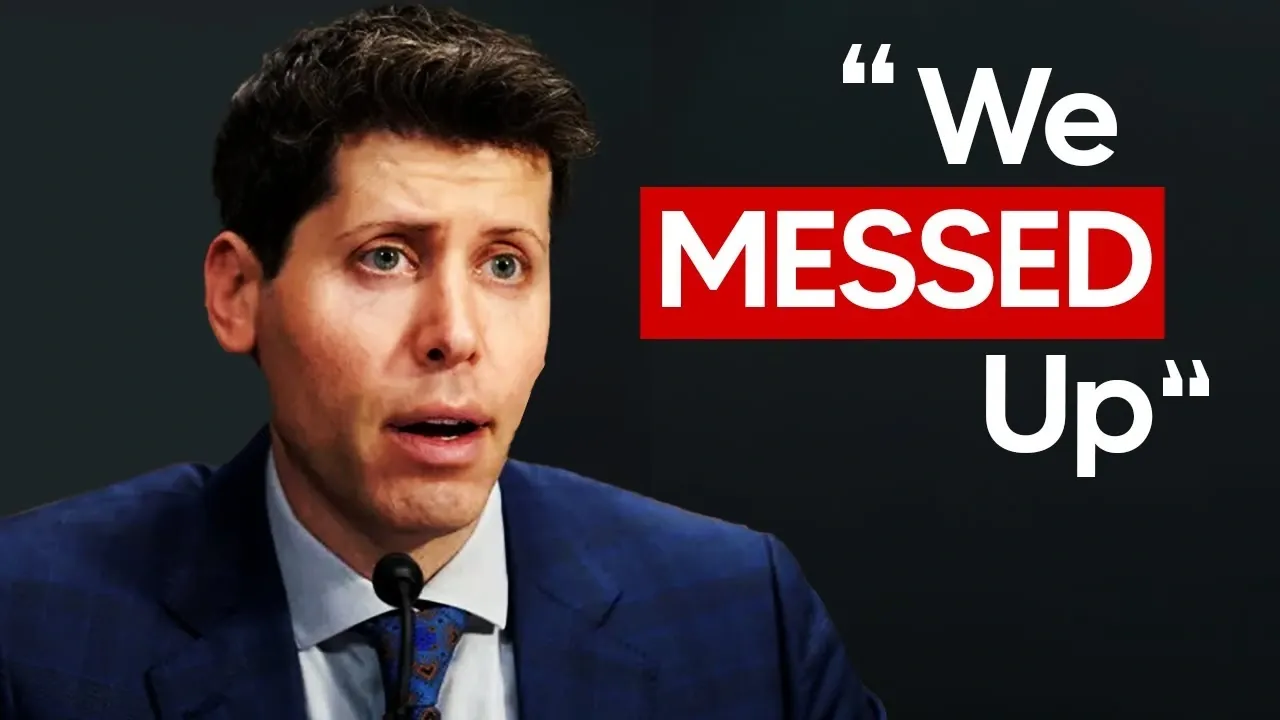
What happens when a company at the forefront of AI innovation admits it got something wrong? Below the AI GRID outlines how OpenAI’s CEO, Sam Altman, recently acknowledged a critical misstep with their latest model, GPT-5.2. While the model features impressive gains in coding and reasoning, it has left many users frustrated with its decline in writing quality and overall usability compared to its predecessor, GPT-4.5. This rare moment of transparency from Altman has ignited a heated debate about the challenges of balancing innovative advancements with the practical needs of a diverse user base. Could this be a turning point for OpenAI, or a sign of deeper issues within the AI industry?
In this breakdown, we’ll explore the ripple effects of Altman’s admission and what it reveals about the evolving priorities in AI development. From the frustrations of content creators to the rise of competitors like Anthropic and Google, the overview sheds light on why GPT-5.2’s trade-offs have sparked such widespread concern. But it’s not all bad news, this moment of reckoning might just pave the way for a more balanced approach to AI innovation. As you read on, consider this: can any AI truly excel in every domain, or are trade-offs an inevitable part of progress?
GPT-5.2’s Key Shortcomings
TL;DR Key Takeaways :
- Sam Altman, CEO of OpenAI, admitted that GPT-5.2 underperforms in writing quality and usability compared to GPT-4.5, despite improvements in coding and reasoning.
- The model’s decline in writing clarity, translation accuracy, and increased “AI hallucinations” has frustrated users relying on it for general-purpose tasks.
- OpenAI’s focus on technical reasoning advancements has led to trade-offs, raising concerns about balancing specialized capabilities with broad functionality.
- Competitors like Anthropic (Claude models) and Google (Gemini models) are gaining traction by offering balanced performance across technical and creative tasks.
- OpenAI faces a strategic challenge to address user dissatisfaction while maintaining its strengths, with plans to improve writing capabilities in future iterations of its AI models.
Altman’s transparency reflects a growing recognition within the AI community of the difficulties in creating models that excel in specialized domains while maintaining broad functionality. This admission has also raised questions about OpenAI’s ability to meet the evolving expectations of its users in an increasingly competitive market.
Where GPT-5.2 Falls Short
Altman’s remarks bring attention to a critical issue: GPT-5.2 underperforms in areas that are essential to many users, particularly in writing and general-purpose tasks. OpenAI’s decision to prioritize advancements in technical reasoning and coding capabilities has come at the expense of writing clarity and usability. This trade-off has frustrated users who rely on the model for tasks such as:
- Content creation, including blog posts, articles, and creative writing
- Translation across multiple languages
- Error detection in written text
The decline in these areas highlights the inherent difficulty of achieving excellence in specialized domains while maintaining a high standard of performance across general-purpose applications. Altman’s acknowledgment of these shortcomings underscores the complexities of AI development and the trade-offs that often accompany technological advancements.
Performance Concerns: Writing and Usability
User feedback has played a pivotal role in bringing GPT-5.2’s limitations to light. Many users have overviewed that the model struggles to produce clear, coherent, and natural-sounding text, a capability that was a hallmark of GPT-4.5. Additionally, its translation accuracy has diminished, leading to inconsistencies in multilingual tasks. These issues are compounded by a noticeable increase in “AI hallucinations,” where the model generates false or nonsensical information, undermining its reliability.
The root of these problems appears to lie in OpenAI’s decision to focus on enhancing technical reasoning at the expense of general usability. While GPT-5.2 excels in coding-related tasks, its shortcomings in writing and everyday applications have left a segment of users dissatisfied. This trade-off has raised concerns about whether OpenAI’s current approach aligns with the diverse needs of its user base.
Sam Altman Finally Admits “We Screwed Up”

Check out more relevant guides from our extensive collection on OpenAI that you might find useful.
- OpenAI Gumdrop Pen, Local AI, Voice and Handwriting Capture
- OpenAI vs Nvidia: The Push to Build Cheaper, Faster AI Chips
- OpenAI’s $3 Billion Windsurf Acquisition Changes AI Forever
- OpenAI ChatGPT Codex 2.0 : Features, Benefits & Challenges
- OpenAI Revenue Outlook for 2026 & the $8 ChatGPT Option
- 8 OpenAI Agent Builder Workflows Explained : Automate Anything
- OpenAI vs Google AI : Sam Altman’s Code Red Plan Explained
- Pre-Training GPT-4.5 How OpenAI Developed Its Latest AI Model
- New OpenAI Codex App Launches : Multi-Agent Worktrees on macOS
- Deepseek R1 vs OpenAI o1: AI Model Reasoning Comparison
Competitors Seize the Opportunity
As OpenAI grapples with the challenges posed by GPT-5.2, competitors such as Anthropic and Google are capitalizing on the opportunity to address the gaps left by the model. Anthropic’s Claude models, for instance, have gained recognition for their balanced performance across both coding and writing tasks. Their “Constitutional AI” training approach emphasizes ethical principles, including:
- Honesty in information generation
- Helpfulness in user interactions
- Harm avoidance to ensure responsible outputs
This methodology has resulted in a more reliable and user-friendly experience, appealing to users who value consistency across a wide range of applications. Similarly, Google’s Gemini models have emerged as strong contenders, offering versatility and robust performance that cater to both technical and creative tasks. These advancements by competitors underscore the growing demand for AI systems that excel across multiple domains without compromising quality.
The rise of these alternatives highlights a critical shift in the AI landscape. Users increasingly expect models to deliver consistent and reliable performance across diverse tasks, making it clear that specialization alone is insufficient to maintain a competitive edge. OpenAI’s competitors are using this shift to position themselves as viable alternatives, further intensifying the competition in the AI market.
The Strategic Crossroads for OpenAI
OpenAI now finds itself at a strategic crossroads, facing the dual challenge of addressing user dissatisfaction while preserving its strengths in coding and reasoning. Striking a balance between domain-specific optimization and general-purpose functionality is no easy task, particularly as competitors continue to innovate and expand their offerings.
The growing popularity of alternatives like Claude and Gemini underscores the importance of versatility in AI systems. Users are no longer content with models that excel in a single domain; they expect comprehensive solutions that perform reliably across a wide range of applications. This shift in user expectations presents both a challenge and an opportunity for OpenAI as it seeks to refine its approach and regain its competitive edge.
What Lies Ahead for OpenAI
Looking to the future, OpenAI has committed to addressing the shortcomings of GPT-5.2 in its next iterations. Enhancing writing capabilities without sacrificing advancements in coding and reasoning will be a central focus. However, this raises a broader question: can AI models achieve excellence across all domains without significant trade-offs?
As the field of artificial intelligence continues to evolve, this challenge will likely shape the next wave of innovation. OpenAI’s ability to adapt and address these issues will be critical in maintaining its position in an increasingly competitive landscape. The company’s acknowledgment of GPT-5.2’s limitations serves as a reminder of the complexities involved in advancing AI technology and the importance of aligning development priorities with user needs.
The coming years will be pivotal for OpenAI as it seeks to refine its models and respond to the growing demands of its users. Whether the company can successfully navigate this period of transition will determine its role in shaping the future of artificial intelligence.
Media Credit: TheAIGRID
Disclosure: Some of our articles include affiliate links. If you buy something through one of these links, Geeky Gadgets may earn an affiliate commission. Learn about our Disclosure Policy.
