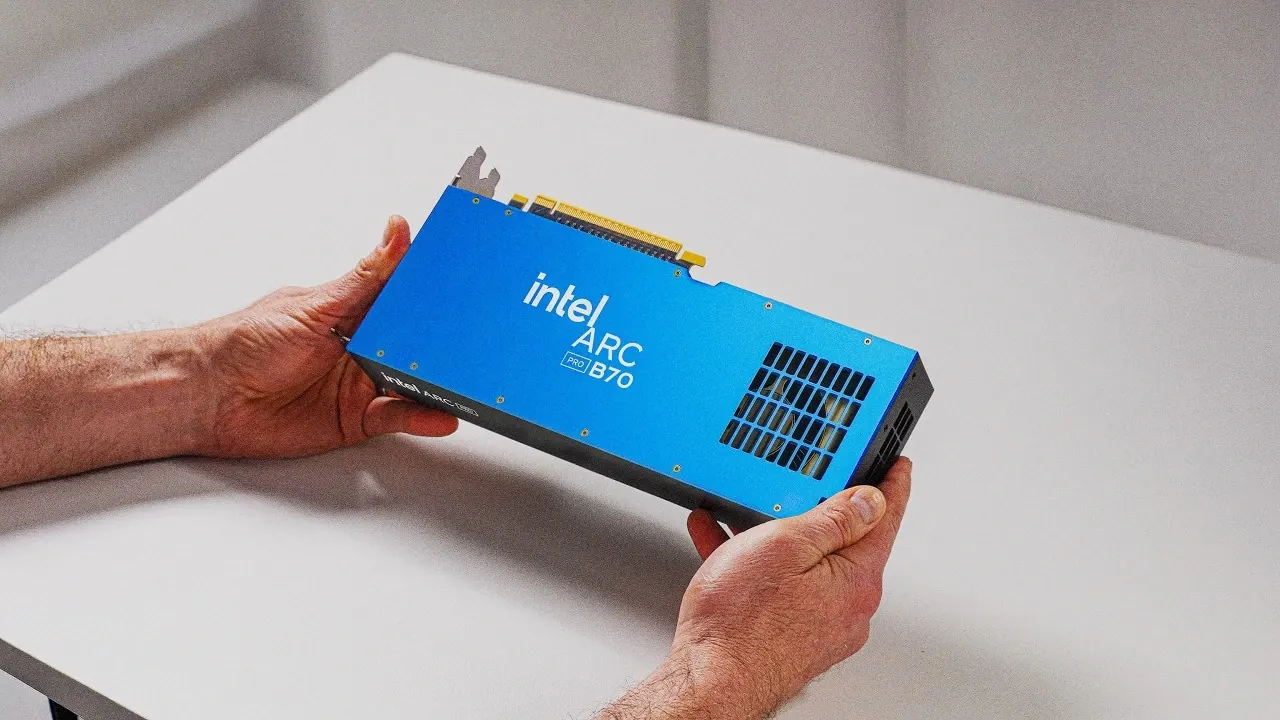
The Intel Arc Pro B70 is a professional-grade GPU designed to meet the needs of AI professionals and computational workloads, offering a balance between affordability and performance. With 32 GB of VRAM and a price under $1,000, it provides a cost-effective alternative to higher-priced competitors like Nvidia’s RTX Pro 4000. However, as Alex Ziskind highlights, its performance is shaped by factors such as memory bandwidth, which is capped at 68 GB/s and its reliance on Intel’s proprietary software ecosystem. These characteristics make it particularly well-suited for single-GPU tasks, though its scalability in multi-GPU configurations remains limited.
Explore how the Arc Pro B70 compares to its competitors in key areas like memory capacity, software compatibility and real-world applications. Gain insight into its strengths in handling local AI tasks, such as text and image generation, as well as its challenges with multi-GPU scalability due to PCIe communication bottlenecks. This guide also breaks down the trade-offs professionals should consider when selecting a GPU for AI workloads, helping you determine if the Arc Pro B70 aligns with your specific project needs.
Intel Arc Pro B70 : Key Features & Pricing
TL;DR Key Takeaways :
- The Intel Arc Pro B70 is a professional-grade GPU with 32 GB of VRAM, designed for AI workloads and computational tasks, priced under $1,000 for affordability.
- Its strengths include high memory capacity for managing large AI models, but its 68 GB/s memory bandwidth may limit performance in memory-intensive tasks compared to competitors.
- The GPU struggles with multi-GPU scalability due to PCIe communication bottlenecks, making it better suited for single-GPU environments.
- Intel’s proprietary software tools, such as SYCL and VLM, offer unique advantages but lack the maturity and widespread adoption of Nvidia’s CUDA and AMD’s HIP, potentially leading to inconsistent performance.
- The Arc Pro B70 is a cost-effective option for local AI tasks and smaller workloads, but its limitations in software ecosystem and scalability may impact its appeal for larger-scale or advanced applications.
The Arc Pro B70 distinguishes itself with its substantial 32 GB of VRAM, a critical feature for managing large AI models and datasets. This memory capacity makes it particularly appealing to professionals working with resource-intensive applications. Priced competitively below $1,000, it offers a compelling option for users who prioritize affordability without compromising on memory capacity.
However, the GPU requires external power, a departure from its predecessor, the Arc Pro B50, which was more power-efficient. This design choice may influence its appeal for users with specific power constraints. Additionally, the Arc Pro B70’s memory bandwidth of 68 GB/s, while sufficient for many tasks, falls short compared to its competitors, potentially impacting performance in memory-intensive workloads. These trade-offs position the B70 as a viable option for users who value cost savings over peak technical specifications.
Performance Insights
The Arc Pro B70 delivers a mixed performance profile when compared to its rivals. In certain AI tasks, it outperforms Nvidia’s RTX Pro 4000, despite having lower memory bandwidth. Similarly, it competes closely with AMD’s Radeon AI R9700, although AMD’s less mature software ecosystem limits its overall performance. These comparisons highlight the B70’s ability to hold its own in specific scenarios, particularly for users focused on single-GPU tasks.
However, the B70 encounters challenges in multi-GPU configurations. PCIe communication bottlenecks hinder its scalability, making it less suitable for large-scale workloads that require seamless multi-GPU integration. This limitation underscores its strengths in single-GPU environments, where its capabilities can be fully utilized without the constraints of inter-GPU communication.

Discover other guides from our vast content that could be of interest on Intel Arc hardware.
- Intel Arc A380 Low-Profile GPU Upgrade Path with XeSS
- Intel Panther Lake Performance : 18A CPU and iGPU Benchmarks Shown
- How to Set up Intel Arc eGPU on Raspberry Pi, Drivers Guide
- Intel Arc Pro B50 Review: A Workstation GPU That Surprises Gamers
- How Intel’s ARC 140T iGPU Handles Modern Games at 1080p
- Intel Arc Pro B50 16GB a Low-Profile GPU for Gamers & Creators
- Intel ARC B580 Review: Best Budget GPU 1440p Gaming in 2025
- Khadas Mind Pro Mini PC Specs : Panther Lake, ARC B390, Ports & Benchmarks
- GMKtec K13 Mini PC: Intel Core Ultra 7256V Gaming Test
Software Ecosystem: Strengths and Weaknesses
The Arc Pro B70 relies on Intel’s proprietary software tools, such as SYCL and VLM, to optimize its performance for AI and computational workloads. These tools offer unique advantages for specific tasks, particularly in areas like local AI processing and model training. However, Intel’s software ecosystem lacks the maturity and widespread adoption of Nvidia’s CUDA and AMD’s HIP, which are industry standards for many AI and machine learning applications.
This gap in software ecosystem maturity can lead to inconsistent performance, especially in tasks requiring high concurrency or advanced model quantization. For professionals whose workflows depend heavily on CUDA or HIP, the B70 may not provide the seamless integration and support they require. This highlights the importance of aligning hardware choices with the software environments best suited to specific workloads.
Benchmarks and Real-World Applications
In practical applications, the Arc Pro B70 demonstrates strong performance in local AI tasks, such as text and image generation. It excels in prompt processing and handles single-GPU workloads effectively, making it a reliable choice for professionals working on smaller-scale projects. However, its performance in token generation speeds can vary depending on the complexity of the task, reflecting the impact of its memory bandwidth limitations.
The GPU’s performance diminishes in multi-GPU setups due to communication bottlenecks, which restrict its scalability for larger workloads. These limitations emphasize the importance of careful workload planning to maximize the B70’s capabilities. For users focused on single-GPU tasks, the B70 offers a cost-effective solution with solid performance in targeted applications.
Competitive Landscape
The Arc Pro B70 operates in a competitive market, facing strong challenges from Nvidia and AMD. Here’s how it compares:
- Nvidia RTX Pro 4000: Equipped with newer GDDR7 memory and supported by a robust software ecosystem, the RTX Pro 4000 is a preferred choice for users prioritizing performance and compatibility. However, its higher price point makes it less accessible for budget-conscious professionals.
- AMD Radeon AI R9700: While it matches the B70 in VRAM capacity, the Radeon AI R9700 is more expensive and hindered by a less mature software stack. This limits its appeal for users seeking a balance between cost and functionality.
These comparisons highlight the trade-offs professionals must consider when selecting a GPU for AI and computational workloads. The Arc Pro B70’s affordability and memory capacity make it an attractive option for specific use cases, but its limitations in software ecosystem maturity and multi-GPU scalability may influence its suitability for certain environments.
Limitations to Consider
Despite its strengths, the Arc Pro B70 has several notable limitations that professionals should consider:
- Memory Bandwidth: The GPU’s 68 GB/s bandwidth may restrict its performance in memory-intensive tasks, particularly when compared to competitors with higher bandwidth capabilities.
- Multi-GPU Scalability: PCIe communication bottlenecks reduce its effectiveness for large-scale workloads, making it less suitable for users requiring seamless multi-GPU integration.
- Software Ecosystem: Intel’s proprietary tools, while promising, lack the maturity and widespread adoption of Nvidia’s CUDA and AMD’s HIP, potentially leading to inconsistent performance in certain applications.
These limitations may impact the GPU’s appeal for professionals working in environments that demand high scalability, advanced software compatibility, or peak performance in memory-intensive tasks.
Final Thoughts
The Intel Arc Pro B70 presents a compelling option for budget-conscious professionals and AI enthusiasts. Its 32 GB of VRAM and sub-$1,000 price point make it an attractive choice for local AI tasks and smaller workloads. However, its success depends on Intel’s ability to address its software ecosystem’s limitations and improve multi-GPU scalability.
For users willing to navigate its constraints, the B70 offers a cost-effective alternative to more expensive GPUs. While it may not yet rival the industry leaders in every aspect, it represents a significant step forward in Intel’s efforts to compete in the professional GPU market.
Media Credit: Alex Ziskind
Disclosure: Some of our articles include affiliate links. If you buy something through one of these links, Geeky Gadgets may earn an affiliate commission. Learn about our Disclosure Policy.
