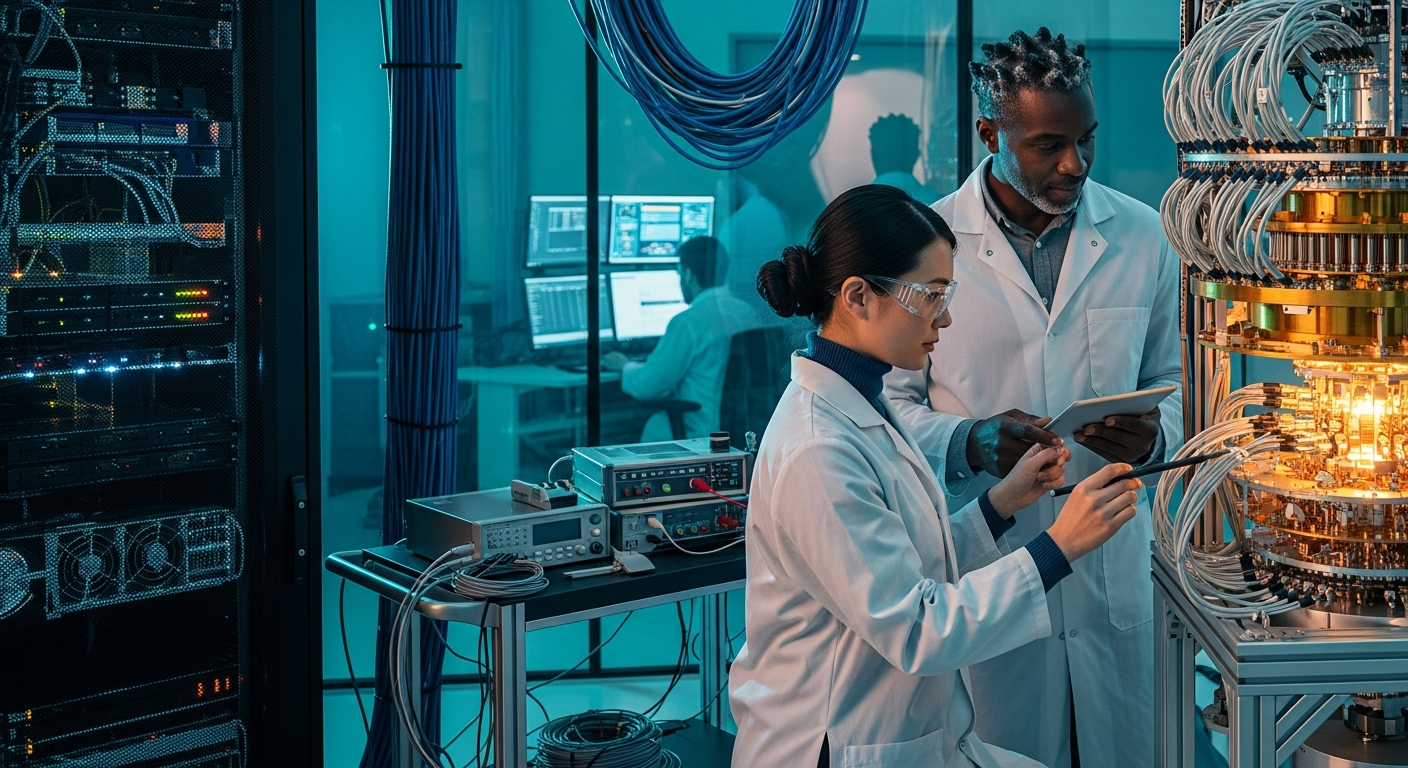
Quantum computers aren’t just physics experiments tucked away in university basements anymore. They’re becoming real engineering projects, deployed by companies that care as much about wiring and refrigeration as they do about qubit counts.
While early headlines loved to trumpet how many qubits a new chip could pack in, the practical challenge of running these machines comes down to a sprawling, deeply complex physical hardware stack. Theoretical physics doesn’t scale on its own; it needs robust infrastructure underneath it. And industry progress is increasingly measured by system stability and error reduction, not just computational promises. The video below from IBM Quantum offers a closer look at how modern quantum computers are built and why the hardware stack is far more complex than most people realize.
What Sits Inside a Modern Quantum Computer
The quantum processor is only one piece of the puzzle
A quantum computer requires a complete physical stack to function, meaning the processing chip is just one component of a much larger machine. The quantum processing unit (QPU) gets most of the attention, but it depends on surrounding shielding, precision wiring, and classical computing infrastructure to do anything useful. Building this complete system demands mechanical, electrical, and cryogenic engineering right alongside fundamental physics research.
To give you a sense of how much focus goes into the non-processor parts: an estimated 37% of all quantum-related companies currently focus exclusively on developing hardware components. That’s more than a third of the industry working on everything except the chip itself. This large infrastructure footprint has also driven interest in modular chiplet architectures that simplify system assembly, something you’ll see echoed later in this piece when scaling challenges come up.
Why qubits are so demanding
Qubits are extraordinarily fragile. They’re susceptible to noise, vibration, heat, and stray electromagnetic interference, sometimes all at once. Even a tiny physical disruption from the surrounding environment can tank computational fidelity and end a calculation before it finishes. Think of it like trying to balance a marble on a needle while someone shakes the table; that’s roughly the kind of sensitivity engineers deal with daily.
Overcoming this fragility demands hardware that can manipulate qubits repeatably and measure them accurately without introducing additional interference. Recent engineering achievements in fault tolerance suggest these control challenges are becoming more manageable for larger-scale operations. Some researchers now argue that useful, large-scale systems may arrive earlier than previously expected, which is encouraging news for anyone tracking this space.
Cryogenic Cooling and the Physical Environment
Why superconducting quantum computers operate near absolute zero
Leading hardware developers often use superconducting qubits to perform advanced calculations and execute logic gates. These processors need operating environments cooled near absolute zero to maintain their quantum states and prevent rapid decoherence. Extreme cooling suppresses ambient thermal noise, allowing superconducting materials to function with the required precision. This strict thermal requirement means the physical processor has to sit inside a large, specialized dilution refrigerator (not a kitchen appliance, despite the name).
The refrigerator is a platform, not just a cooler
A dilution refrigerator functions as a highly engineered platform with multiple thermal stages, vacuum chambers, and mechanical isolation systems. Radiation shielding protects the inner workings, while filtered coaxial wiring carries sensitive microwave signals down to the processor. The physical environment must carefully attenuate incoming signals to prevent excess energy from reaching the chip. Meanwhile, cryogenic amplifiers boost the faint readout signals as they return to room temperature. If you’ve seen photos of those golden chandelier-like structures hanging inside quantum labs, that’s the refrigerator internals you’re looking at.
Here’s a breakdown of the major hardware layers and what each one contributes:
| Hardware Layer | What It Does | Why It Matters |
|---|---|---|
| Quantum processor | Hosts qubits and gates | Performs quantum operations |
| Dilution refrigerator | Cools the chip to millikelvin temperatures | Reduces thermal noise and stabilizes qubits |
| Microwave/RF control chain | Sends pulses to manipulate qubits | Enables gates with precise timing and phase control |
| Readout electronics | Measures qubit states | Converts fragile quantum signals into usable data |
| Synchronization hardware | Keeps channels aligned | Critical for multi-qubit fidelity and feedback |
| Classical compute layer | Schedules, calibrates, and post-processes | Bridges quantum hardware with real applications |
Control Electronics Are the Real Scaling Challenge
Why generic lab instruments don’t scale well
Early hardware experiments relied on discrete, arbitrary waveform generators, digitizers, and standalone lab instruments to control individual qubits. That approach works fine for small benchtop tests, but it becomes impractical once designs scale to hundreds or thousands of control channels. Picture a lab where every qubit needs its own rack-mounted instrument, its own cables, and its own calibration routine. The rack space alone becomes unmanageable, and the cable complexity starts to resemble a server room nightmare.
More critically, synchronization drift and communication latency make deterministic timing difficult across all those disconnected boxes. Without deterministic timing, advanced active error correction routines simply can’t function reliably.
Why dedicated control stacks are becoming essential
Scalable quantum computers rely on tightly synchronized control and readout hardware that behaves as a unified, deterministic system rather than a collection of disconnected tools. As channel counts rise, researchers need to move away from disjointed lab equipment toward dedicated stacks capable of high-performance analog control. This makes modular quantum control architectures increasingly important for operating the next-generation high-qubit processors. Platforms such as the Qblox Cluster package digital pulse processing and analog output into a single 19-inch rack form factor, providing deterministic channel synchronization along with the fast, low-latency feedback required for active reset.
Timing, phase coherence, and feedback
Executing precise multi-qubit gates requires tightly aligned pulse timing and stable phase relationships across all active control lines. Qubits require carefully shaped microwave pulses delivered at precise intervals to accurately change their internal states. Sound familiar if you’ve worked with RF systems? The precision requirements here are orders of magnitude tighter.
Measurement hardware must also operate quickly enough to process readout data and apply conditional logic before the corresponding qubits lose coherence. This demanding low-latency feedback loop sits at the center of active reset protocols and error-correction decoding algorithms.
Readout Chains, Interconnects, and Error Correction Hardware
Measuring a qubit is harder than it sounds
Reading a quantum state is far more delicate than checking a standard classical memory cell. The complete readout chain includes printed-on-chip resonators, microwave lines, sensitive cryogenic amplifiers, and room-temperature digitizers. Poor readout hardware introduces measurement errors that immediately degrade overall system fidelity. Without accurate and fast readout capabilities, continuous error-correction cycles remain out of reach, no matter how good the processor itself is.
Microwave links and modular scaling
Connecting multiple hardware subsystems via microwave packaging and coaxial interconnects poses serious signal-integrity challenges. If you’ve ever dealt with signal loss over long cable runs in a conventional RF setup, imagine that problem multiplied by a factor of a thousand, with tolerances measured in fractions of a degree.
Linking smaller, higher-yield processing units can help developers avoid the low manufacturing yields associated with very large monolithic chips. These modular system designs are widely seen as important for scaling to thousands or even millions of functioning qubits. But maintaining high fidelity across these physical transmission gaps remains a major engineering hurdle that nobody has fully solved yet.
Why error correction changes the hardware equation
Implementing logical error correction significantly increases the required physical infrastructure and component counts for any practical quantum machine. Creating one reliable logical qubit can require dozens or even hundreds of physical qubits working together continuously to detect and correct state changes. Not the kind of ratio most people expect when they first hear about quantum error correction, right?
This process sharply increases demand for high-bandwidth control channels, stable readout infrastructure, and classical processing power. The underlying system architecture must support constant data extraction and real-time pulse adjustments without causing thermal overload inside the refrigerator.
The hardware demands of quantum error correction include:
- More physical qubits for each logical qubit, often at ratios of 100:1 or higher
- Faster and more accurate readout across every channel
- Deterministic synchronization across many channels simultaneously
- Real-time feedback for conditional operations like active reset
- Significantly more classical processing to decode errors and adjust control signals on the fly
How Hybrid Quantum-Classical Systems Bridge the Gap
Why quantum computers won’t replace GPUs or CPUs
Quantum processors act as specialized mathematical accelerators rather than direct replacements for GPUs or CPUs. Classical supercomputers will still be needed for system orchestration, routine hardware calibration, workflow optimization, and complex error decoding. So if you’re imagining a future where quantum boxes sit on every desk, that’s not quite what’s happening here.
Future commercial deployments are likely to remain hybrid by design, combining classical and quantum systems where each performs best. Organizations will route selected high-value mathematical tasks to the quantum accelerator while classical servers continue to handle standard computation.
The growing link between quantum systems and HPC
Connecting quantum processing devices directly to high-performance computing (HPC) infrastructure is becoming a major priority for technology providers. Research organizations are investigating the low-latency networking needed to merge these systems more effectively. This quantum-centric supercomputing model allows classical machines to preprocess complex data before sending instructions down to the dilution refrigerator. The goal is to ensure neither system becomes a bottleneck under demanding scientific or industrial workloads.
Why this matters for real-world deployment
Hybrid architectures allow industries to extract practical value from quantum hardware before full fault tolerance is achieved. Combining traditional AI processing with quantum execution can also speed up routine calibration and error tuning. This shift marks a meaningful step in moving quantum technology from isolated labs into more standardized computing environments. Engineering stability and classical connectivity will ultimately do as much as qubit design to determine commercial success; possibly more.
What the Hardware Race Really Means
So far, you’ve seen that the visible quantum processor chip is only the tip of a much larger mechanical and electrical system. Scaling these computers to commercially viable levels depends on advances in cryogenic shielding, microwave interconnects, and deterministic readout chains. Hardware stability and the practical management of error-correction resources are now central measures of progress, arguably more telling than qubit-count headlines.
The organizations that successfully commercialize quantum computing will be those that can coordinate and optimize the full hardware stack, from the millikelvin processor all the way up to the classical servers running the show at room temperature.
Source & Image Credit: IBM Quantum
Disclosure: Some of our articles include affiliate links. If you buy something through one of these links, Geeky Gadgets may earn an affiliate commission. Learn about our Disclosure Policy.
