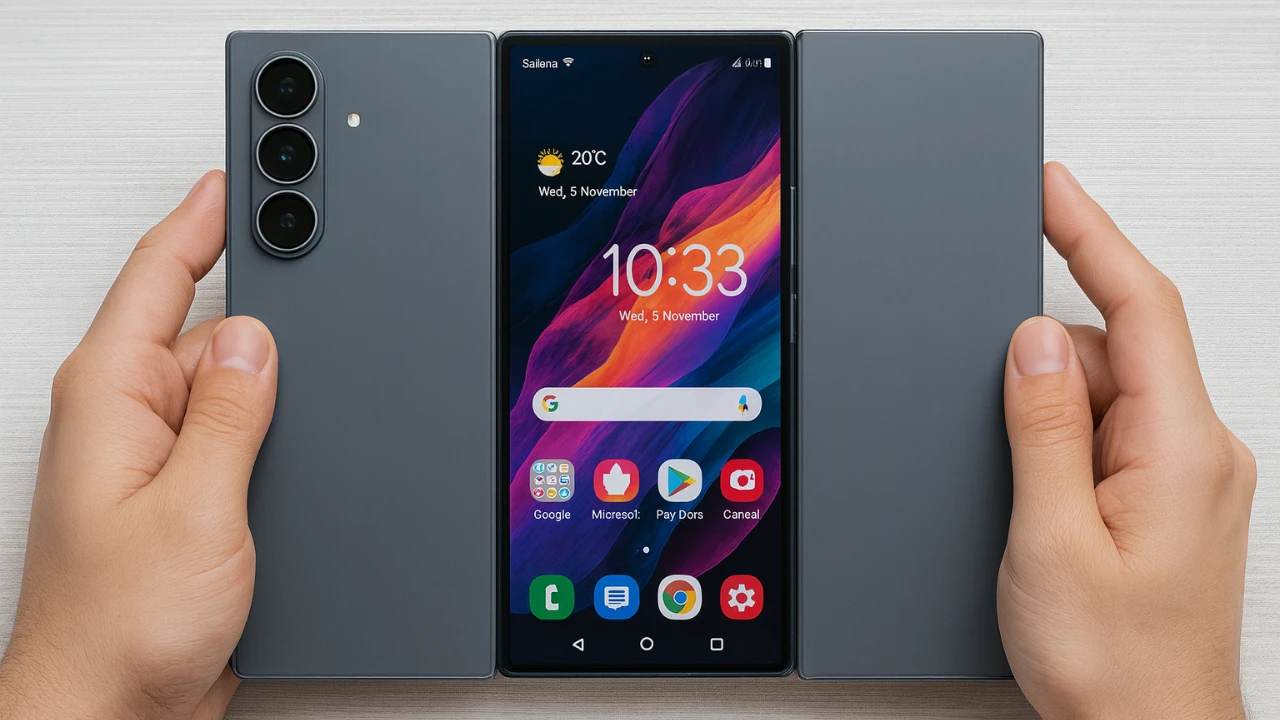
Early information surrounding Samsung’s long-anticipated Galaxy Z Trifold suggests the company isn’t merely preparing another foldable—they’re preparing a device that could redefine what a mobile form factor can be.
A tri-fold smartphone is exponentially more complex than the book-style foldables Samsung currently dominates. It requires new hinge geometries, a flexible display that bends in multiple locations without visible creasing, and internal components that can survive thousands of multi-axis stress cycles. If the leaked specifications are accurate, Samsung is attempting one of the most technically ambitious consumer electronics products ever shipped.
Samsung has only teased the design in limited prototype form, but a wave of new leaks—including strong hints of a December 5th launch in select regions—provides a clearer picture of where the company is heading. Below is a deeper look at the rumored hardware, the engineering behind it, and why this category could become the next frontier of mobile computing.
Design: The Center Screen Architecture
The form factor is the story.
Unlike competitors, leaks suggest Samsung is utilizing a unique “Z-fold” configuration where the cover screen is embedded on the rear center panel.
-
Unfolded: When opened flat, the back of the device reveals three distinct segments: a camera island on the left, a live display in the center, and a protective metal slab on the right.
-
Folded: The side panels collapse inward, sandwiching the fragile main screen safely inside, while the center rear panel becomes the front-facing “phone” screen.
-
Dimensions: The chassis is rumored to be just 4.2 mm thick when open, jumping to roughly 14 mm when folded.
-
The Goal: This specific folding geometry solves the durability issue, ensuring the soft internal screen is never exposed when the device is in your pocket.
Expected Trade-offs
Weight is the big unknown. Even with advanced alloys and carbon-infused hinge materials, a device with two hinges and a multi-layer display stack will inevitably weigh more than a standard slab phone. If it exceeds 300g, ergonomics could become a concern—but Samsung is reportedly taking aggressive steps to keep mass distribution even across the panels.
Displays: Ending the Cover Screen Compromise
Foldable phones have historically suffered from awkward aspect ratios or low-brightness external screens. Samsung appears determined to eliminate those compromises.
The Main Display (Unfolded)
- Size: 10.0 inches
- Type: LTPO OLED
- Refresh Rate: 120Hz
- Brightness: Up to 1,600 nits
- Resolution: 2232 × 3184 (~389 ppi)
- Certifications: Expected HDR10+
A 10-inch flexible OLED of this size and quality represents a major manufacturing milestone. Producing a panel that remains uniform across three separate folds requires extremely precise ultra-thin glass (UTG) engineering and new anti-crease materials. If Samsung can achieve near-invisible crease lines, this display will feel more like a small tablet than a foldable phone.
The Cover Display
- Size: 6.5 inches
- Type: OLED
- Brightness: A blistering 2,600 nits (rumored)
- Refresh Rate: 120Hz
This would make the Trifold’s outer screen one of the brightest mobile displays ever shipped—crucial for usability when the device is closed.
Performance: Qualcomm’s Most Extreme Mobile Processor Yet
Almost every leak points to Samsung adopting Qualcomm’s next flagship SoC for 2025: the Snapdragon 8 Elite Gen 5. Built on a cutting-edge 3 nm node, the chip is reportedly engineered for multi-display workloads—exactly what a tri-fold device demands.
CPU Layout (Rumored)
- 2× 4.6 GHz Oryon V3 Phoenix L (Performance cores)
- 6× 3.62 GHz Oryon V3 Phoenix M (Efficiency cores)
This configuration prioritizes fast, sustained multitasking. A tri-fold device might run three apps at once, split across different screen segments, with background AI tasks and high refresh rates. That requires a processor designed not just for peak performance, but for sustained thermal stability across a larger chassis.
GPU
- Adreno 840
This GPU should deliver console-level throughput, making the Trifold potentially one of the most powerful mobile gaming tablets ever made.
Memory & Storage
- 16GB RAM (standard)
- 512GB or 1TB UFS 4.x storage
The RAM figure is especially important—running multiple full-sized apps simultaneously demands more memory than a single-screen phone.
Software: A New One UI for a New Hardware Class
The device is expected to ship with Android 16 and a new version of One UI optimized specifically for a tri-pane layout.
Anticipated Software Features
- Drag-and-drop multitasking across all three panels
- A “desktop-lite” mode when fully unfolded
- App continuity that shifts layouts depending on which panels are open
- Adaptive taskbars and floating window support
- Enhanced DeX integration
This software layer may be one of Samsung’s biggest challenges. Hardware alone won’t sell a tri-fold—seamless workflows will.
Cameras: Bringing Ultra-Tier Photography to Foldables
Foldables have historically compromised on cameras due to limited internal space. The Galaxy Z Trifold aims to break that trend.
Rumored Camera System
- Main: 200 MP wide, f/1.7, OIS
- Ultrawide: 50 MP (rumored)
- Telephoto: Not confirmed, could be digital crop via 200 MP sensor
- Video: 8K @ 30fps, 4K @ 60fps
If Samsung manages to fit a true Ultra-grade 200MP sensor into a 4.2 mm unfolded chassis, it could represent one of the most impressive feats of mobile engineering ever achieved.
The tri-fold design may also enable new shooting modes:
- Dual-angle photography with the device partially folded
- Tripod-mode stabilization using the device’s own panels
- External display preview for capturing selfies with the main camera system
Battery & Connectivity: Balancing Power in a Three-Panel Device
A 10-inch display and two hinges demand substantial battery resources. Current leaks indicate:
Battery
- 5,600 mAh total, split across multiple cells
Splitting the battery is necessary for weight distribution and hinge mechanics. Samsung may use a custom charging architecture to ensure even heat generation and safe power delivery across the tri-segment layout.
Charging
- 45W wired
Wireless and reverse wireless charging are still unconfirmed—likely due to internal space constraints.
Connectivity
- Wi-Fi 7
- Bluetooth 6.0
- Global GPS suite
- Full 5G support (mmWave varies by region)
Omissions
- No 3.5mm headphone jack
- No microSD slot
Both omissions are consistent with Samsung’s premium flagship strategy.
Durability Questions (The Elephant in the Room)
A tri-fold raises several critical engineering questions:
- Hinge longevity: Two independent hinge systems must remain synchronized.
- Crease visibility: Three-fold points increase complexity dramatically.
- Dust resistance: True IP ratings could be difficult due to multiple hinge gaps.
- Thermals: Larger screens and a powerful SoC could push heat toward hinge areas.
Samsung’s experience with the Z Fold and Z Flip lines gives it a head start, but this device still represents an entirely new class of mechanical engineering challenges.
Verdict: A New Phase of Smartphone Innovation?
If even 70% of these leaks materialize, the Galaxy Z Trifold will be one of the most ambitious mobile devices ever built. It aims to outclass rivals like the Huawei Mate XT while creating a new category: a pocketable, uncompromised tablet.
Is it niche? Probably—especially with a rumored $3,000 starting price.
Is it important? Absolutely. This could be the template for the next decade of mobile design.
With a rumored reveal date of December 5th in Korea and China (global rollout later), we won’t have to wait long to see how much of the hype becomes reality.
Rumored Specifications Cheat Sheet
| Category | Specification |
|---|---|
| Network | GSM / CDMA / HSPA / EVDO / LTE / 5G |
| Dimensions | Unfolded: 4.2 mm • Folded: ~14 mm |
| Main Display | 10.0″ LTPO OLED, 120Hz, 1600 nits |
| Cover Display | 6.5″ OLED, 120Hz, 2600 nits |
| Chipset | Snapdragon 8 Elite Gen 5 (3 nm) |
| Memory | 16GB RAM • 512GB / 1TB UFS 4.x |
| Main Camera | 200 MP (OIS) + 50 MP Ultrawide (Rumored) |
| Battery | 5,600 mAh • 45W Wired Charging |
| Connectivity | Wi-Fi 7, Bluetooth 6.0, GPS |
| Price | Est. $3,000 (Rumored) |
Find out more details about the Samsung Galaxy Z TriFold with other articles and guides we have written below.
- Samsung Galaxy Z Trifold: Everything You Need to Know
- Samsung Galaxy Z Tri-Fold Price, Features, and Release Date
- Samsung Galaxy Z Tri-Fold: Release Date Revealed
- Samsung Galaxy Z Tri-Fold: Features, Specs, and Price
- Samsung Galaxy Z Tri-Fold: Design, Performance, and Price
Disclosure: Some of our articles include affiliate links. If you buy something through one of these links, Geeky Gadgets may earn an affiliate commission. Learn about our Disclosure Policy.
