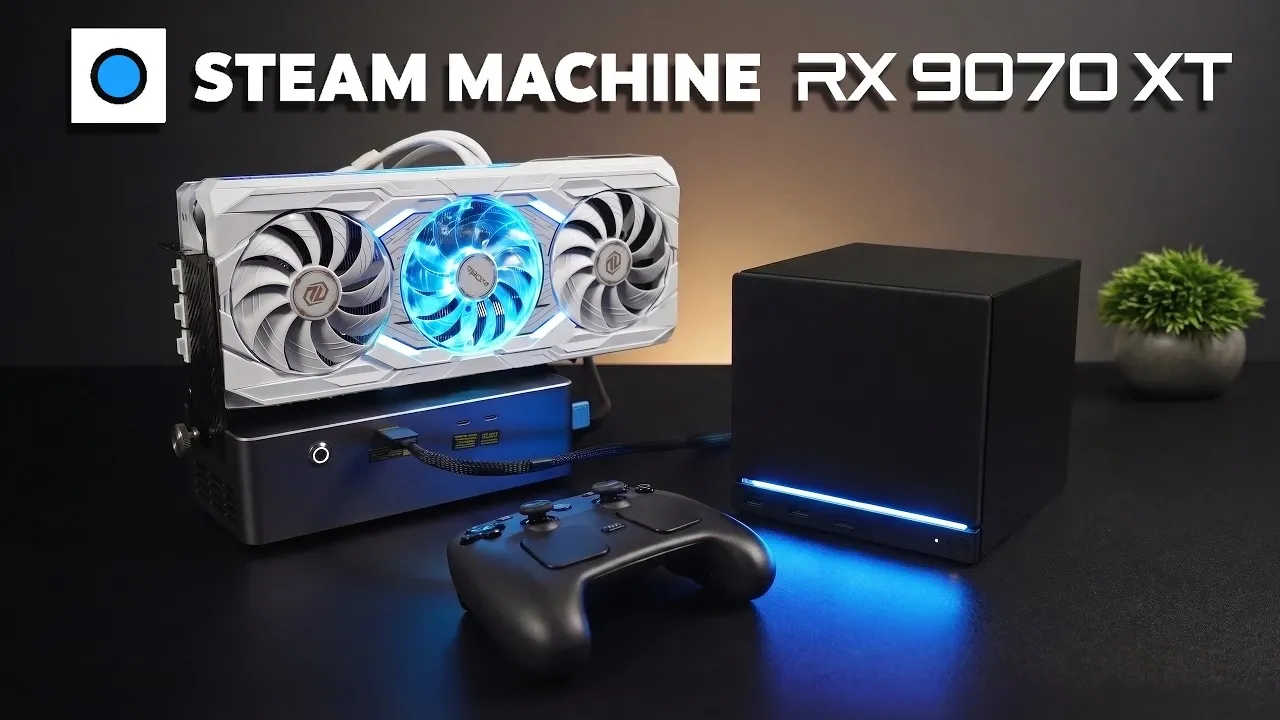
Pairing the AMD Radeon RX 9070 XT eGPU with Valve’s Steam Machine offers a unique glimpse into the potential of modular gaming setups. As demonstrated by ETA Prime, this experimental configuration relies on an Oculink-to-M.2 adapter to connect the external GPU, overcoming the Steam Machine’s inherent hardware constraints. The setup also required relocating the Steam OS to an external SSD and upgrading the system’s memory to 64GB, making sure sufficient resources for modern gaming demands. Despite these enhancements, the Steam Machine’s Ryzen CPU, with its 30W thermal design power, emerged as a limiting factor, particularly in CPU-intensive scenarios, underscoring the challenges of achieving balanced performance in such configurations.
Explore how this unconventional pairing impacts gaming performance, including frame rate improvements of up to 183% at 4K resolution in titles like Cyberpunk 2077 and Shadow of the Tomb Raider. Gain insight into the role of advanced technologies like FidelityFX Super Resolution and frame generation in optimizing gameplay, as well as the technical hurdles encountered during the setup, such as compatibility issues with Oculink cables and BIOS adjustments. Whether you’re curious about the feasibility of external GPUs or interested in the broader implications for modular gaming systems, this explainer provides a detailed breakdown of both the benefits and limitations of this experimental approach.
Hardware Configuration: Assembling the System
TL;DR Key Takeaways :
- Pairing the AMD Radeon RX 9070 XT eGPU with Valve’s Steam Machine significantly boosts gaming performance, particularly at higher resolutions, but requires extensive hardware modifications.
- The setup utilized an Oculink-to-M.2 adapter, external SSD for Steam OS, an Austar AG03 dock and an 800W power supply, alongside a memory upgrade to 64GB.
- Performance gains included up to 183% frame rate improvements at 4K resolution in games like Cyberpunk 2077 and Horizon Zero Dawn Remastered, aided by technologies like FidelityFX Super Resolution and frame generation.
- The Steam Machine’s six-core Ryzen CPU emerged as a bottleneck, limiting the RX 9070 XT’s full potential in CPU-intensive tasks, highlighting the need for balanced hardware configurations.
- Technical challenges, such as compatibility issues, lack of USB 4/Thunderbolt support and complex setup processes, make this approach impractical for most users, though it offers valuable insights for hardware enthusiasts.
To integrate the RX 9070 XT eGPU with the Steam Machine, an Oculink-to-M.2 adapter was employed, using the system’s M.2 slot for connectivity. This modification necessitated relocating the Steam OS to an external SSD, making sure sufficient storage for games and system files. The eGPU itself was housed in an Austar AG03 dock, powered by an 800W power supply to meet the RX 9070 XT’s substantial energy requirements. Additionally, the system’s memory was upgraded to 64GB, providing ample resources to handle modern gaming workloads.
Despite these enhancements, the Steam Machine’s six-core, 12-thread Ryzen CPU, with a modest 30W thermal design power (TDP), emerged as a limiting factor. While capable of supporting many gaming scenarios, the processor’s constraints prevented the RX 9070 XT from achieving its full potential, particularly in CPU-intensive tasks. This bottleneck underscores the importance of balanced hardware configurations when attempting such upgrades.
Performance Gains: Unlocking New Potential
The integration of the RX 9070 XT eGPU resulted in substantial improvements in gaming performance, particularly at higher resolutions. Benchmarks revealed frame rate increases of up to 183% at 4K resolution in select titles. Games such as Cyberpunk 2077, Shadow of the Tomb Raider, and Horizon Zero Dawn Remastered exhibited smoother gameplay, even at high or ultra settings.
Advanced technologies like FidelityFX Super Resolution (FSR) and frame generation played a pivotal role in optimizing performance. These tools allowed for higher frame rates without compromising visual quality, particularly in demanding titles like Ratchet & Clank: Rift Apart and Forza Horizon 6. However, the Steam Machine’s CPU occasionally struggled to keep pace, limiting the RX 9070 XT’s performance in certain scenarios. This highlights the need for a more robust processor to fully harness the GPU’s capabilities.

Check out more relevant guides from our extensive collection on Steam Machine that you might find useful.
- Inside Valve’s Unusual Rollout Plan for the Steam Machine
- Why Valve’s New Steam Machine Could Outperform the PS5 in Your Living Room
- Valve Confirms Summer 2026 Release Window for Steam Machine and Steam Frame
- What Valve’s Leaked June 2026 Steam Machine Details Mean for Your Living Room
- Leaked Geekbench Scores Reveal the True Power of the $750 Steam Machine
- What Valve’s Latest Hardware Leaks Reveal About the Modular Steam Machine
- Why Valve’s Latest SteamOS Update Changes Everything for Your Steam Machine
- Latest Leaked Clues Pointing to Valve’s Steam Machine Launch Date
- What Analysts Actually Expect Valve to Charge for the Steam Machine
- How to Build a Capable DIY Steam Machine for Under $170
Technical Challenges: Overcoming Barriers
The process of integrating the RX 9070 XT eGPU with the Steam Machine was far from straightforward. Several technical challenges emerged during the setup, including:
- Compatibility issues with Oculink cables and power management settings, such as Active State Power Management (ASPM), which required manual adjustments to ensure stable operation.
- Configuring the system to prioritize the eGPU over the internal GPU, a process that demanded careful attention to BIOS and software settings.
- The absence of USB 4 or Thunderbolt support, which could have provided a more efficient and streamlined connection for the eGPU.
The reliance on an Oculink-to-M.2 adapter introduced additional complexity, highlighting the limitations of the Steam Machine’s aging hardware. These challenges underscore the experimental nature of this setup and the technical expertise required to implement it successfully.
Gaming Performance: Pushing the Limits
Performance testing across various resolutions and settings showcased the RX 9070 XT’s capabilities, with noticeable improvements in both frame rates and visual fidelity. For example:
- Cyberpunk 2077 experienced significant gains, with FidelityFX Super Resolution allowing smoother gameplay at high settings.
- Shadow of the Tomb Raider demonstrated the effectiveness of frame generation in maintaining consistent performance, even during graphically intensive sequences.
At 1080p, 1440p and 4K resolutions, the RX 9070 XT consistently delivered enhanced gaming experiences. However, the Steam Machine’s CPU occasionally became a bottleneck, particularly in games that demanded extensive processing power. This limitation highlights the importance of a balanced system to fully exploit the GPU’s potential.
Limitations and Future Prospects
While this experiment successfully demonstrated the feasibility of enhancing the Steam Machine with an external GPU, it also revealed several critical limitations:
- The absence of USB 4 or Thunderbolt support restricts future upgrade options and complicates the setup process, making it less accessible for the average user.
- The Steam Machine’s CPU remains a significant performance ceiling, preventing the RX 9070 XT from achieving its maximum potential in certain scenarios.
Exploring alternative GPUs, such as the RX 7900 XTX, could provide further insights into potential performance gains. However, the technical complexity and hardware constraints of this setup make it an impractical solution for most users. For enthusiasts willing to navigate these challenges, this experiment offers valuable insights into the possibilities of modular gaming systems.
Ultimately, while the RX 9070 XT eGPU significantly enhances the Steam Machine’s gaming performance, the limitations of the system’s architecture and the complexity of the setup process suggest that this approach is best suited for those with a deep interest in hardware experimentation. For the broader gaming audience, more integrated and user-friendly solutions may be a more practical path forward.
Media Credit: ETA PRIME
Disclosure: Some of our articles include affiliate links. If you buy something through one of these links, Geeky Gadgets may earn an affiliate commission. Learn about our Disclosure Policy.
