What if you could replicate any voice, yes, any voice—with just a few audio samples? In this overview, Sam Witteveen explores how the Qwen 3 TTS AI model has shattered barriers in voice cloning and text-to-speech technology, making it accessible to everyone, not just tech giants. Imagine creating a voice assistant that sounds like your favorite celebrity, or producing multilingual voiceovers with native accents, all without needing advanced technical skills. By being open source, Qwen 3 TTS has leveled the playing field, offering unprecedented creative freedom to developers, researchers, and hobbyists alike. It’s not just a step forward; it’s a seismic shift in how we approach voice synthesis.
In this breakdown, you’ll discover how Qwen 3 TTS combines voice customization, multilingual capabilities, and emotional expression to deliver lifelike results. Whether you’re curious about designing bespoke voices for creative projects or exploring how this technology could transform industries like education and entertainment, there’s something here for everyone. But the real magic lies in its simplicity, what once required expensive resources and expertise is now available to anyone with a vision. The possibilities are as exciting as they are endless, and they might just change how you think about the voices around you.
Qwen 3 TTS Models Key Features
TL;DR Key Takeaways :
- The Qwen 3 TTS models are open source, offering advanced features like voice cloning, multilingual speech generation, and voice customization, providing widespread access to access to high-quality TTS technology.
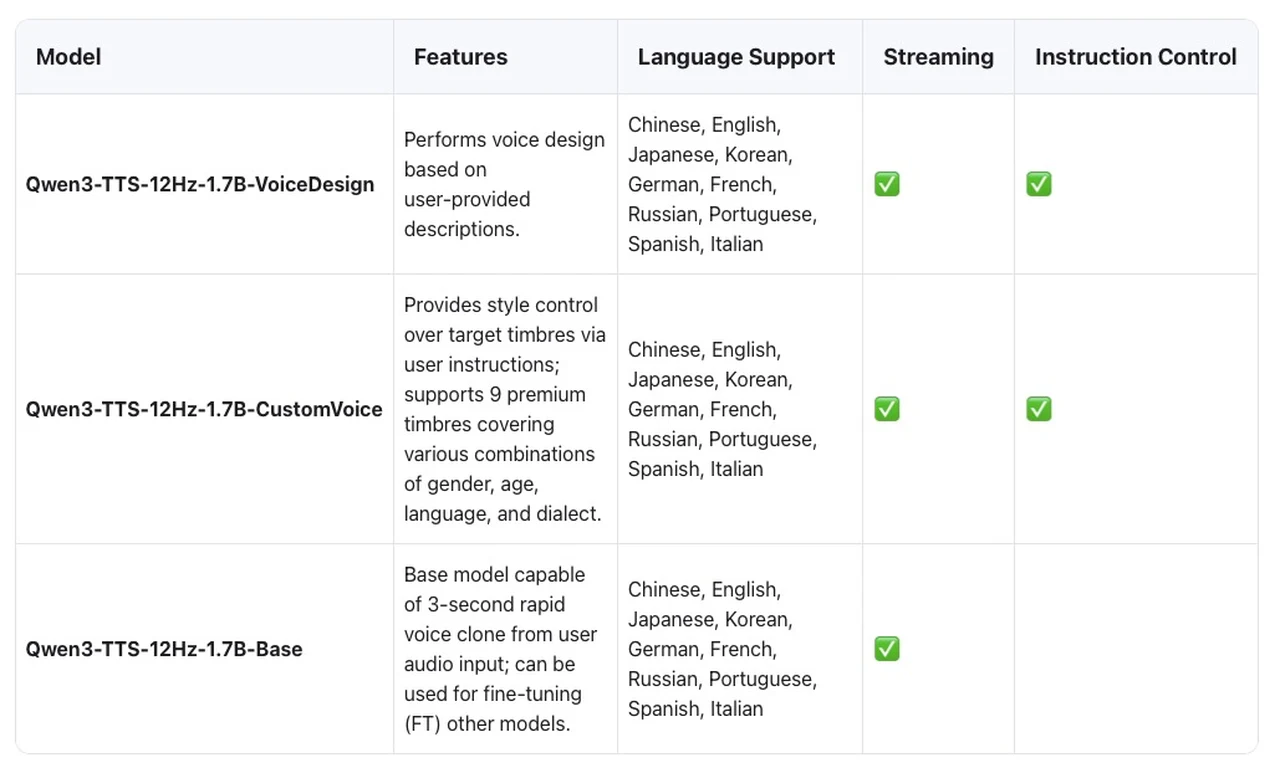
- Two model configurations are available: a lightweight 0.6B model for efficiency and a 1.7B model with enhanced customization, allowing tailored outputs and creative flexibility.
- Support for 10 languages, 9 dialects, and 49 tambas ensures native accents and authentic pronunciation, promoting inclusivity and global applications.
- Key features include voice cloning with minimal samples, emotional and stylistic variations, and support for complex text inputs like multilingual code-switching and long-form narratives.
- Real-world applications span multilingual voiceovers, personalized voice assistants, creative projects, and inclusivity for underrepresented languages, with potential for future edge computing and omni-modal AI integration.
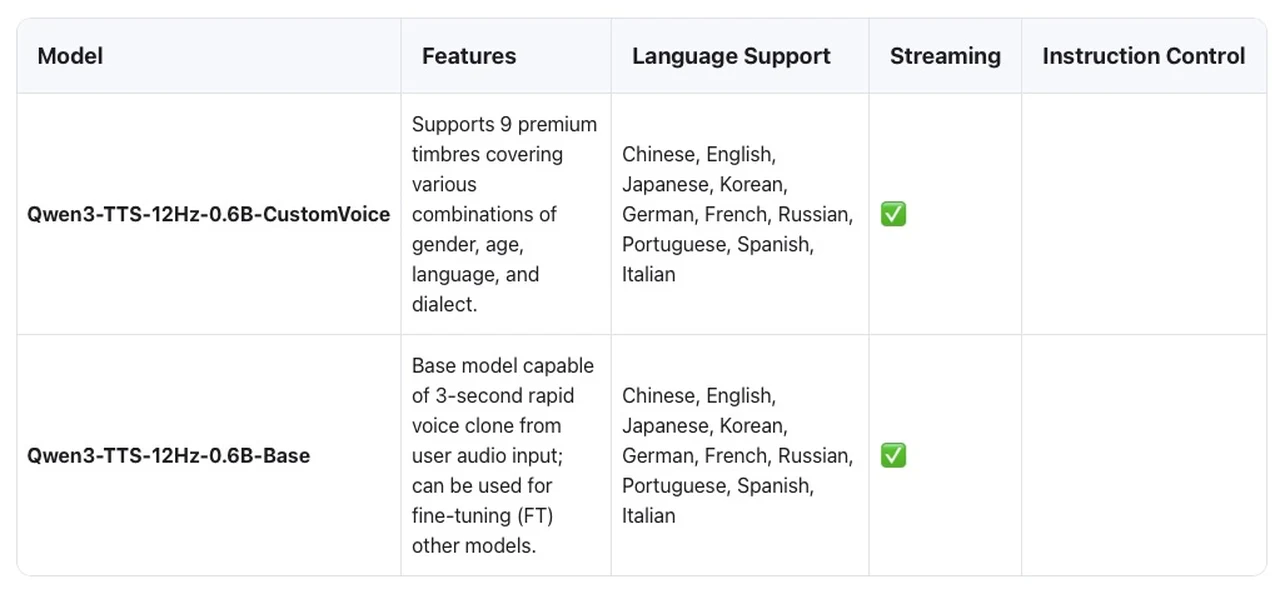
The Qwen 3 TTS models are available in two configurations, catering to diverse needs:
- A lightweight 0.6B model designed for efficient performance and lower computational requirements.
- A more advanced 1.7B model offering enhanced customization capabilities, including instruction control for tailored outputs.
By offering these models as open source, the developers remove licensing barriers, allowing you to explore and implement innovative TTS technology without restrictions. This accessibility encourages creativity and allows businesses, researchers, and hobbyists to use the models for various applications.
Multilingual Capabilities and Dialect Support
One of the standout features of Qwen 3 TTS is its ability to generate speech in 10 languages, 9 dialects, and 49 tambas. This extensive multilingual support ensures that you can produce speech with native accents and authentic pronunciation, making it ideal for global applications. Whether you’re creating multilingual voiceovers, developing educational tools, or producing content for diverse audiences, the model’s linguistic versatility is a significant advantage. This capability also promotes inclusivity by allowing the representation of underrepresented languages and dialects in voice technology.

Voice Cloning and Customization
Qwen 3 TTS excels in voice cloning, allowing you to replicate voices using just a few audio samples. This streamlined process eliminates the need for extensive fine-tuning, making it accessible even for those without technical expertise. Additionally, the voice design feature enables you to describe specific characteristics, such as tone, style, or emotion, and generate a custom voice tailored to your needs. This functionality is particularly valuable for:
- Creating personalized voice assistants with distinct personalities.
- Designing unique characters for creative projects like animations or video games.
- Developing branded audio content for marketing and advertising purposes.
The ability to craft voices that align with specific requirements enhances the creative potential of the technology.
Advanced Features for Complex Applications
The Qwen models are equipped to handle complex text inputs and scenarios, making them suitable for a wide range of applications. Key features include:
- Support for symbols and multilingual code-switching, making sure accurate pronunciation in mixed-language contexts.
- Capabilities for long-form text generation, allowing the creation of detailed narratives or audiobooks.
- Batch processing for generating multiple outputs simultaneously, improving efficiency for large-scale projects.
Additionally, the models allow for emotional and stylistic variations, such as whispering, dramatic tones, or cheerful expressions, adding depth and realism to the generated speech. These features make the Qwen 3 TTS models a versatile tool for industries ranging from entertainment to education.
Qwen TTS AI Model – Clone Any Voice for Free

Uncover more insights about Qwen AI in previous articles we have written.
- New Alibaba Qwen 2.5 AI Models Outperform Llama 3.1 405B
- Qwen 3 Code : 2,000 Free AI Runs Daily for Developers
- Qwen 3 Open Source Hybrid AI Beats Deepseek R1 : Performance
- Qwen 2 impressive LLM and AI coding assistant
- How QWEN 3 Coder Outperforms GPT-4.1 in AI Coding
- Exploring the Power of Small LLM AI Models Like Qwen 3
- Qwen 3 Coder vs GPT-4.1: Why Developers Are Making the Switch
- Qwen 3 vs Kimi K2 : AI Model Precision vs Versatility, Who Wins
- Qwen 3 vs GPT-4.1: How Alibaba’s AI is Changing the Game
- ChatGPT 5 vs Claude vs Qwen : Best AI Models for App Dev in 2025
Technical Innovations Behind Qwen 3 TTS
The Qwen models use advanced technical methodologies to deliver high-quality results. These innovations include:
- End-to-end training, which ensures seamless integration of components for optimal performance and natural-sounding speech.
- Enhanced tokenization and codebooks, improving phonetic accuracy and allowing the generation of more realistic voices.
These advancements simplify the user experience, making the models accessible even to those with limited technical expertise while maintaining professional-grade output. The combination of innovative technology and user-friendly design positions Qwen 3 TTS as a leader in the TTS domain.
Accessibility and Practical Usability
As an open source technology, the Qwen 3 TTS models are freely available for experimentation and customization. You can access demos and collaborative notebooks on platforms like Hugging Face, allowing you to explore the models’ capabilities firsthand. This accessibility fosters innovation by allowing developers, researchers, and hobbyists to experiment with and refine the technology. Whether you’re building a prototype, conducting academic research, or pursuing a creative project, the Qwen models provide the tools to bring your ideas to life.
Real-World Applications
The versatility of the Qwen models opens the door to a wide array of practical applications. These include:
- Producing multilingual voiceovers for global audiences, enhancing accessibility and engagement.
- Developing personalized voice assistants with unique characteristics, improving user interaction and satisfaction.
- Designing custom voices for creative projects, such as animated characters, audiobooks, or video games.
- Fine-tuning TTS systems for underrepresented languages and dialects, promoting inclusivity in voice technology.
These applications highlight the potential of Qwen 3 TTS to transform industries and redefine how we interact with voice technology.
Future Directions in TTS Technology
The future of Qwen 3 TTS holds exciting possibilities. Smaller, on-device versions of the models could enable edge computing applications, such as offline voice assistants or real-time speech synthesis on mobile devices. Additionally, integrating TTS with other AI capabilities, such as natural language understanding or image recognition—could lead to omni-modal systems that redefine human-computer interaction. These advancements would not only enhance the functionality of TTS systems but also expand their potential applications across various domains.
By making these advanced tools freely available, the Qwen 3 TTS models empower you to explore, innovate, and shape the future of voice synthesis. Whether you’re a developer, researcher, or creative professional, the possibilities are vast, offering new opportunities to push the boundaries of what text-to-speech technology can achieve.
Media Credit: Sam Witteveen
Disclosure: Some of our articles include affiliate links. If you buy something through one of these links, Geeky Gadgets may earn an affiliate commission. Learn about our Disclosure Policy.
