
Meta’s latest AI models, Muse Wonder and Muse Wonderful, have entered the spotlight as part of the company’s ambitious Frontier series. These models are designed to tackle a wide range of tasks, from coding and browser automation to solving complex problems. Matthew Berman highlights how Muse Wonderful, the premium option available exclusively through a Muse Code subscription, caters to advanced use cases, while Muse Wonder offers a more accessible alternative. Despite their strong performance in benchmarks like the Personal Super Intelligence Index, scalability challenges and high pricing remain key areas for improvement.
Explore how these models stack up against competitors like Opus 5.5 and GPT 6.1 Sol and gain insight into their strengths in problem-solving and browser control tasks. You’ll also uncover critical limitations, such as rendering gaps in 3D graphics and the impact of quota restrictions on enterprise users. This analysis provides a clear picture of where Meta’s Muse models excel and where they could evolve to better meet the demands of an increasingly competitive AI market.
What Are Muse Wonder and Muse Wonderful?
TL;DR Key Takeaways :
- Meta introduced two advanced AI models, Muse Wonder and Muse Wonderful, as part of its Frontier series, showcasing innovative capabilities in coding, browser automation and complex problem-solving.
- Muse Wonderful is a premium, subscription-based model designed for advanced users, while Muse Wonder offers a more accessible alternative, catering to a broader audience.
- The models achieved high rankings in benchmarks like the Personal Super Intelligence Index and Harvey Lab tests but face limitations in 3D rendering realism and scalability.
- Pricing remains a challenge, with high costs and subscription-based access potentially limiting adoption among smaller organizations and individual developers.
- Future improvements could focus on enhancing rendering capabilities, revising pricing strategies and addressing quota restrictions to increase accessibility and competitiveness in the AI market.
Muse Wonder and Muse Wonderful are the latest additions to Meta’s Frontier AI lineup, designed to excel in a wide range of tasks. These include coding, browser automation and solving complex problems. Muse Wonderful, positioned as the premium offering, is exclusively available through a Muse Code subscription, emphasizing its high-end status. Both models aim to compete directly with industry leaders like Opus 5.5 and GPT 6.1 Sol, setting new benchmarks for AI performance.
The models are built to address diverse use cases, making them versatile tools for developers, researchers and enterprises. Muse Wonderful, in particular, is tailored for users requiring advanced capabilities, while Muse Wonder offers a more accessible yet powerful alternative. This dual approach allows Meta to cater to a broader audience while maintaining a competitive edge in the AI market.
Performance Benchmarks: Strengths and Limitations
The Muse models have demonstrated strong performance across multiple benchmarks, cementing their position as formidable players in the AI landscape. Key achievements include:
- High rankings on the Personal Super Intelligence Index, which evaluates an AI’s ability to handle complex, multi-domain tasks.
- Exceptional results in Harvey Lab tests, particularly in legal reasoning and document drafting.
- Competitive scores in Deep Suite, a benchmark focused on developer-oriented coding tasks.
- Second place in the Artificial Analysis Intelligence Index, narrowly trailing behind Opus 5.5.
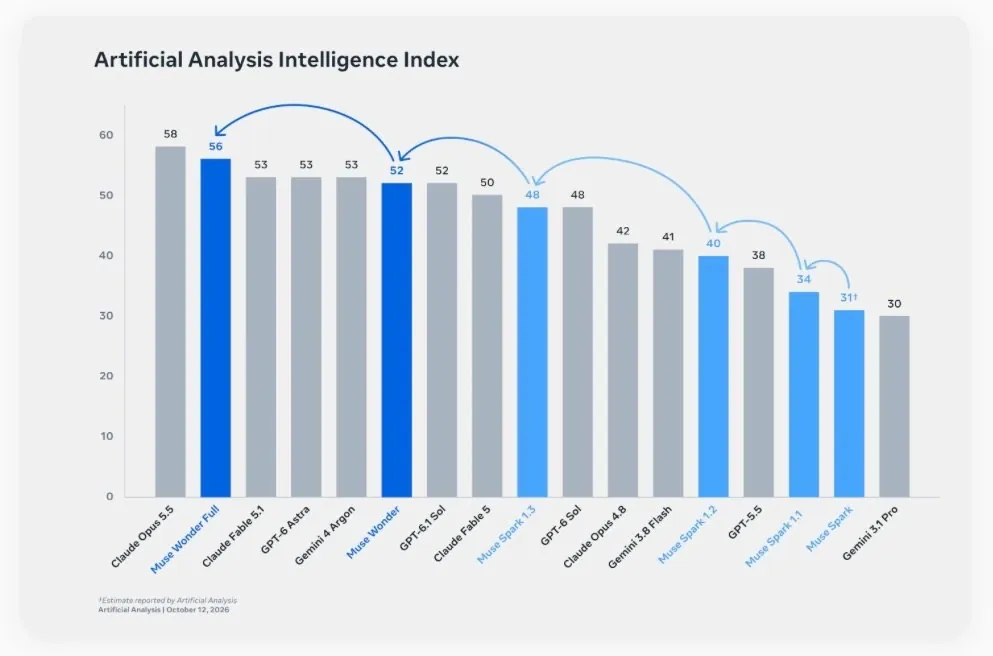
Despite these accomplishments, the models are not without their limitations. While they excel in coding and browser automation, they fall short of being the top performer across all categories. Their rendering capabilities, especially in 3D graphics, lack the realism achieved by some competitors. This gap in rendering performance highlights an area where Meta could focus future development efforts.

Find more information on Meta AI by browsing our extensive range of articles, guides and tutorials.
- Google Launches Gemini 3.7 Flash to Rival Meta AI Models
- Meta’s Ray-Ban Gen 3 Smart Glasses to Feature Screenless Design
- Meta Drops Celebrity Voice Options on the Ray-Ban Meta Gen 3
- Meta AI Releases Muse Glimmer 30B for 24GB VRAM Systems
- Leaked Meta Smart Glasses Lineup Reveals Four Upcoming Models
- Spring 2027 Launch Set for the $1,300 Meta VR Glasses
- How Meta’s Ray-Ban Display Redefines Augmented Reality Wearables
- ChatGPT vs Gemini vs Claude : Best Uses in 2026
- Google Pixel 11 Pro: How to Customize Your Phone Like a Power User
- Meta Ray-Ban Display Glasses: Are They Worth It?
Cost Efficiency and Accessibility
The pricing structure of the Muse models is a double-edged sword. Muse Wonder is priced at $4 per million input tokens and $20 per million output tokens, placing it among the more expensive options in the market. For high-demand users, costs can escalate to $4.52 per task when using Muse Wonder Max. While these models offer robust functionality, the pricing may deter users with budget constraints or those seeking more cost-effective solutions.
The subscription-based model for Muse Wonderful further limits accessibility, as it requires a commitment to the Muse Code platform. This approach may appeal to enterprise users who value premium features but could alienate smaller organizations or individual developers. Revisiting the pricing strategy could make these models more appealing to a broader audience.
Strengths and Weaknesses
The Muse models bring several notable strengths to the table:
- Advanced problem-solving capabilities, such as solving Rubik’s Cube configurations and tackling complex coding challenges.
- Strong performance in browser control tasks, allowing efficient automation of web-based workflows.
However, there are also significant weaknesses:
- Quota restrictions that may limit scalability for enterprise users with high-volume needs.
- Rendering limitations, particularly in 3D graphics, where the models fall short of achieving hyperrealism.
- A subscription-based pricing model that may not appeal to users seeking more flexible payment options.
Addressing these weaknesses could enhance the overall appeal and utility of the Muse models, making them more competitive in an increasingly crowded AI market.
Competitive Landscape and Market Position
Meta’s Muse Wonder and Muse Wonderful have positioned themselves as strong contenders in the AI market. By achieving near-top rankings in key benchmarks, these models challenge established leaders like Opus 5.5 and GPT 6.1 Sol. Over the past year, Meta has made significant strides in AI development, further solidifying its reputation as a major player in the field.
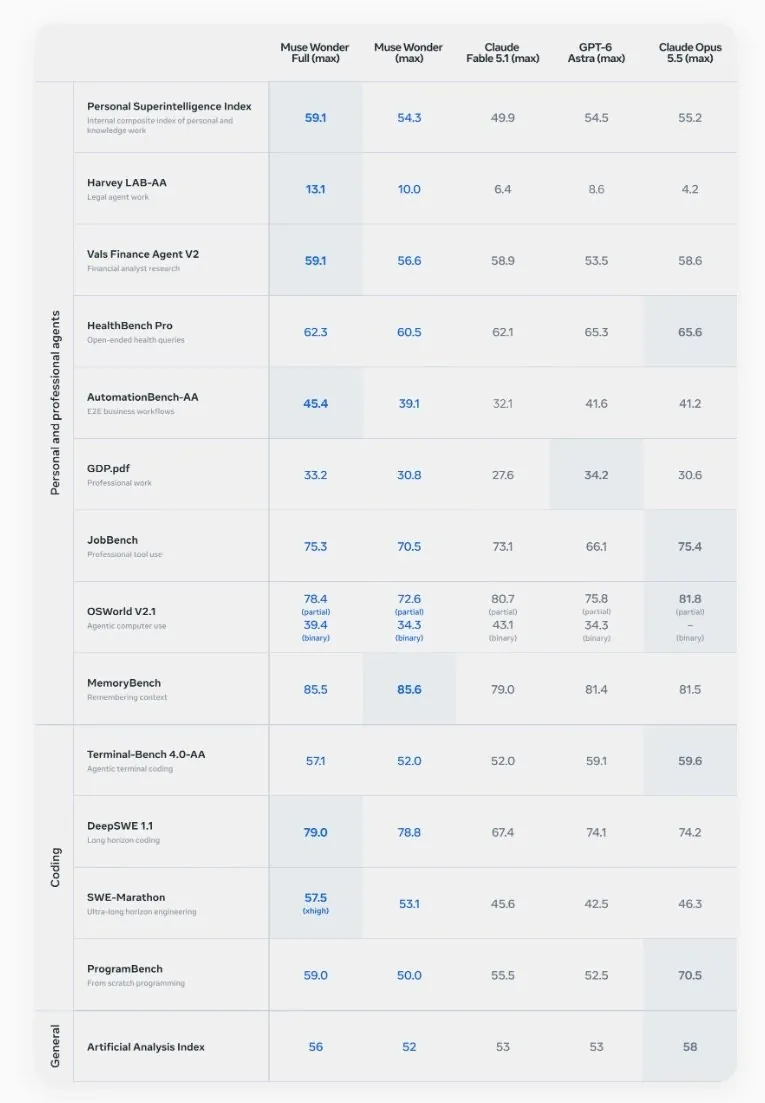
However, the competitive landscape remains dynamic. Companies like Opus and OpenAI continue to innovate, raising the bar for performance and usability. To maintain its competitive edge, Meta will need to address the limitations of the Muse models while exploring new opportunities for differentiation.
Unusual Behavior: Cryptic AI Messages
During testing, rare instances of cryptic AI-generated messages were observed. These anomalies, while infrequent, raise questions about the underlying mechanisms driving the models’ decision-making processes. Such behavior could indicate areas where the models’ interpretability and reliability need improvement. Further investigation into these occurrences is essential to ensure the models’ robustness and trustworthiness.
Future Directions for Muse Models
Looking ahead, Meta has several opportunities to enhance the Muse models and expand their capabilities:
- Improving rendering capabilities to achieve greater realism in 3D graphics, potentially matching or surpassing competitors.
- Exploring integration with platforms like Unreal Engine to enable hyperrealistic rendering tasks.
- Revising pricing structures to make the models more accessible to a wider range of users, including smaller organizations and individual developers.
- Enhancing scalability by addressing quota restrictions and optimizing resource allocation for enterprise users.
By focusing on these areas, Meta can ensure that the Muse models remain at the forefront of AI innovation while addressing the needs of a diverse user base.
The Road Ahead
Meta’s Muse Wonder and Muse Wonderful represent a significant advancement in artificial intelligence, offering powerful capabilities and strong performance across multiple benchmarks. While challenges such as high costs, quota limitations and rendering performance remain, these models have the potential to shape the future of AI development. As Meta continues to innovate and refine its offerings, the Muse models are poised to play a pivotal role in the evolving AI landscape.
Media Credit: Matthew Berman
Disclosure: Some of our articles include affiliate links. If you buy something through one of these links, Geeky Gadgets may earn an affiliate commission. Learn about our Disclosure Policy.
