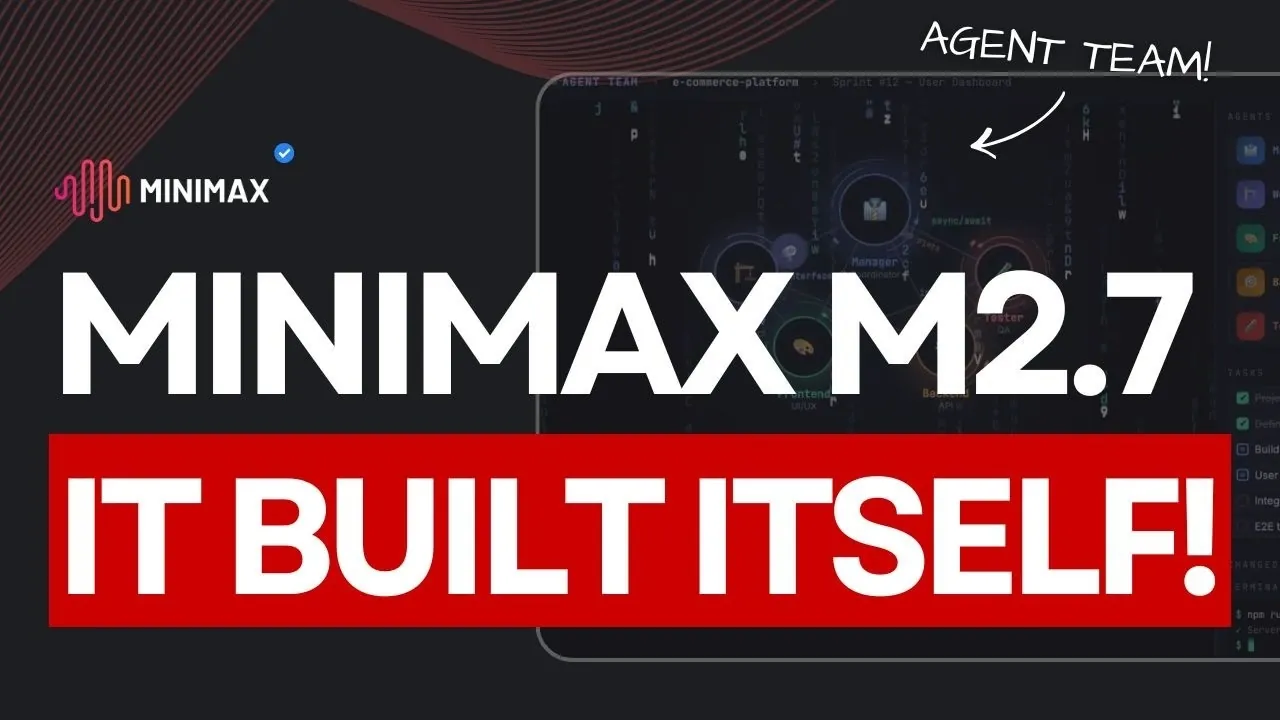
Self-evolving AI is no longer a distant concept, as demonstrated by MiniMax M2.7’s remarkable ability to improve itself without human input. By using iterative self-assessment cycles, this model identifies areas for refinement and implements changes autonomously, excelling in tasks like coding and system problem-solving. Universe of AI highlights how MiniMax M2.7 also introduces “agent teams,” allowing multiple AI agents to collaborate on complex challenges, such as optimizing workflows or competing in machine learning scenarios. This capability is further showcased in the Open Room demo, where users can observe these agents adapting and working together in real time.
Explore how Google’s revamped design platforms, including vibe coding and design.md, are streamlining creative workflows and learn about Anthropic’s Claude Co-work feature, which simplifies remote task execution across devices. You’ll also gain insight into Mistral Small 4’s unified AI model, which consolidates diverse functionalities into a single system for efficient performance. These advancements collectively highlight the expanding role of AI in fostering collaboration, enhancing productivity and addressing complex challenges across industries.
MiniMax M2.7: The Self-Evolving AI
TL;DR Key Takeaways :
- MiniMax M2.7: A self-evolving AI model capable of autonomous improvement, collaboration in multi-agent environments and practical applications across industries like coding and enterprise management.
- Google’s AI Design Tools: Enhanced tools like Stitch AI Design Canvas and design.md streamline UI/UX workflows, allowing intuitive design exploration and efficient transitions from concepts to functional code.
- Anthropic’s Claude Co-work: A feature for seamless remote task execution across devices, prioritizing data security while automating time-consuming tasks to boost productivity.
- Mistral Small 4: A unified AI model integrating reasoning, vision, coding and chat into a compact, open source system that balances versatility, efficiency and cost-effectiveness.
- AI Trends: These innovations reflect a shift toward autonomous systems, integrated workflows and user-centric tools that enhance productivity, creativity and operational efficiency.
MiniMax M2.7 represents a new step in AI autonomy with its ability to evolve independently. Through iterative cycles of self-assessment and optimization, this model identifies weaknesses, refines its processes and implements improvements, all without requiring human intervention. This self-evolving mechanism allows M2.7 to excel in diverse areas such as coding, system-level problem-solving and professional office tasks.
A defining feature of M2.7 is its innovative “agent teams,” where multiple AI agents collaborate to make decisions in complex, multi-agent environments. These teams are capable of addressing challenges such as machine learning competitions or optimizing workflows in professional settings. To showcase its versatility, MiniMax has introduced Open Room, an interactive demo where users can observe character agents in action, demonstrating the model’s ability to adapt and collaborate effectively.
By automating self-improvement and fostering teamwork among AI agents, MiniMax M2.7 sets a new standard for autonomous systems, offering practical applications across industries ranging from software development to enterprise management.
Google’s AI Design Tools: Creativity Meets Efficiency
Google has reimagined its AI design tools to enhance creativity and efficiency in UI/UX workflows. The Stitch AI Design Canvas has been transformed into an AI-native platform, introducing “vibe coding,” a feature that enables intuitive and interactive design exploration. With vibe coding, you can experiment with multiple design directions simultaneously, even using voice commands for hands-free input, making the design process more dynamic and accessible.
Another standout innovation is design.md, a portable design framework that simplifies rapid prototyping. Integrated with AI Studio, this framework facilitates smooth transitions from design concepts to functional code, reducing the time and effort required for development. Additionally, updates to the Gemini API now allow developers to combine tools like Google Search and Maps with custom functions in a single call, streamlining complex operations and improving overall productivity.
These enhancements empower developers and designers to create more efficiently, using AI-driven platforms to explore creative possibilities while maintaining precision and control over their workflows.
Take a look at other insightful guides from our broad collection that might capture your interest in AI models.
- Which Claude 3 AI model is best? All three compared and tested
- 12 Research Papers, 6 Years : The AI Industry Explained
- NVIDIA Open AI Models Released at CES 2026 & Faster Platform
- Run Local AI Models on Your PC or Mac for Coding, Study & More
- Midjourney V7 Default Style Realism Example.Webp
- AI actors advanced AI video creation and 3D AI models
- How Encord Simplifies AI Training with Fine Tuning Tools
- Stability AI unveils TripoSR AI image to 3D model generator
- Model Collapse in AI: Why Training on Synthetic Text Degrades Quality
- Agent Zero : Private Local AI Agent with Docker & Terminal Access
Anthropic’s Claude Co-work: Remote Task Execution Made Simple
Anthropic has introduced Claude Co-work, a feature designed to simplify remote task execution and enhance collaboration across devices. This tool allows you to delegate desktop tasks via mobile messaging, making sure seamless integration between devices while prioritizing data security. Tasks are executed locally with user-approved access, maintaining a high level of privacy and control.
Claude Co-work excels in automating background tasks such as summarizing lengthy documents, organizing files, or managing schedules. By handling these time-consuming activities, it enables you to focus on higher-priority responsibilities, improving overall productivity. Its emphasis on security and efficiency makes it particularly valuable for professionals navigating remote workflows or managing distributed teams.
This feature demonstrates how AI can bridge the gap between devices and streamline remote operations, offering practical solutions for modern work environments.
Mistral Small 4: A Unified AI Model
Mistral Small 4 introduces a consolidated AI model that integrates multiple functionalities, reasoning, vision, coding and chat, into a single, efficient system. This unified approach eliminates the need for multiple specialized models, providing a streamlined solution for diverse tasks while reducing complexity.
One of the model’s key features is configurable reasoning, which allows you to adjust computational effort based on the complexity of the task. This adaptability ensures optimal performance across a wide range of applications. Despite its compact size, Mistral Small 4 matches or exceeds the performance of larger models on various benchmarks, offering a cost-effective alternative for enterprises. The model is fully open source, allowing developers to customize and deploy it in self-hosted environments, provided they have access to enterprise-grade hardware.
By combining versatility, efficiency and accessibility, Mistral Small 4 demonstrates the potential of unified AI systems to address diverse challenges without compromising performance.
Key Takeaways
The advancements discussed here reflect a broader trend toward autonomous AI systems, integrated workflows and user-centric tools that enhance productivity and innovation.
- MiniMax M2.7 showcases the potential of self-evolving AI to operate independently, improve over time and collaborate effectively in complex environments.
- Google’s AI design tools empower developers and designers with intuitive, AI-driven platforms that streamline creative workflows and accelerate development processes.
- Anthropic’s Claude Co-work simplifies remote task execution, allowing seamless collaboration across devices while prioritizing data security and efficiency.
- Mistral Small 4 highlights the value of unified AI models, offering a versatile and cost-effective solution for diverse applications.
These innovations illustrate how AI is evolving to meet the demands of modern industries, providing tools and systems that enhance efficiency, reduce costs and foster creativity. As AI continues to advance, its ability to adapt and integrate into various workflows will shape the future of technology, unlocking new opportunities for growth and transformation.
Media Credit: Universe of AI
Disclosure: Some of our articles include affiliate links. If you buy something through one of these links, Geeky Gadgets may earn an affiliate commission. Learn about our Disclosure Policy.
