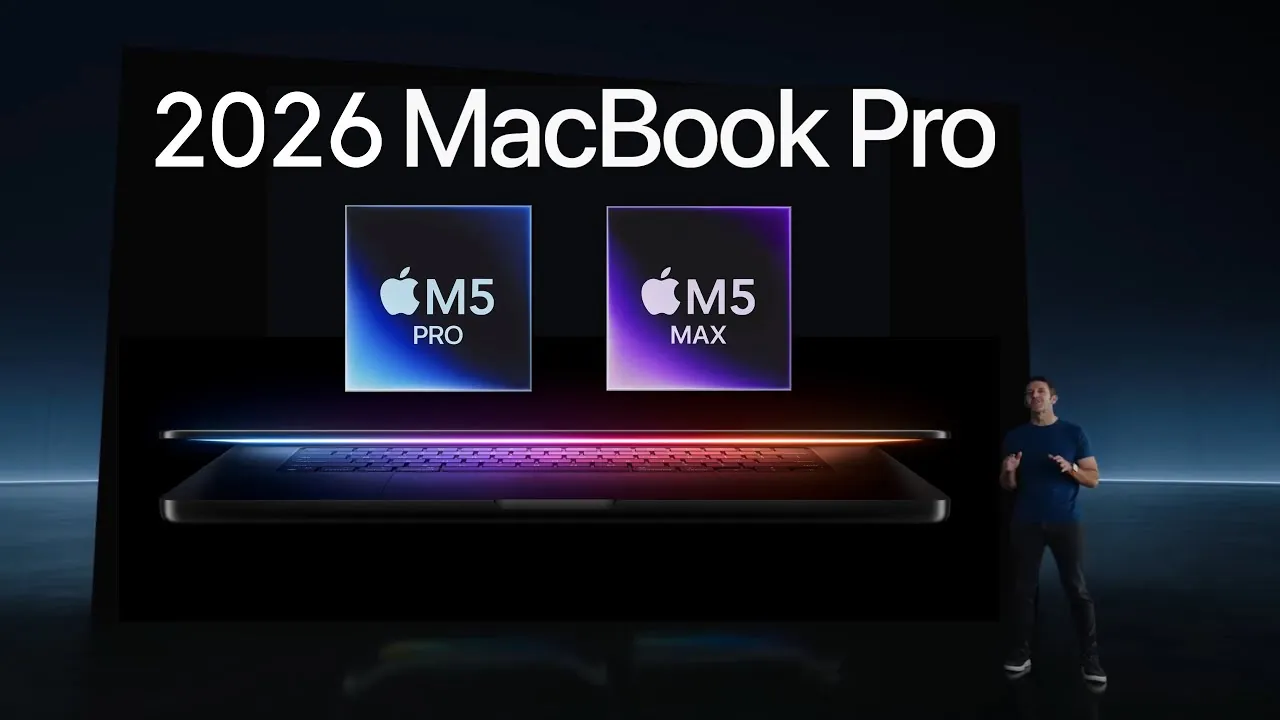
Apple is preparing to unveil its latest MacBook Pro models, featuring the highly anticipated M5 Pro and M5 Max chipsets. These new additions to Apple’s silicon lineup represent a significant step forward in the company’s hardware strategy, offering targeted performance enhancements and a glimpse into the future of Apple’s computing ecosystem. The launch comes at a carefully chosen moment, coinciding with other major announcements, including the release of the Creator Studio software bundle and Apple’s quarterly earnings report. This strategic timing underscores Apple’s ability to align product innovation with its broader business objectives. The video below from SaranByte gives us more details on what Apple has planned.

Key Dates and Strategic Timing
The official unveiling of the M5 Pro and M5 Max MacBook Pros is set to take place during Apple’s “Apple Experience” event in Los Angeles, scheduled from January 27–29, 2026. This event is poised to be a focal point for Apple’s latest innovations, with key dates including:
- January 28: Launch of the Creator Studio software bundle, designed to complement the M5 series’ capabilities.
- January 29: Apple’s quarterly earnings announcement, highlighting the company’s financial performance and market strategy.
The timing of this launch is no coincidence. Apple has a well-documented history of synchronizing product releases with earnings calls to emphasize its technological advancements alongside its financial achievements. Additionally, recent shipping delays for high-end M4 Max MacBook Pro configurations suggest Apple is clearing inventory to make room for the new models. While the base 14-inch MacBook Pro with the standard M5 chip was quietly updated in October 2025, the M5 Pro and M5 Max variants are expected to deliver more substantial upgrades, particularly for professional users.
What’s New: Modular Chip Architecture
A defining feature of the new MacBook Pro models is the introduction of the M5 Pro and M5 Max chips, which are rumored to incorporate a modular chip architecture. This innovative design could allow users to configure CPU and GPU components independently, offering greater flexibility for professionals with specific performance requirements.
While the external design, display technology, and port configurations are expected to remain largely consistent with previous models, the internal upgrades signal a shift in Apple’s approach to silicon development. The modular architecture is particularly significant for professionals in fields such as:
- Video editing: Enhanced rendering speeds and smoother workflows.
- Music production: Improved processing for complex audio projects.
- Graphic design: Faster performance for demanding design software.
This approach highlights Apple’s commitment to addressing the needs of creative professionals who rely on high-performance computing. By offering customizable hardware configurations, Apple is positioning itself as a leader in professional-grade computing solutions.
Performance Gains: Incremental but Targeted
The M5 Pro and M5 Max chips are expected to deliver incremental yet meaningful performance improvements over their predecessors. These enhancements are designed to cater to users running resource-intensive applications, such as video editing software, 3D modeling tools, and digital audio workstations.
For instance, the newly announced Creator Studio software bundle is optimized to use the full potential of the M5 series, providing tools tailored for creative workflows. However, for users already equipped with recent M1, M2, M3, or M4 Pro/Max models, the performance gains may feel more evolutionary than innovative. While the updates are significant, they are unlikely to drastically alter the experience for those already familiar with Apple’s advanced silicon technology.
The M5 Pro and M5 Max chips are also expected to improve energy efficiency, potentially extending battery life for users who rely on their MacBook Pros for long hours of work. This combination of performance and efficiency reflects Apple’s ongoing efforts to refine its hardware offerings without compromising on usability.
Looking Ahead: A Transitional Phase
The M5 Pro and M5 Max MacBook Pros represent more than just incremental upgrades—they mark a transitional phase in Apple’s broader hardware evolution. Industry rumors suggest that larger changes, such as OLED displays, touchscreen support, and thinner designs, are on the horizon for late 2026 and beyond. These advancements, coupled with the anticipated M6 chip, could redefine the MacBook Pro lineup in the coming years.
For now, the M5 Pro and M5 Max generation serves as a bridge between Apple’s current offerings and its future innovations. By introducing modular architecture and focusing on targeted performance improvements, Apple is laying the groundwork for more significant developments. This transitional phase reflects the company’s strategic approach to balancing immediate enhancements with long-term vision, making sure that its products remain competitive in a rapidly evolving market.
As Apple continues to refine its silicon technology, the M5 Pro and M5 Max models stand as a testament to the company’s commitment to innovation. These devices not only address the needs of today’s professionals but also pave the way for the next generation of computing solutions.
Take a look at other insightful guides from our broad collection that might capture your interest in M5 Pro and M5 Max chips.
- NEW MacBook Pro M5 Pro & M5 Max LEAKS REVEALED
- 2026 MacBook Pro Rumors: M5 Pro & M5 Max Updates Explained
- MacBook Pro M5 Pro Release Date, Specs, and Pricing Details
- Apple M5 Pro and M5 Max MacBook Pros: Release Date
- Apple’s M5 Pro & M5 Max MacBook Pros: Coming Next Week
Source & Image Credit: SaranByte
Disclosure: Some of our articles include affiliate links. If you buy something through one of these links, Geeky Gadgets may earn an affiliate commission. Learn about our Disclosure Policy.
