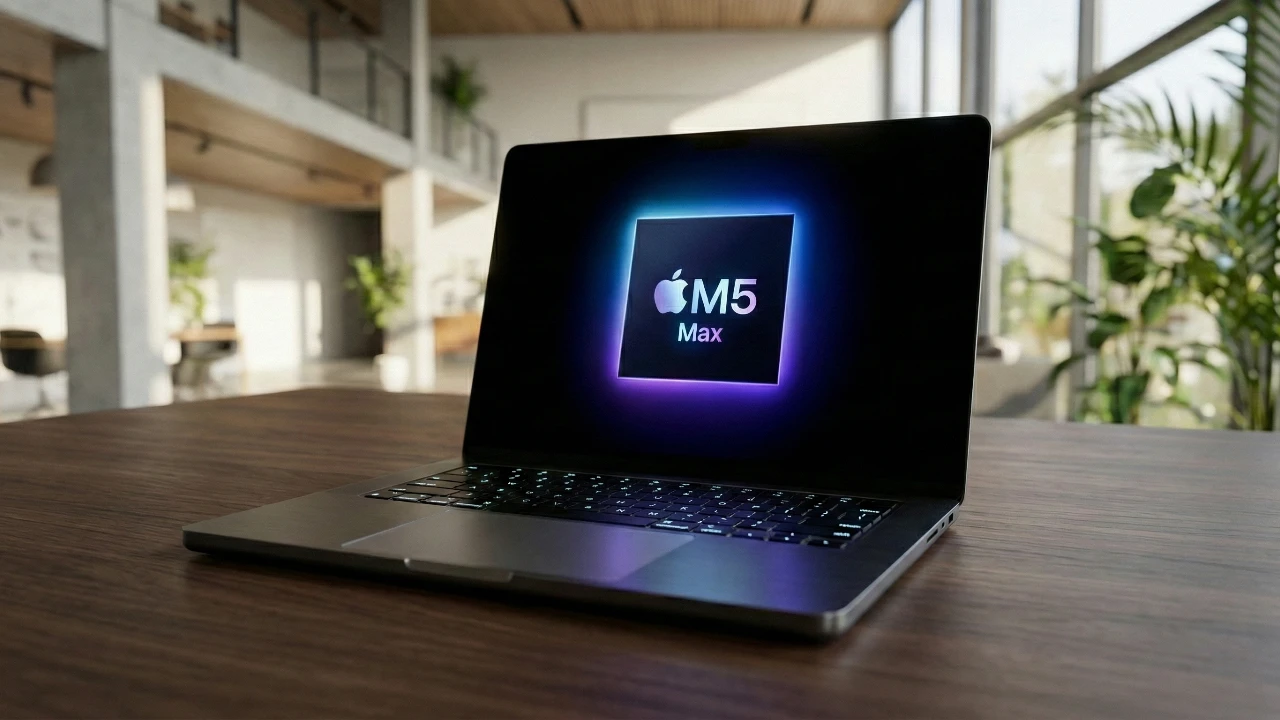
Apple’s upcoming MacBook Pro refresh is set to deliver a significant leap in performance, driven by the new M5 Pro and M5 Max chipsets. At the same time, the external design of the 14-inch and 16-inch models remains consistent with the 2021 versions, and the internal upgrades promise to redefine expectations for both CPU and GPU performance. This release is expected to be the final iteration of the current MacBook Pro design before Apple transitions to OLED displays with the anticipated M6 series. The video below from
Matt Talks Tech gives us more details about the new MacBook Pro models.

Refined Design with Mini-LED Displays
The design of the new MacBook Pro models remains largely unchanged from the 2021 versions, continuing Apple’s focus on mini-LED display technology. This display type is known for its vivid colors, high contrast, and excellent brightness, making it a favorite among professionals and creatives. While there has been speculation about the introduction of a new color option, it appears unlikely for this release.
The mini-LED displays remain a strong feature for users who prioritize visual accuracy, particularly in fields like video editing, photography, and graphic design. However, the next major design shift is expected with the M6 series, which is rumored to feature OLED displays that promise even better contrast and energy efficiency.
M5 Pro Chipset: A Powerful Upgrade for Professionals
The M5 Pro chipset is engineered to handle demanding workloads with ease, offering substantial performance improvements over its predecessors. It is designed to cater to professionals who require high levels of processing power for their work. Key performance metrics include:
- Single-Core Performance: Predicted to reach approximately 4,133, offering a meaningful boost for tasks that rely on high clock speeds, such as software compilation and data processing.
- Multi-Core Performance: Expected scores of 25,700 for binned models and 29,700 for unbinned versions represent a significant improvement, more than doubling the performance of the M1 Pro.
- GPU Power: With scores of 142,000 for binned models and 158,000 for unbinned ones, the M5 Pro delivers over a 50% improvement compared to the M4 Pro, making it ideal for graphics-intensive tasks like 3D rendering and video editing.
These advancements make the M5 Pro an excellent choice for professionals in fields such as software development, data analysis, and creative media production. It ensures that users can handle complex workflows without compromising on speed or efficiency.
M5 Max Chipset: Unmatched Performance for Power Users
For users who require even greater performance, the M5 Max chipset pushes the boundaries of high-end computing. While its single-core performance is similar to the M5 Pro, its multi-core and GPU capabilities set it apart as a powerhouse for resource-intensive tasks. Key highlights include:
- Multi-Core Performance: Expected to exceed 30,000, nearly tripling the capabilities of the M1 Max. This makes it an ideal choice for tasks like scientific simulations, machine learning, and large-scale software development.
- GPU Performance: Scores of 219,000 for binned models and 256,000 for unbinned versions represent a 2.5x improvement over the M1 Max. This level of performance is particularly valuable for professionals working in video production, 3D modeling, and game development.
The M5 Max not only outperforms its predecessors but is also expected to surpass the M3 Ultra in raw CPU performance. This positions Apple as a leader in the high-performance laptop market, offering devices that cater to the most demanding professional and technical workloads.
Preparing for the OLED Transition
This refresh is likely the final iteration of the current MacBook Pro design cycle. Apple’s next major update, expected with the M6 series, is rumored to introduce OLED displays alongside a potential new design language. OLED technology is anticipated to bring improvements in contrast ratios, color accuracy, and power efficiency, further enhancing the MacBook Pro’s appeal to professionals.
Until the OLED transition occurs, the M5 Pro and M5 Max chipsets ensure that the current generation of MacBook Pro models remains competitive. These devices offer innovative performance, making them a compelling choice for users who need reliable and powerful tools for their work.
Why the M5 Pro and M5 Max Matter
The introduction of the M5 Pro and M5 Max chipsets represents a significant step forward in laptop performance, particularly for professionals and power users. These new models offer several key benefits:
- Enhanced Single-Core and Multi-Core Performance: Ideal for tasks like software development, data analysis, and scientific research, making sure faster processing and reduced wait times.
- Improved GPU Capabilities: Perfect for video editing, 3D rendering, and other graphics-intensive applications, providing smoother workflows and better results.
- Future-Proof Performance: With performance levels that surpass even the M3 Ultra, these devices are designed to remain relevant and powerful for years to come.
Whether you’re a creative professional, a software developer, or a technical expert, the M5 Pro and M5 Max chipsets offer the performance and reliability needed to tackle the most demanding tasks. As Apple prepares for the OLED era with the M6 series, this refresh ensures that the current generation of MacBook Pro models remains a top-tier option for high-performance computing.
Advance your skills in the MacBook Pro by reading more of our detailed content.
- M5 MacBook Pro OLED Details LEAKED! Insider Info You NEED
- OLED MacBook Pro 2026 – Design REVEALED 9 BIG LEAKS
- 2026 MacBook Pro Redesign: OLED Displays & More
- Everything We Know About the 2026 OLED MacBook Pro
- M5 MacBook Pro: Release Date, Price, and the OLED Display
Source & Image Credit: Matt Talks Tech
Disclosure: Some of our articles include affiliate links. If you buy something through one of these links, Geeky Gadgets may earn an affiliate commission. Learn about our Disclosure Policy.
