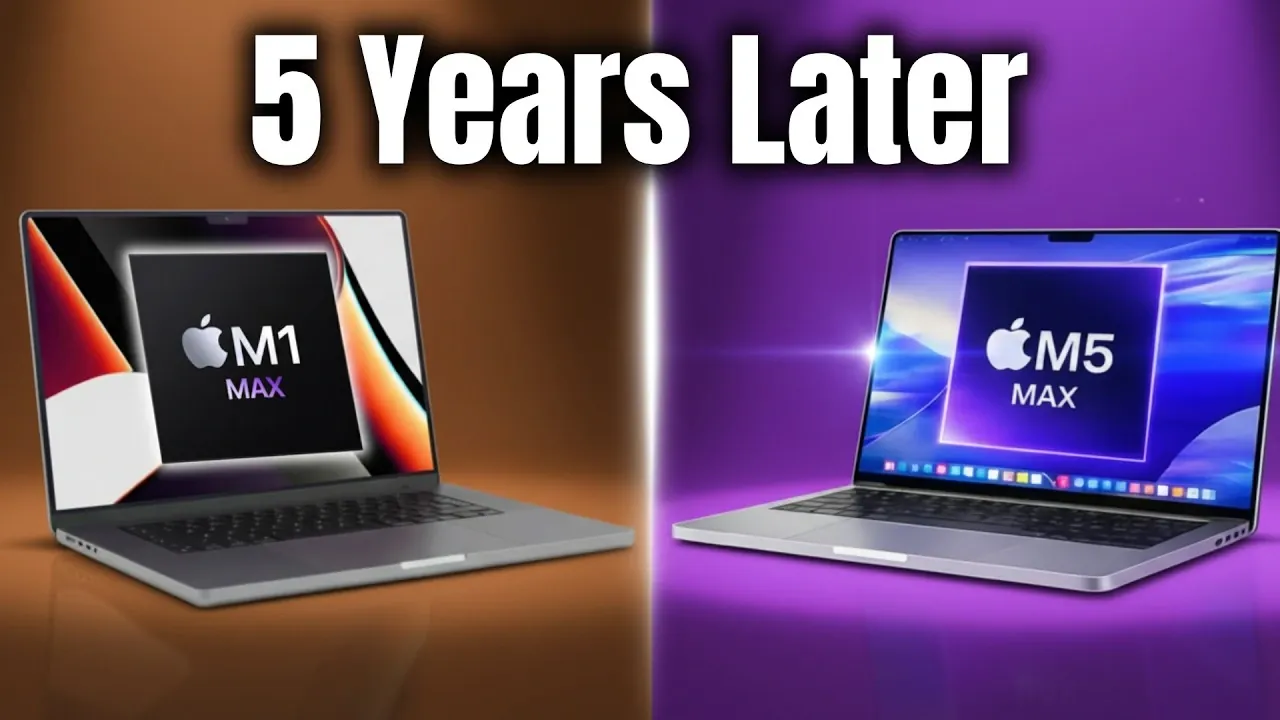
Apple’s M1 Max and M5 Max processors mark two pivotal moments in the evolution of high-performance computing. Released five years apart, these chips embody Apple’s commitment to innovation while adhering to a consistent design philosophy. But how substantial are the advancements between these two processors? The video below from Matt Talks Tech provides more insights into their performance, memory architecture, and design to determine whether the leap forward justifies an upgrade.

M1 Max: Setting a New Standard
The M1 Max, introduced in 2021, was a new achievement in Apple’s transition to custom silicon. Featuring a 10-core CPU, up to a 32-core GPU, 64GB of unified memory and 400GB/s memory bandwidth, it was designed to handle demanding workloads with ease. Its unified memory architecture allowed the CPU and GPU to share memory seamlessly, reducing latency and improving efficiency.
This processor quickly became a favorite among creative professionals and developers. Tasks like video editing, 3D rendering and software development were executed with remarkable speed and energy efficiency. The M1 Max also stood out for its quiet operation and portability, making it a versatile choice for professionals on the go. Even today, the M1 Max remains a capable performer, underscoring the forward-thinking engineering that defined its launch.
M5 Max: Pushing the Boundaries
Building on the foundation laid by the M1 Max, the M5 Max represents a significant leap forward. With an 18-core CPU, a 40-core GPU, 128GB of unified memory and 614GB/s memory bandwidth, the M5 Max nearly doubles the performance of its predecessor in many areas. Benchmarks such as Geekbench 6 highlight substantial gains in both single-core and multicore performance, cementing the M5 Max as a powerhouse for high-performance computing.
These enhancements translate into faster exports, smoother multitasking and improved handling of complex workflows. The GPU’s increased core count significantly boosts rendering speeds and performance in graphically intensive applications. Additionally, the M5 Max introduces incremental improvements in AI-related tasks, reflecting Apple’s growing emphasis on machine learning and artificial intelligence integration.
Performance Comparison: CPU, GPU and Memory
The performance gap between the M1 Max and M5 Max is most evident in their CPU, GPU and memory capabilities. Here’s a breakdown of how they compare:
- CPU: The M5 Max’s 18-core CPU delivers a significant boost in multicore tasks, making it ideal for resource-intensive workflows. Its improved single-core performance ensures faster responsiveness for everyday tasks.
- GPU: With a 40-core GPU, the M5 Max offers nearly double the graphical performance of the M1 Max, excelling in tasks like video editing, 3D modeling and motion graphics.
- Memory: Both processors use Apple’s unified memory architecture, but the M5 Max’s increased bandwidth (614GB/s vs. 400GB/s) and capacity (128GB vs. 64GB) make it better suited for memory-intensive applications, such as handling large datasets or running multiple demanding programs simultaneously.
These advancements make the M5 Max a compelling choice for professionals requiring top-tier performance. However, the M1 Max remains a strong contender for less demanding workflows, offering excellent value for its capabilities.
Design Consistency and Durability
While the internal hardware has undergone significant upgrades, Apple has retained the same external design for both models. The MacBook Pro’s aluminum chassis, high-resolution Retina display and robust keyboard remain unchanged, providing a familiar experience for users upgrading from the M1 Max. This consistency ensures that the focus remains on performance rather than aesthetics.
The longevity of the M1 Max is a testament to its robust engineering. Even as the M5 Max raises the bar, the M1 Max continues to deliver reliable performance for a wide range of professional tasks. This balance between innovation and durability highlights Apple’s commitment to creating products that stand the test of time.
Evaluating the Need to Upgrade
Deciding whether to upgrade from the M1 Max to the M5 Max depends on your specific needs and workflows. Here’s a guide to help you make an informed decision:
- Upgrade to the M5 Max: If your work involves intensive tasks such as 3D rendering, large-scale video editing, or running multiple demanding applications simultaneously, the M5 Max’s enhanced performance and expanded memory capacity make it a worthwhile investment.
- Stick with the M1 Max: If your current device handles your workload efficiently and you don’t require innovative performance, the M1 Max remains a reliable and capable option that continues to deliver excellent results.
Balancing Innovation and Longevity
The M1 Max and M5 Max exemplify Apple’s dual commitment to innovation and durability. The M5 Max pushes the boundaries of high-performance computing, offering significant upgrades for professionals who need them. Meanwhile, the M1 Max continues to prove its value, demonstrating that Apple’s products are designed to remain competitive over time.
Ultimately, the decision to upgrade depends on your specific requirements. Both processors highlight Apple’s ability to innovate while making sure that its products maintain their relevance, a balance that solidifies its position as a leader in high-performance computing.
Become an expert in M1 Max with the help of our in-depth articles and helpful guides.
- M5 Max Upgrade Guide: When to Buy vs Waiting for the M6 Max
- M5 Max vs M4/M3/M2/M1 Max: MacBook Pro Upgrade Guide
- M5 Max vs M4 Max MacBook Pro: 30% Faster
- 14 inch M1 Max MacBook Pro gets reviewed (Video)
- M4 Max vs M3 Max vs M1 Max: Which MacBook Pro ?
Source & Image Credit: Matt Talks Tech
Disclosure: Some of our articles include affiliate links. If you buy something through one of these links, Geeky Gadgets may earn an affiliate commission. Learn about our Disclosure Policy.
