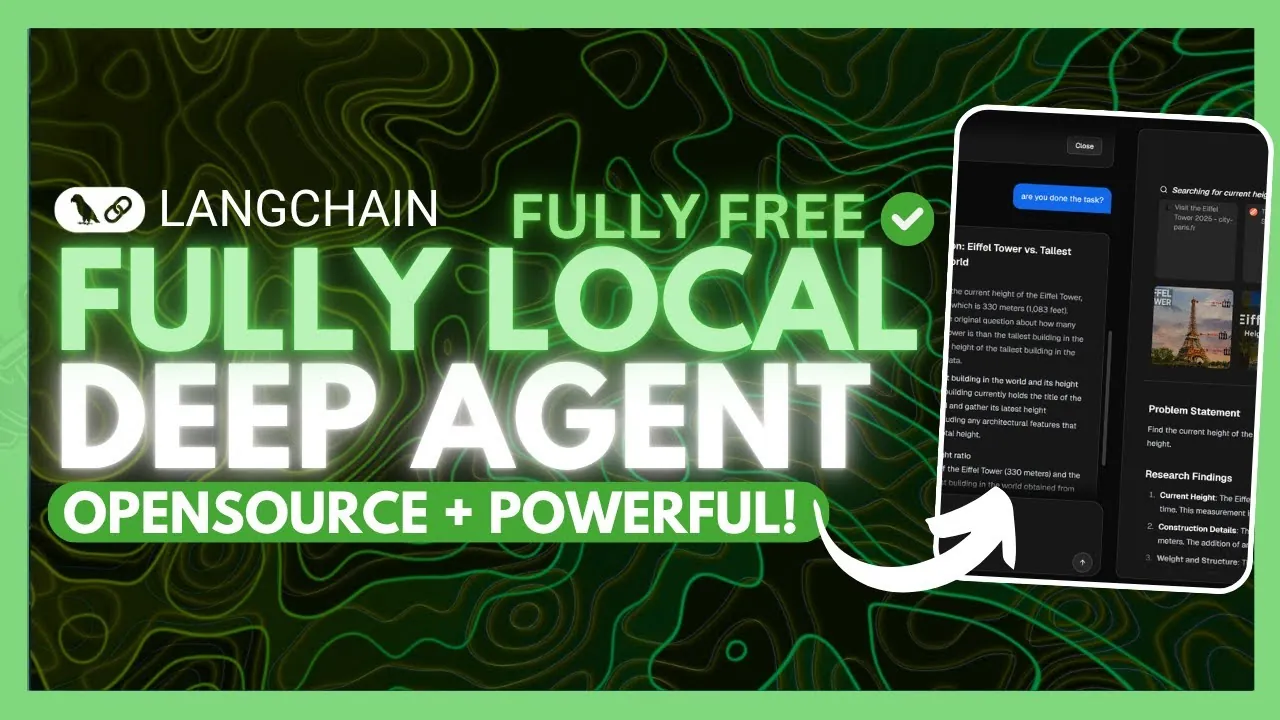
What if you could harness the power of advanced AI research tools without relying on proprietary platforms or sacrificing control over your data? Imagine a system that combines the sophistication of innovative technologies like ChatGPT agents with the freedom and flexibility of open source software—deployed entirely on your local machine. Enter Open Deep Research, a new platform that redefines how researchers, developers, and innovators approach complex challenges. With its multimodal capabilities and customizable workflows, this tool is poised to disrupt the status quo, offering a powerful alternative to closed systems like OpenAI’s ChatGPT agent or Gemini. But is it truly as fantastic as it sounds?
World of AI provide an overview of how Open Deep Research enables users to tackle intricate problems with precision, adaptability, and autonomy. From its real-time web search functionality to its intuitive dashboard creation tools, the platform is packed with features designed to streamline workflows and enhance productivity. You’ll discover how its structured, three-step process ensures clarity and actionable results, and why its open source nature makes it a future-ready solution for diverse industries. Whether you’re an academic, a developer, or an AI enthusiast, this platform offers a glimpse into what’s possible when innovation meets accessibility. Could this be the tool that transforms your research process? Let’s find out.
Open Deep Research Overview
TL;DR Key Takeaways :
- Open Deep Research is an open source, locally deployable research platform by LangChain, offering an alternative to proprietary tools like ChatGPT, Gemini, and Gro.
- Key features include multimodal provider support, real-time web search, customizable dashboards, detailed report generation, and compatibility with open source models like Olama.
- The platform employs a structured three-step workflow: task scoping, research phase with distributed agents, and comprehensive report generation.
- Its Studio UI provides a user-friendly interface for managing agents, customizing workflows, and accessing API documentation, catering to both novice and advanced users.
- Open Deep Research is highly flexible and extensible, supporting API integrations and customizations, making it suitable for diverse applications across industries and future-ready for evolving needs.
Core Features and Functional Capabilities
Open Deep Research is equipped with a range of features that simplify and enhance the research process. These capabilities are designed to address the demands of modern research while maintaining adaptability and precision:
- Multimodal Provider Support: Integrate seamlessly with diverse data sources, allowing comprehensive and multidimensional analysis.
- Real-Time Web Search: Access the latest information directly from the web, making sure your research remains current and relevant.
- Dashboard Creation: Build intuitive and visually appealing dashboards to organize, analyze, and present findings effectively.
- Report Generation: Compile detailed, actionable reports tailored to specific research objectives, streamlining decision-making processes.
- Open source Model Compatibility: Use models like Olama to create adaptable and scalable workflows, enhancing the platform’s versatility.
These features make Open Deep Research a valuable tool for a wide array of applications, ranging from academic research to AI-driven projects, making sure that users can address complex challenges with ease.
Structured Workflow for Efficient Research
Open Deep Research employs a streamlined three-step workflow to ensure clarity, efficiency, and precision throughout the research process. This structured approach is designed to guide users from the initial planning stages to actionable outcomes:
- Task Scoping: Begin by defining your research objectives and generating a focused brief. This step ensures that the scope of your research aligns with your goals, providing a clear direction for subsequent phases.
- Research Phase: A supervisor agent coordinates tasks among sub-agents, which handle data collection, analysis, and cleaning. This distributed approach ensures thoroughness and accuracy while minimizing redundancy.
- Report Generation: The platform compiles findings into a comprehensive report, customized to your initial brief. This ensures that the final output is both actionable and aligned with your research objectives.
This workflow not only enhances productivity but also ensures that each stage of the research process is methodical and results-oriented, making it easier to achieve meaningful insights.
Open Deep Research Overview

Here are additional guides from our expansive article library that you may find useful on local AI models.
- How to Run Llama 3.2 Vision AI Models Locally for Max Privacy
- Build a Local AI Research Assistant Using Google Gemma 3
- How to analyze your finances using AI locally
- How to Build a Local AI Voice Assistant with a Raspberry Pi
- Run a 600 Billion Parameter AI Model Locally on Your PC
- Deploy DeepSeek and Large AI Models Locally on Your Phone for
- How to build a high-performance AI server locally
- How SmolLM3 Delivers Local AI Power in a Small Package
- How to Build a Local AI Web Search Assistant with Ollama
- Refact AI coding assistant can be installed locally or in the cloud
Setup and Customization
Setting up Open Deep Research requires some technical preparation, but its flexibility and potential for customization make the effort worthwhile. To get started, follow these steps:
- Install essential tools such as Git and Python.
- Clone the repository and configure a virtual environment to ensure a clean and isolated setup.
- Set up environment variables to enable smooth operation and integration with external tools.
Once the platform is installed, users can take advantage of its extensive customization options. Agents, tools, and models can be tailored to meet specific research requirements, making Open Deep Research a versatile solution for a wide range of use cases.
Applications Across Industries
Open Deep Research’s adaptability makes it suitable for a variety of applications, catering to professionals across different fields. Some of its key use cases include:
- Comprehensive Research: Conduct in-depth studies across multiple domains, using multimodal integration for richer insights.
- Detailed Summaries: Generate concise yet thorough summaries of complex topics, aiding in quick decision-making.
- Complex Query Resolution: Address intricate problems by automating workflows and using advanced analytical tools.
- AI-Driven Applications: Build custom applications by integrating APIs, web search capabilities, and other tools to create innovative solutions.
These applications highlight the platform’s ability to handle diverse tasks, making it a valuable asset for researchers, developers, and industry professionals alike.
Studio UI and User-Friendly Tools
The Studio UI serves as the central hub for managing agents, tracking logs, and configuring settings within Open Deep Research. This intuitive interface is designed to accommodate both novice and advanced users, offering a range of tools to enhance usability:
- Upload files and manage assistants to streamline workflows and organize data effectively.
- Customize workflows to align with specific research needs, making sure flexibility and precision.
- Access detailed API documentation for advanced customizations and seamless integrations with external tools.
By providing a user-friendly interface, Open Deep Research ensures that users can navigate the platform efficiently, regardless of their technical expertise.
Flexibility and Future-Ready Extensibility
One of the standout features of Open Deep Research is its flexibility and extensibility. The platform supports integration with a variety of APIs and tools, allowing users to expand its capabilities as their needs evolve. Whether you are working on a specific project or developing a custom AI-driven application, Open Deep Research can adapt to your requirements, making sure long-term utility and relevance.
This adaptability makes it an ideal choice for professionals seeking a scalable and future-ready research platform. By using its open source nature, users can continuously refine and enhance the platform to meet emerging challenges and opportunities.
Empowering Research with Open Deep Research
Open Deep Research stands out as a powerful, open source solution for conducting advanced research and automating complex tasks. With its multimodal integration, configurable tools, and local deployment options, it offers a reliable and flexible platform for researchers, developers, and innovators. By following its structured workflow and using its extensive features, users can streamline their research processes, enhance accuracy, and generate actionable insights tailored to their objectives. This platform not only simplifies the research journey but also enables users to achieve meaningful outcomes in an increasingly data-driven world.
Media Credit: WorldofAI
Disclosure: Some of our articles include affiliate links. If you buy something through one of these links, Geeky Gadgets may earn an affiliate commission. Learn about our Disclosure Policy.
