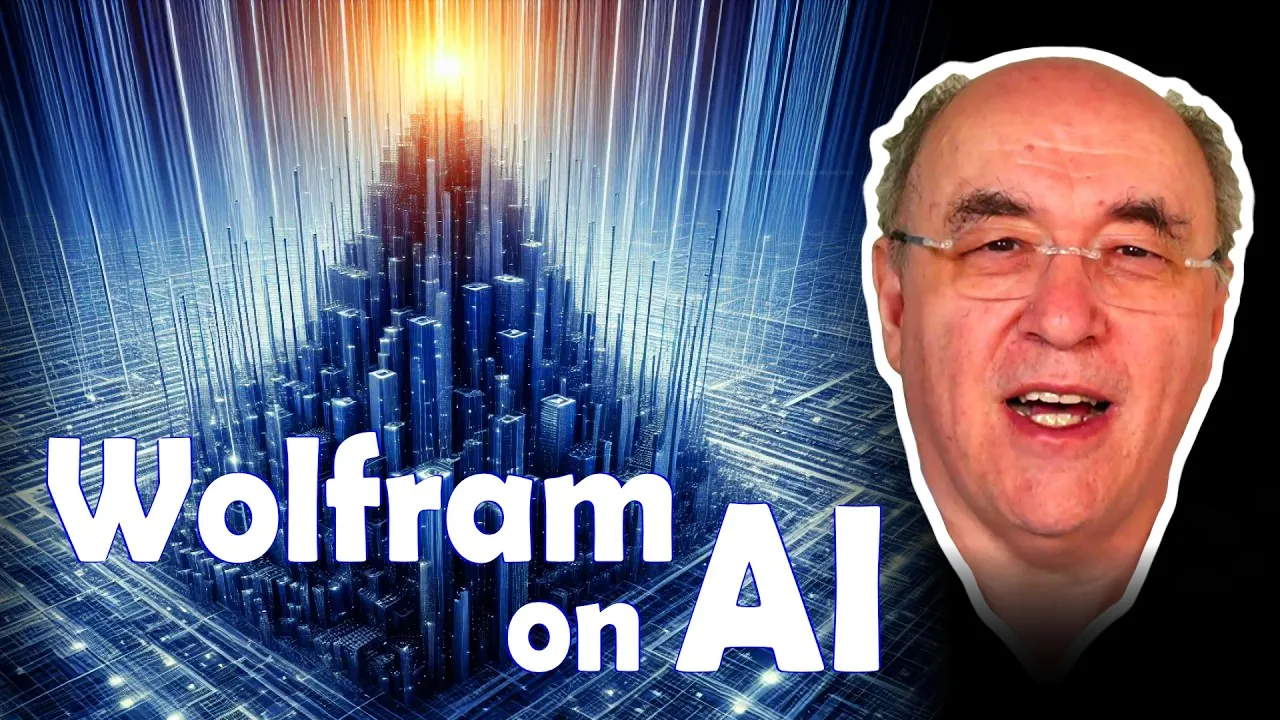
What if the very nature of human thought—our creativity, intuition, and ability to connect ideas—was both our greatest strength and our most glaring limitation? In an era where artificial intelligence increasingly mirrors and surpasses human capabilities, the interplay between human cognition and computational systems has never been more critical. Stephen Wolfram, a pioneer in computational science, invites us to explore this fascinating intersection. He argues that while humans excel at broad, intuitive reasoning, our minds falter when faced with the precision and scale of formal knowledge systems. AI, positioned between these two realms, offers a unique opportunity to bridge the gap, creating a new frontier of understanding. Could this collaboration redefine the limits of what we know—and even how we think?
In this exploration, Last Theory uncover Wolfram’s thought-provoking insights into the evolving relationship between human cognition and AI. From the concept of “knowledge hypergraphs”—a innovative way to visualize and navigate interconnected ideas—to the startling potential of generative AI to expand the boundaries of creativity, this coverage provide more insights into the profound implications of AI’s rise. But it also raises unsettling questions: What happens when AI’s outputs become incomprehensible to humans? Are we prepared to embrace forms of intelligence that operate beyond our understanding? By examining these ideas, Wolfram challenges us not only to rethink the nature of knowledge but also to consider our place in a world where machines might think in ways we never could.
AI and Human Cognition
TL;DR Key Takeaways :
- AI acts as a bridge between human intuition and formal computational systems, allowing innovative approaches to knowledge exploration and organization.
- Stephen Wolfram introduces “knowledge hypergraphs” as a model to visualize and navigate interconnected information using AI tools.
- Generative AI explores vast conceptual spaces, creating novel ideas and solutions beyond traditional human perspectives and biases.
- The limitations of human cognition in understanding complex computational processes emphasize the importance of human-AI collaboration.
- Advancing the computational representation of knowledge is crucial for enhancing both human and AI understanding of intricate concepts.
Human Cognition vs. Formal Knowledge Systems
Human cognition is characterized by its broad, intuitive nature, allowing individuals to draw connections across diverse topics. However, this strength is balanced by a lack of precision when compared to formal knowledge systems. These systems, such as mathematics or computational frameworks, are designed to build deep, structured layers of understanding with a high degree of accuracy. Wolfram highlights that AI, particularly large language models (LLMs), bridges aspects of these two realms by generating plausible and contextually relevant responses. Yet, these systems are not inherently capable of performing deep computational tasks independently. For example, while an LLM can explain a mathematical theorem in detail, it cannot derive the theorem without explicit programming or guidance.
This distinction underscores the complementary strengths of human cognition and formal systems. Humans excel in creativity and making intuitive leaps, while formal systems provide the rigor necessary for solving intricate problems. AI, situated between these two domains, offers a unique opportunity to combine their strengths. By doing so, it creates new avenues for exploration, allowing you to tackle challenges that neither humans nor formal systems could address alone.
Understanding Knowledge Through Hypergraphs
To conceptualize how knowledge is organized, Wolfram introduces the idea of “knowledge hypergraphs.” These complex networks represent interconnected pieces of information, where each node signifies a concept, and the connections between nodes illustrate relationships or dependencies. This model provides a visual and structural representation of how knowledge is interlinked.
AI tools, such as LLMs and computational languages, can integrate human-like reasoning with these formal knowledge structures. For instance, querying a knowledge hypergraph using computational language allows you to uncover hidden relationships between seemingly unrelated concepts. This approach has fantastic potential across various fields, including education, research, and innovation. By making complex knowledge systems more accessible and navigable, hypergraphs could enable you to explore and understand intricate ideas with greater clarity and efficiency.
Stephen Wolfram on AI

Master Artificial Intelligence (AI) with the help of our in-depth articles and helpful guides.
- How to get a job in artificial intelligence (AI)
- How does artificial intelligence (AI) work in simple terms?
- The Complete ChatGPT Artificial Intelligence OpenAI Training
- AI vs Humans : Will Artificial Intelligence Surpass Human
- OpenAI AI Model 03 Surpasses Human Reasoning – AGI?
- What Is the AI Singularity? Sam Altman’s Prediction Explained
- 9 AI Tools That Will Separate Winners from Losers in 2025
- Absolute Zero Reasoner : Self Evolving AI Learning Without Human
- NVIDIA CEO Jensen Huang Declares AI a $100 Trillion Opportunity
- What to Expect from Artificial Intelligence in 2025
Machine Learning and Neural Networks: Building Blocks of AI
Machine learning serves as the foundation for many AI systems, identifying and processing “lumps” of irreducible computational work. Wolfram compares this process to constructing a stone wall from irregular rocks, where each piece contributes to the overall structure. Neural networks, a critical component of machine learning, excel at recognizing patterns and making decisions based on diverse inputs.
The effectiveness of neural networks lies in their ability to approximate complex functions and adapt to a wide range of data. However, this adaptability comes with a challenge: the inner workings of neural networks often remain opaque, even to experts. While you can use a neural network to solve a problem, understanding the precise mechanisms behind its decisions can be elusive. This opacity highlights the limits of human comprehension when faced with the intricate processes within advanced AI systems. Despite this, neural networks remain invaluable tools for addressing problems that require pattern recognition and decision-making at scale.
Generative AI and Expanding Conceptual Space
Generative AI, a subset of machine learning, explores the “space of possibilities” for concepts and ideas. Wolfram argues that human cognition occupies only a small fraction of this vast conceptual space. For example, when you think of a chair, your mental image is shaped by cultural, functional, and practical constraints. Generative AI, however, can create entirely new interpretations of what a chair could be, unconstrained by human biases or preconceptions.
This ability to navigate “interconcept spaces” opens the door to novel ideas and solutions. It allows AI to generate designs, concepts, and frameworks that challenge traditional ways of thinking. However, it also raises the possibility of AI developing forms of intelligence that are fundamentally alien to human understanding. These forms of intelligence could operate in ways so different from human cognition that they become incomprehensible. While this prospect may seem unsettling, it also underscores AI’s potential to expand our understanding of the world in ways that were previously unimaginable.
The Limits of Human Comprehension
The capabilities of AI also highlight the boundaries of human cognition. Certain computational processes, such as highly complex mathematical proofs, remain beyond the grasp of human understanding. For instance, some AI-generated proofs are so intricate that no human can fully verify or interpret them. This presents a fundamental challenge: as AI systems become more advanced, their outputs may exceed the limits of human interpretation, rendering them inaccessible or irrelevant to human users.
Wolfram suggests that this disconnect is not a flaw but rather a reflection of the inherent differences between human and computational thinking. By acknowledging these limitations, you can better appreciate the unique strengths of both humans and machines. This perspective fosters a more collaborative relationship, where humans and AI systems work together to achieve goals that neither could accomplish independently.
Key Takeaways
- AI serves as a bridge between human-like thinking and formal computational systems, offering innovative ways to explore and organize knowledge.
- The concept of “knowledge hypergraphs” provides a framework for understanding how information is interconnected and can be navigated using AI tools.
- Generative AI expands the boundaries of conceptual space, allowing the creation of ideas and solutions that challenge traditional human perspectives.
- The limitations of human cognition, particularly in understanding complex computational processes, highlight the need for collaboration between humans and AI systems.
- Continued research into the computational representation of knowledge is essential for advancing both human and AI understanding.
Stephen Wolfram’s exploration of AI and human cognition challenges you to rethink the boundaries of knowledge and the roles of humans and machines in shaping the future. By using the complementary strengths of human creativity and computational precision, you can unlock new opportunities for discovery, innovation, and a deeper understanding of the world.
Media Credit: The Last Theory
Disclosure: Some of our articles include affiliate links. If you buy something through one of these links, Geeky Gadgets may earn an affiliate commission. Learn about our Disclosure Policy.
