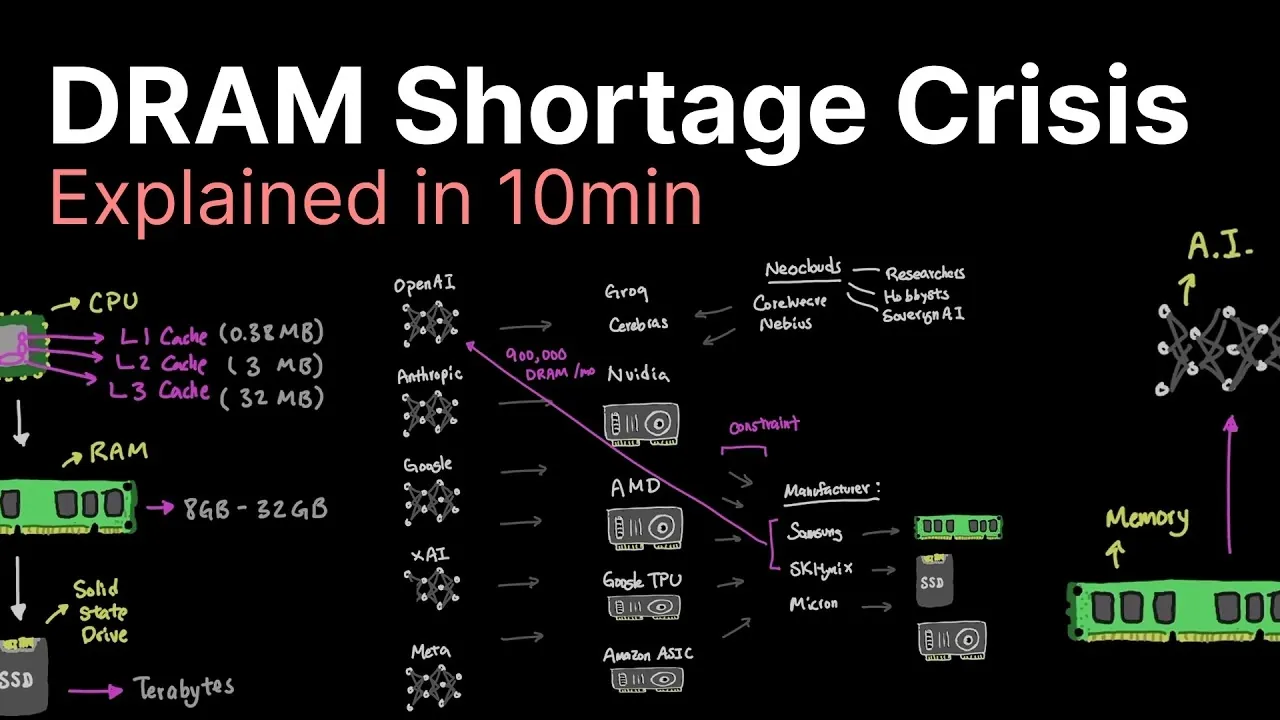
What happens when the backbone of modern technology, memory, becomes a scarce resource? The global DRAM shortage isn’t just a supply chain hiccup; it’s a full-blown crisis reshaping industries from AI development to consumer electronics. Prices for memory products have skyrocketed by as much as 300%, leaving businesses and individuals scrambling to adapt. In this breakdown, Caleb Writes Code walks through how the convergence of surging AI demands, production bottlenecks, and geopolitical tensions has created a perfect storm for the memory market. With manufacturers prioritizing high-bandwidth memory (HBM) for AI data centers over consumer-grade DRAM, the ripple effects are being felt across the tech ecosystem.
This guide unpacks the intricate web of factors driving the crisis, from the growing reliance on HBM in AI workloads to the cyclical vulnerabilities of the memory industry. You’ll discover how the race to power advanced AI models is reshaping production priorities, why expanding manufacturing capacity isn’t a quick fix, and how geopolitical barriers are further complicating the landscape. Whether you’re a tech enthusiast, business leader, or just curious about why your next laptop might cost more, this overview offers a deeper understanding of the forces at play. The story of the DRAM shortage is more than just numbers, it’s a glimpse into the future of technology and the challenges we face in keeping up with its demands.
Global DRAM Memory Shortage Overview
TL;DR Key Takeaways :
- The global DRAM shortage is driven by surging AI demand, supply chain disruptions, and manufacturers prioritizing high-bandwidth memory (HBM) over consumer-grade DRAM.
- AI applications, particularly large-scale models, heavily rely on HBM, creating a supply imbalance and intensifying competition for memory resources.
- Supply chain challenges, including delays in manufacturing expansion and geopolitical tensions, are prolonging the crisis and limiting production capacity.
- The shortage has caused significant price increases for memory products, with consumer-grade DRAM prices rising by up to 300%, impacting both consumers and businesses.
- Geopolitical and technological hurdles, such as China’s lag in advanced memory production and trade restrictions, further exacerbate the global supply-demand imbalance.
AI’s Role in Driving Memory Demand
AI applications are a dominant force behind the current DRAM shortage. Large-scale AI models, developed by companies such as OpenAI, Google, and Meta, require vast amounts of memory to function effectively. These models rely heavily on high-bandwidth memory (HBM), which provides the speed and capacity necessary to process massive datasets. AI data centers prioritize HBM over consumer-grade DRAM, creating a supply imbalance that disrupts the broader memory market. This shift in demand has placed unprecedented pressure on the supply chain, leaving fewer resources available for traditional memory products. As AI continues to evolve and expand, the demand for HBM is expected to grow, further straining the already limited supply.
Memory Hierarchy and Performance Bottlenecks
Modern AI workloads have exposed the limitations of traditional computing architectures. Conventional configurations involving CPUs, RAM, and SSDs often lack the bandwidth required to handle the intensive demands of advanced AI models. In contrast, graphics processing units (GPUs) equipped with HBM, such as Nvidia’s H100, have become indispensable for AI tasks, delivering significantly higher throughput. However, this reliance on specialized memory technologies has intensified competition for HBM, reducing the availability of consumer-grade memory products. The growing dependency on GPUs and HBM underscores the need for innovation in memory hierarchy to address performance bottlenecks and ensure a more balanced allocation of resources.
2026 DRAM Memory Shortage Crisis Explained

Stay informed about the latest in High-Bandwidth Memory (HBM) by exploring our other resources and articles.
- TPUs vs GPUs the AI Hardware Decision
- iPhone 20 Specs: 2nm Chips, Under-Display Cameras & No Cutouts
- iPhone 20th Anniversary: The Radical Redesign Revealed
- Apple’s 20th Anniversary iPhone: Features, Design, and More
- Everything You Need to Know About the Nvidia RTX 5090 GPU
Supply Chain Challenges
The memory supply chain is under immense strain as manufacturers like Samsung, SK Hynix, and Micron shift their focus toward producing HBM to meet the demands of AI applications. This strategic pivot has resulted in a decline in the production of consumer-grade DRAM and NAND storage, further aggravating the shortage. Compounding the issue is the time-intensive nature of building new memory manufacturing facilities, or fabs, which can take anywhere from two to five years to become operational. These delays mean that the current shortage is unlikely to see immediate relief. Additionally, supply chain disruptions caused by geopolitical tensions, natural disasters, and logistical challenges have further complicated efforts to stabilize the market.
Market Impact: Rising Prices and Economic Strain
The DRAM shortage has had a profound impact on the market, with memory prices experiencing dramatic increases. In some cases, consumer-grade memory products have seen price hikes of up to 300% in recent months. For instance, Samsung has raised its memory prices by 80%, reflecting the severe supply constraints. These rising costs are not only affecting individual consumers but also businesses that rely on memory-intensive applications, such as cloud computing, gaming, and data analytics. The economic strain caused by these price increases is being felt across industries, highlighting the widespread consequences of the shortage.
Historical Context: Cycles and Controversies
The memory industry’s history provides valuable insights into the current crisis. The sector has long been characterized by cyclical patterns of boom and bust, often driven by inventory fluctuations, overproduction, and supply chain disruptions. These cycles have made the industry particularly vulnerable to external shocks, such as the recent surge in AI-driven demand. Additionally, the memory industry has faced controversies, including price-fixing scandals where major manufacturers colluded to manipulate prices. These practices have contributed to the cyclical nature of the market, creating an environment where shortages and surpluses are recurring challenges.
Geopolitical and Technological Hurdles
Geopolitical factors are playing a significant role in the DRAM shortage. For example, China, a major player in the global technology landscape, lags behind leading manufacturers in memory technology. Chinese fabs, such as CXMT, are still producing older DDR4 memory, while competitors like Samsung and SK Hynix have advanced to more innovative technologies. Although CXMT’s planned IPO may accelerate innovation, China remains three to five years behind its global counterparts. This technological gap limits the global supply of advanced memory products, further exacerbating the shortage. Additionally, trade restrictions and export controls have created further barriers, complicating efforts to address the supply-demand imbalance.
Looking Ahead: A Prolonged Crisis
The DRAM shortage is expected to persist for the foreseeable future. The combination of high demand from AI applications, slow manufacturing expansion, and reduced output of consumer-grade memory suggests that price normalization could take years. The cyclical nature of the memory industry, coupled with ongoing geopolitical and technological challenges, adds further complexity to the situation. For now, the global memory market remains in a state of uncertainty, with no immediate resolution in sight. Stakeholders across the supply chain will need to adapt to this evolving landscape, exploring innovative solutions to mitigate the impact of the crisis and ensure long-term stability.
Media Credit: Caleb Writes Code
Disclosure: Some of our articles include affiliate links. If you buy something through one of these links, Geeky Gadgets may earn an affiliate commission. Learn about our Disclosure Policy.
