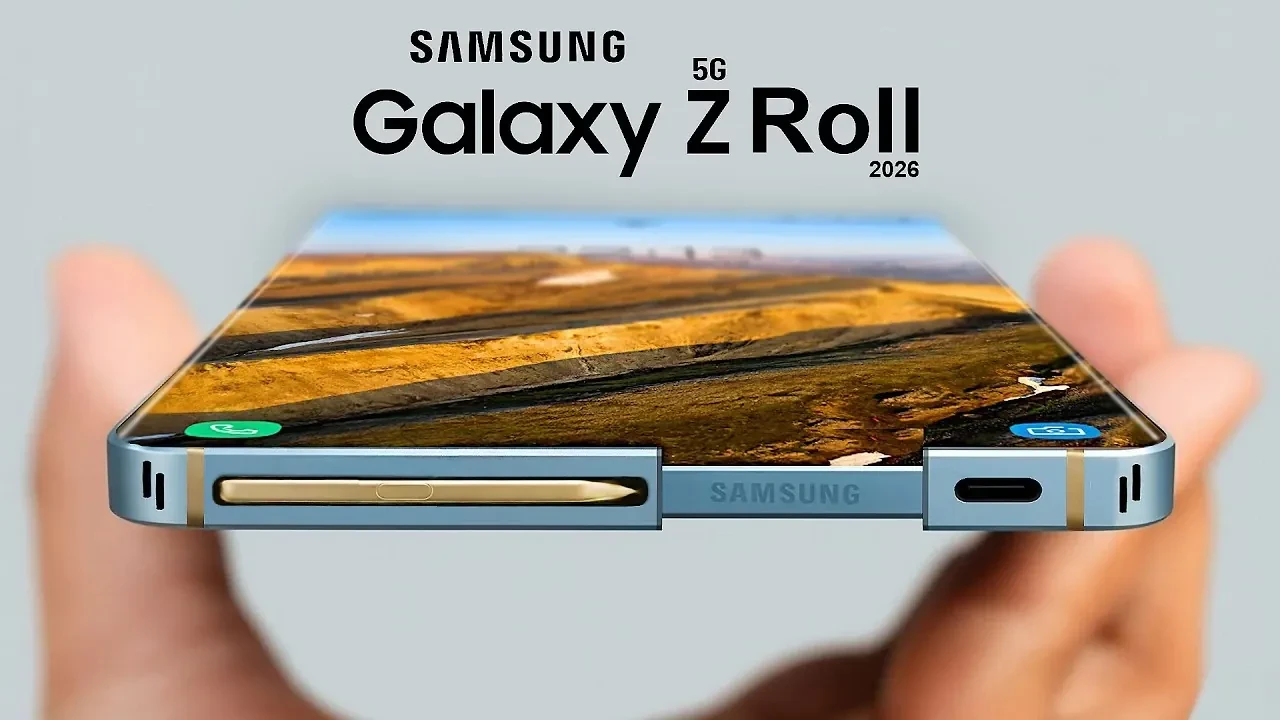
When details leaked about Samsung’s rumored Galaxy Z Roll 5G, the mobile world focused on the jaw-dropping numbers: a massive 12.4-inch expandable screen, a 324-megapixel camera, and a cutting-edge Snapdragon 8 Elite Gen 6 Pro chipset. It promises to solve the single biggest complaint of the foldable era—the persistent screen crease—by using a motorized scrolling mechanism to hide the display inside a premium titanium frame.
But moving from an aggressive prototype to a consumer-ready flagship in late 2026 presents massive technical challenges. While a rollable form factor elegantly bypasses the physics of folding a screen in half, it introduces an entirely new set of engineering anxieties. If Samsung wants to convince buyers to choose a rollable over a traditional folding phone, it must solve three critical hardware vulnerabilities.

The Motor Problem: Speed, Wear, and Emergency Retraction
The core convenience of a device like the Galaxy Z Roll 5G rests on its motorized scrolling system. Unlike a foldable phone, which a user can manually rip open in a fraction of a second, a rollable depends entirely on micro-motors to smoothly extend the flexible AMOLED panel to its full 12.4 inches.
This creates an immediate real-world issue: speed versus mechanical stress. If the motor expands the screen too quickly, it risks stretching or tearing the delicate substrate layers. If it moves too slowly, the user experience becomes frustrating. Early industry testers note that a three-to-four-second motorized delay feels sluggish when you just want to quickly show someone a photo or reply to an urgent document.
Furthermore, mechanical components inevitably experience wear and tear. Samsung will need to guarantee that these internal micro-gears can withstand hundreds of thousands of cycles without grinding down or losing alignment. There is also the nightmare scenario of an accidental drop: if a rollable phone slips from a user’s hand while fully extended, can the internal software trigger an instantaneous, high-speed emergency retraction before impact? Without an automated defense system, an open rollable is a highly fragile target.
The Debris Trap: Maintaining a Sterile Internal Roller
Foldable phones have spent generations perfecting “sweeper” bristles inside their hinges to keep pocket lint, dust, and sand from slipping behind the screen. For a rollable phone, the threat of debris is magnified significantly.
As the 12.4-inch display rolls back into the titanium housing, it acts like a conveyor belt, drawing everything it touched out in the wild directly into the heart of the device. If even a single grain of hard ambient sand gets past the outer seal and rolls up into the tightly packed internal spool, it will press directly against the flexible panel. Every subsequent expansion and retraction will grind that debris against the screen, creating permanent scratches from the inside out.
Samsung’s rumored solution is an advanced nano-coating and an IP68 dust-and-water resistance rating, but achieving a true hermetic seal on a motorized tracking track is an unprecedented engineering feat.
Battery Packaging: Rigid Chemistry in a Moving Chassis
The leaked specifications point to a massive 8,000mAh dual-cell silicon-anode battery. On paper, this is a brilliant upgrade. Silicon-anode technology allows for much higher energy density in a smaller physical footprint compared to traditional lithium-ion packs.
However, packaging a massive battery alongside a motorized spool system is a volumetric puzzle.
-
Traditional foldables split the battery evenly between two distinct, rigid halves.
-
A rollable device has only one static “core” side; the expanding side of the phone is essentially a hollow frame that slides outward on tracks.
This forces Samsung to pack the processor, the heavy 324MP camera module, the S Pen silo, the motors, and the entire 8,000mAh battery into the non-moving portion of the chassis. This asymmetric weight distribution could make the phone feel incredibly lopsided in hand when fully extended, heavily weighting the grip to one side.
Foldable vs. Rollable: The Ultimate Form Factor Face-off
To understand where the Galaxy Z Roll 5G fits in the upcoming mobile landscape, we have to look at how it stack up against current premium form factors, like Samsung’s own rumored Galaxy Z Fold 8 Ultra.
| Feature | Galaxy Z Fold 8 Ultra (Foldable) | Galaxy Z Roll 5G (Rollable) |
| Display Crease | Noticeable visual and tactile center groove | None (Zero-crease scrolling design) |
| Screen Protection | Closes shut like a book, shielding the main screen | Screen remains exposed to pockets on the outer track |
| Thickness | Bulky when folded (~10-12mm thick) | Uniform, traditional smartphone thickness |
| Operation | Instant manual opening | Motorized deployment delay (estimated 2–3 seconds) |
| App Scaling | Fixed aspect ratios (Square-ish inner screen) | Dynamic, adaptive aspect ratios as it unrolls |
While foldables offer excellent physical protection by trapping the main screen safely inside the device when closed, they remain thick and heavy in the pocket. The rollable alternative gives users a perfectly flat, uniform smartphone form factor that expands into a true widescreen media canvas—but it demands absolute faith in internal robotics.
The Market Context: Why Samsung Must Jump First
Samsung is facing fierce competition in the premium mobile space. Competitors like Huawei have already disrupted the market with tri-fold devices, aggressively pushing the boundaries of screen real estate. Meanwhile, Apple continues to file patents for its own flexible screen tech, waiting for the underlying hardware to mature before making a move.
By targeting a late 2026 release for the Galaxy Z Roll 5G, Samsung is attempting to reclaim its crown as the undisputed king of display innovation. If they can successfully debut a motorized scrolling system that keeps out dust, survives everyday drops, and balances an 8,000mAh battery, they won’t just solve the foldable crease problem—they will set the design blueprint for the next decade of mobile computing.
Rumored Specifications
| Category | Specification (Leaked/Rumored) |
| Main Display | 12.4-inch Rollable Dynamic AMOLED 2X (Expandable) |
| Refresh Rate | 1Hz – 144Hz Adaptive LTPO |
| Peak Brightness | 3,000 Nits |
| Mechanism | Motorized “Zero-Crease” Scrolling System |
| Processor | Qualcomm Snapdragon 8 Elite Gen 6 Pro (2nm) |
| RAM | 12GB / 16GB LPDDR6 |
| Storage | 512GB / 1TB / 2TB (UFS 5.0) |
| Primary Camera | 324MP ISOCELL HR1 Sensor (OIS) |
| Telephoto | 50MP Periscope (10x Optical Zoom) |
| Ultrawide | 12MP with Macro Capabilities |
| Front Camera | 12MP Under-Display Camera (UDC 3.0) |
| Battery | 8,000mAh Dual-Cell Silicon-Anode |
| Charging | 100W Wired / 25W Wireless |
| Build Material | Grade 5 Titanium Alloy Frame |
| Stylus Support | Built-in S Pen Slot (2.1ms Latency) |
| Durability | IP68 Rated (Advanced Nano-coating) |
| OS | Android 17 with One UI 9.0 |
| Estimated Price | Starting at ~$2,799 USD |
Browse through more resources below from our in-depth content covering more areas on Rollable smartphone.
- Samsung Galaxy Z Roll 5G: Features, Specs and Release Date
- The Magic of the Samsung Galaxy Z 5G Roll Revealed
- Samsung Galaxy Z Roll 5G: 12.4-Inch Rollable Display Specs
- Samsung Galaxy Z Roll 5G: The End of the Screen Crease?
- The Galaxy Z Roll 5G Is Samsung’s Wildest Design Ever
Source Miror Pro
Disclosure: Some of our articles include affiliate links. If you buy something through one of these links, Geeky Gadgets may earn an affiliate commission. Learn about our Disclosure Policy.
