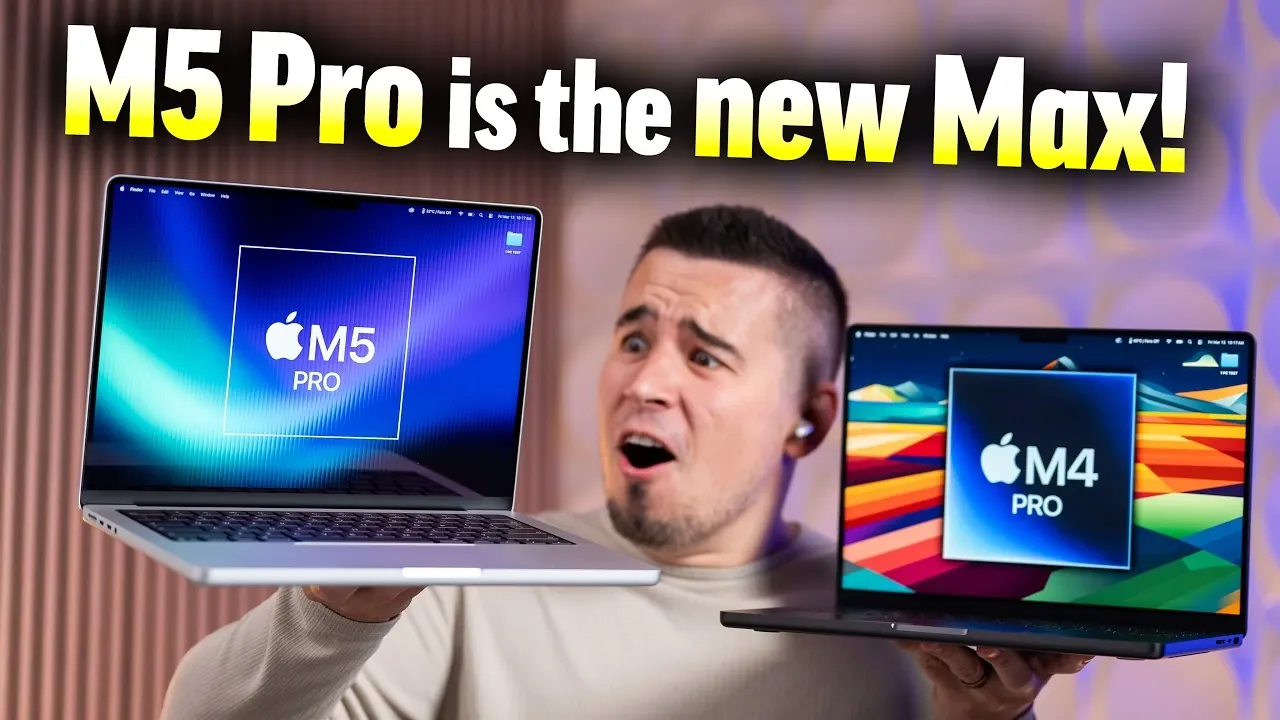
The M5 Pro chip introduces a range of notable advancements in performance and efficiency, setting a new standard for high-performance processors. With a redesigned core architecture, enhanced AI and GPU capabilities, and significantly faster SSD speeds, it aims to elevate the computing experience. However, these improvements come with certain trade-offs, particularly in thermal management and battery life. For users already equipped with the M4 Pro, the decision to upgrade requires careful consideration of these factors.

Core Architecture: A Redesign for Power
The M5 Pro features a revamped core architecture that replaces traditional efficiency cores with 10 mid-cores and 5 super cores. This innovative design delivers a 24% to 32% boost in multi-core performance, allowing faster execution of demanding tasks such as video editing, 3D rendering and complex simulations. Additionally, single-core performance improves by 8.5%, making sure smoother operation for everyday applications like web browsing and productivity software.
This architectural overhaul is particularly beneficial for professionals and power users who rely on their devices for intensive workloads. Whether you’re editing high-resolution videos or running computational simulations, the M5 Pro’s design ensures a seamless and efficient experience.
AI and GPU: Smarter and Faster
The M5 Pro places a strong emphasis on AI capabilities, integrating advanced AI accelerators directly into its GPU cores. This results in nearly double the AI performance, allowing faster machine learning computations and more efficient processing for tasks such as image recognition, predictive analytics and natural language processing.
Graphics performance also sees a substantial boost, with rendering and gaming benchmarks showing improvements ranging from 20% to 50%. The inclusion of enhanced ray tracing technology allows for realistic lighting and shadow effects, making it a valuable tool for gamers, 3D artists and creative professionals. These advancements position the M5 Pro as a compelling choice for users seeking innovative performance in AI-driven and graphics-intensive applications.
SSD Speeds: Lightning-Fast Storage
Storage performance is another area where the M5 Pro excels. SSD read speeds have increased from 5,000 MB/s in the M4 Pro to an impressive 13,000 MB/s, while write speeds have jumped from 5,000 MB/s to 10,000 MB/s. These improvements translate to significantly reduced load times, whether you’re transferring large files, launching resource-intensive applications, or working with data-heavy workflows.
For professionals handling large datasets or creative projects, these faster SSD speeds ensure a more seamless and efficient experience. Tasks that previously required extended waiting periods, such as exporting high-resolution videos or loading complex design files, are now completed in a fraction of the time.
Application Benchmarks: Real-World Performance
In real-world application benchmarks, the M5 Pro demonstrates exceptional performance across a variety of tasks. Video editing, 3D rendering and music production benefit significantly from the chip’s enhanced capabilities, allowing users to complete high-computation processes more quickly and focus on their creative output.
However, photo editing yields mixed results, with the M4 Pro occasionally outperforming the M5 Pro. This discrepancy is attributed to software limitations that fail to fully use the M5 Pro’s new architecture. These findings highlight the importance of software optimization in maximizing the potential of advanced hardware.
Thermal and Battery Trade-Offs
Despite its impressive performance, the M5 Pro comes with certain compromises. The chip’s higher power consumption leads to faster battery drain during intensive tasks, which may be a concern for users who prioritize portability and extended battery life. Additionally, thermal management faces challenges, with the M5 Pro experiencing higher power spikes and slightly elevated temperatures compared to its predecessor.
For users who frequently work on the go or rely on their devices for extended periods without access to charging, these factors may outweigh the benefits of the M5 Pro’s performance enhancements. It’s essential to weigh these trade-offs against your specific needs and usage patterns before deciding to upgrade.
Who Should Upgrade?
The M5 Pro offers a compelling upgrade for users with older MacBook models powered by M1 or M2 Pro chips. Its performance rivals higher-tier chips like the M4 Max and M3 Ultra, making it an attractive option for those seeking innovative capabilities at a more accessible price point.
However, for users already equipped with the M4 Pro, the improvements may feel incremental rather than fantastic. Unless your workflow specifically benefits from the M5 Pro’s advancements in AI or GPU performance, the upgrade may not provide enough value to justify the cost. Carefully consider whether the chip’s new features align with your professional or personal computing needs.
Price-to-Performance: A Balanced Proposition
The M5 Pro strikes a strong balance between cost and capability, delivering performance that competes with premium chips at a fraction of the price. For professionals and power users looking to future-proof their devices, the M5 Pro offers a robust solution that can handle demanding tasks with ease.
However, the value proposition ultimately depends on your specific requirements. If your workflow involves AI-driven applications, graphics-intensive tasks, or data-heavy operations, the M5 Pro’s advancements will likely provide significant benefits. On the other hand, users who prioritize portability, battery life, or already own the M4 Pro may find the upgrade less essential.
Making the Right Choice
The M5 Pro chip represents a significant advancement in processor technology, offering a redesigned core architecture, enhanced AI and GPU capabilities, and faster SSD speeds. These features make it a powerhouse for demanding tasks, from creative workflows to data-intensive applications. However, the trade-offs in thermal management and battery life, combined with the incremental improvements over the M4 Pro, mean that the decision to upgrade should be carefully considered.
For users seeking innovative performance and ready to embrace the latest advancements, the M5 Pro delivers. But for those content with the M4 Pro or prioritizing portability and battery life, the upgrade may not be essential. Ultimately, the choice depends on your specific needs and how you plan to use your device.
Check out more relevant guides from our extensive collection on M5 Pro chip that you might find useful.
- Apple M5 Pro and M5 Max MacBook Pros Coming Soon
- M5 Pro and M5 Max MacBook Pros: Release Date
- Apple M5 Pro and M5 Max MacBook Pros: Release Date
- Apple M5 Pro and M5 Max MacBook Pros: Release Date
- Apple M5 Pro and M5 Max MacBook Pros Launch Wednesday
Source & Image Credit: Max Tech
Disclosure: Some of our articles include affiliate links. If you buy something through one of these links, Geeky Gadgets may earn an affiliate commission. Learn about our Disclosure Policy.
