Residential proxies route your traffic through real household connections, which is why price trackers, ad verifiers, sneaker bots and multi-account managers pay by the gigabyte for them. The market has a handful of giants, a tier of value providers and a growing number of newcomers, and the headline price per gigabyte hides most of the differences.
We compared seven of the most-searched providers on pool size, real entry price, trial and refund terms, payment methods and identity checks, and added the questions most comparison pages skip: how to tell whether an IP is really residential, and how to work out what a gigabyte actually buys you.
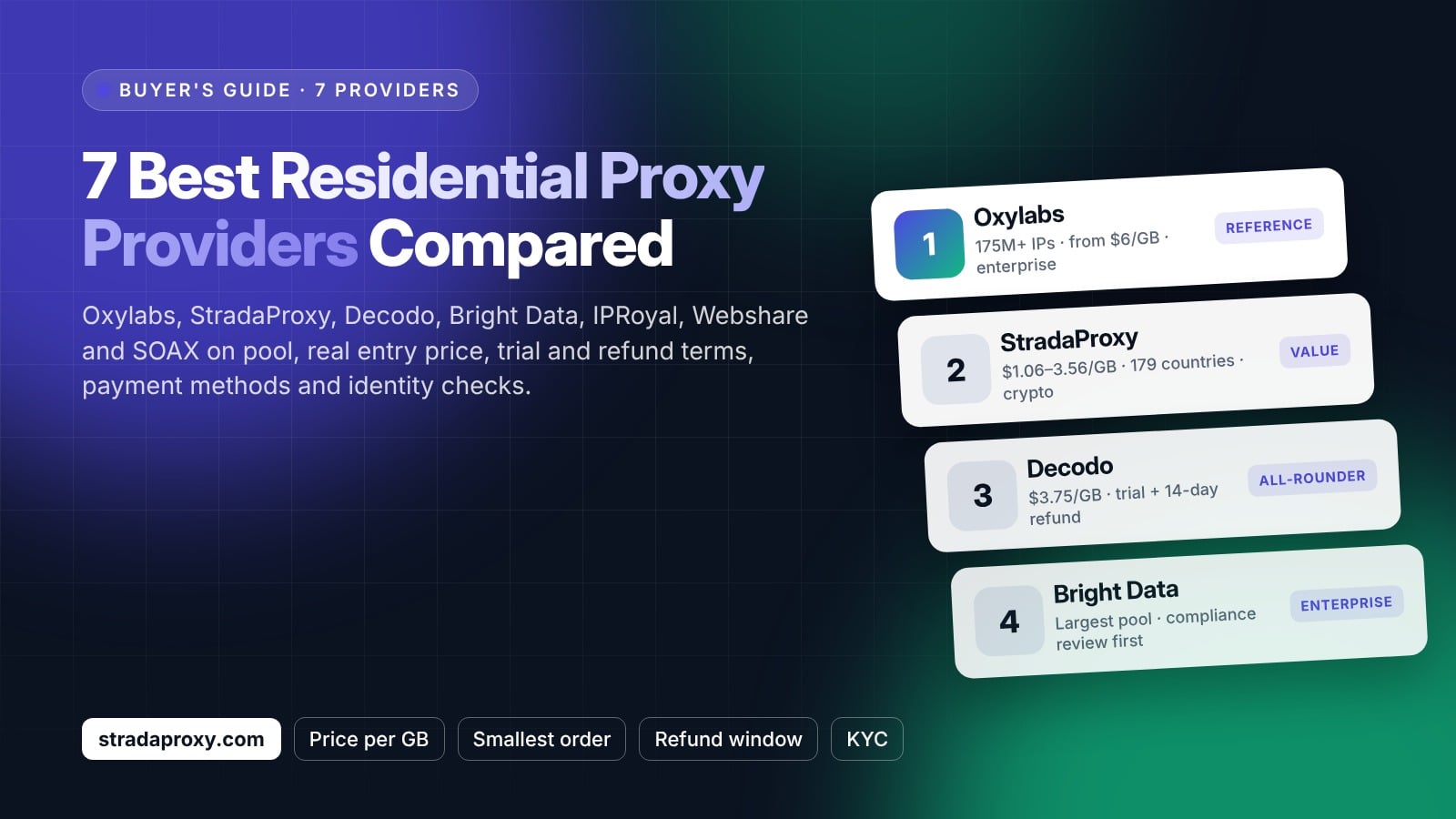
Per-gigabyte prices are only comparable once you know the smallest order, the refund window, and whether you will be asked for ID.
TL;DR
- Oxylabs ranks first overall. StradaProxy is the value pick, with published prices from $3.56 down to $1.06 per GB and a $35.63 minimum order.
- Decodo is the easiest starting point for small teams because of its trial and refund policy.
- Compare the smallest order, the refund window, and whether ID checks apply, not only the per-GB price.
- Buy the smallest plan first, test it on your real targets, and judge success rate per gigabyte.
Residential, datacenter, ISP and mobile in one paragraph
A datacenter proxy sits on a hosting company’s range: fast, cheap, and flagged as hosting by any site that buys IP intelligence. A residential proxy borrows a real consumer connection, usually from a user who opted into an SDK in exchange for a free app, so it looks like a home broadband line and is charged by traffic.
An ISP proxy (sometimes “static residential”) is a datacenter-hosted address registered to a consumer ISP: residential reputation with datacenter speed, sold per IP per month. A mobile proxy uses carrier IPs shared by thousands of phones, which makes platforms reluctant to block them.
This guide is about the second type, which is the one you need when the target checks reputation, needs a city-level location, or is a social platform.
What actually matters when choosing
Four things decide whether a residential proxy plan works for you. Coverage: how many countries and cities you can target, and whether targeting is set in the dashboard or encoded in the username so it works from any script.
Session control: how long a sticky session can hold one IP, which matters for logins and checkouts, versus rotating every request, which matters for scraping. Commercials: the smallest purchase, whether unused traffic expires, and whether you can get money back if the pool does not suit your targets.
Onboarding: some providers run know-your-customer checks before you can buy, others only when you pay by crypto or use certain targeting filters, and payment methods range from cards only to crypto only.
How we compared them
All figures come from each provider’s own pricing, documentation and policy pages rather than from affiliate reviews. Entry price is the cheapest published per-gigabyte rate at the smallest plan, with any promotional rate noted.
Pool sizes are the provider’s own claims and cannot be independently verified. NetNut, which appears on most older lists, is excluded because its domain currently carries a law-enforcement seizure notice.
| Provider | Pool and coverage (claimed) | Entry price | Trial / refund | Payment and KYC |
|---|---|---|---|---|
| 1. Oxylabs | 175M+ IPs | From $6/GB on the smallest plan | $5 welcome credit; refund terms not stated on the pricing page | Card and PayPal among others; KYC may be required for some targeting filters |
| 2. StradaProxy | 179 countries; pool size not published | $1.06–$3.56/GB by tier; smallest order $35.63 | Refund within 3 days for first-time buyers under 100 MB | Crypto only (USDT, BTC); no KYC stated |
| 3. Decodo | 115M+ IPs | $3.75/GB on 3 GB plan; $4/GB pay as you go | 3-day, 100 MB trial; 14-day money-back | Card, PayPal, crypto |
| 4. Bright Data | Largest claimed pool in the market | $4/GB pay as you go at promotional rate | Trial for businesses after review | Compliance (KYC) review before access; no crypto published |
| 5. IPRoyal | Large pool; sticky sessions up to 7 days | $7/GB subscription; $7.35/GB pay as you go | Traffic never expires; trial offered without published terms | Card and crypto; risk-based KYC |
| 6. Webshare | 80M+ IPs | $3.50/GB on the 1 GB promotional plan | No trial; refund if under 0.1 GB used within 48 hours | Card |
| 7. SOAX | Residential plus mobile; smaller pool | Sandbox from $5, $4 or $2/GB depending on country tier | Paid sandbox instead of a trial | Card; crypto only after KYC |
1. Oxylabs
Oxylabs is the reference point for enterprise residential proxies: a pool claimed at over 175 million IPs, country, city and ASN targeting, a mature dashboard and documentation that most competitors imitate.
The cost of that maturity is the entry price, from $6 per gigabyte on the smallest plan; a $5 welcome credit stands in for a trial and the pricing page does not spell out refund terms, so ask before a large purchase.
Identity verification may be required for some targeting filters. If budget is secondary to coverage and support, it remains the safe choice.
2. StradaProxy
StradaProxy is the value pick on this list and the simplest to start with. Its residential plans are published as a single per-gigabyte tier table running from $3.56 down to $1.06, with the smallest order of $35.63 stated up front, covering 179 countries.
HTTP, HTTPS and SOCKS5 all run on the same host and port, and country, city and sticky sessions of up to two hours are set through the username string, so there is no control panel to learn and the same credentials work in a browser, a bot or a script.
Payment is crypto only, in USDT or Bitcoin, and first-time buyers who have used under 100 MB can claim a refund within three days. There is no API and the pool size is not published, which are the honest limits of a young provider; the pricing and the username-based set-up are the reasons to try it.
3. Decodo
Decodo, the rebranded Smartproxy, is the mid-market favourite for good reason. A claimed 115 million IPs, $3.75 per gigabyte on the 3 GB plan or $4 pay as you go, a three-day trial with 100 MB included, a 14-day money-back guarantee and card, PayPal and crypto payments make it the easiest provider to evaluate without risk.
It is the best all-rounder for small teams who want a trial and a refund policy before committing.
4. Bright Data
Bright Data claims the largest residential pool in the industry and sells the most tooling around it: scraping browsers, data sets and compliance workflows.
Every customer goes through a compliance review before access, there is no published crypto option, and the $4 per gigabyte pay-as-you-go rate is a promotional one against a higher list price. For a company with a compliance team it is the most complete platform here; for an individual it is the slowest to get into.
5. IPRoyal
IPRoyal’s distinguishing feature is that purchased traffic never expires, so a $7 gigabyte bought today is still there next year, and sticky sessions can hold an IP for up to seven days, longer than anyone else on the list.
The pay-as-you-go rate is $7.35 per gigabyte, crypto is accepted and identity checks are applied on a risk basis throughout the customer journey. It suits occasional users who hate watching unused bandwidth evaporate, and account managers who need the same IP for a week.
6. Webshare
Webshare built its name on free and cheap datacenter proxies and brings the same pricing instinct to residential: $3.50 per gigabyte on the 1 GB promotional plan, with a claimed 80 million IPs.
There is no trial, and refunds apply only if you have used under 0.1 GB within 48 hours. The dashboard is clean and the price is hard to argue with for light use.
7. SOAX
SOAX sells residential and mobile IPs from a smaller pool and replaces the free trial with a paid sandbox priced from $5, $4 or $2 per gigabyte depending on the country tier. Crypto payment unlocks only after know-your-customer checks. It is a considered choice for mobile-proxy work and strict compliance, less so for a quick experiment.
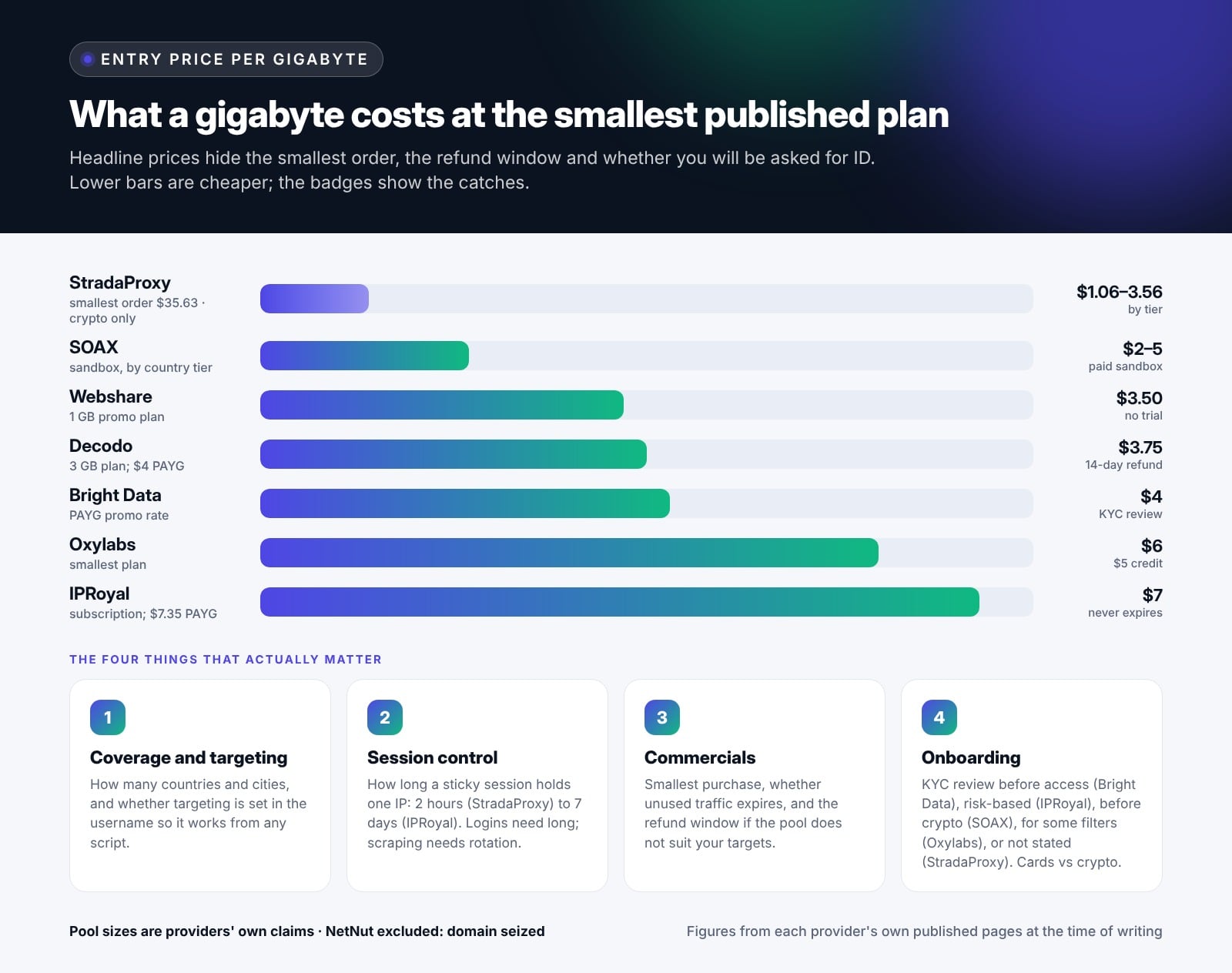
What a gigabyte costs at the smallest published plan, and the four things that decide whether the plan fits your job.
Rotating or sticky: match the session to the job
Rotating means a new IP on every request, which is what you want for scraping prices or search results, because no single address makes enough requests to be rate-limited.
Sticky means one IP held for a set period, which is what logins, carts and account management need, because a session that changes address mid-way looks like a hijack and gets challenged.
Providers differ sharply here: StradaProxy holds a session for up to two hours, most set ten to thirty minutes by default, and IPRoyal goes to seven days. For multi-account work on social platforms, a long sticky session per account, in the account’s registration city, is worth more than a huge pool.
On StradaProxy’s residential plans, sticky sessions of up to two hours are set in the username string, so switching between rotating and sticky needs no dashboard.
How to check that an IP is actually residential
Before trusting a provider with a sensitive target, pull a few IPs from the pool and look them up on an IP checker that shows the ASN and risk flags. A residential IP resolves to a consumer ISP (a cable, fibre or mobile carrier) with no hosting, proxy or VPN flag.
If the ASN is a cloud or hosting company, you have been sold a datacenter or ISP address under a residential label. Fraud-score tools add a second opinion: a score in the low range on a consumer ASN is what you want, and a high score means the address has been burned by previous users.
Do this on day one, inside the refund window, with the targets you actually care about, because a pool that is clean for one site can be exhausted on another.
What a gigabyte really buys
Per-gigabyte prices only mean something next to the size of the pages you load. A product page with images can be two to three megabytes, so a gigabyte is roughly 400 loads; a JSON API response is a few kilobytes, so the same gigabyte covers tens of thousands of calls.
Then account for retries: a provider with a 90% success rate costs 10% more per useful request than its sticker price, and one at 70% costs 40% more.
That is why a $6 provider with a 98% success rate on your target can be cheaper than a $2 provider at 70%, and why the only honest comparison is cost per successful request on your own targets, measured on the smallest plan before you scale.
Verdict
Oxylabs and Bright Data are enterprise platforms priced and reviewed accordingly. Decodo is the best place for most small teams to start, because the trial and refund policy let you test before you pay.
StradaProxy undercuts all of them on published price with the simplest set-up, at the cost of crypto-only payment and a shorter track record, and is worth a $35 test on any project where cost per gigabyte dominates.
IPRoyal rewards infrequent users and long sessions, Webshare suits light budgets, and SOAX fits mobile and compliance-heavy work. Buy the smallest plan first, test against your real targets, and judge success rate per gigabyte rather than the sticker price.
Frequently asked questions
Are residential proxies legal? Using one is legal in most jurisdictions; what you do through it is what matters. Scraping public data, ad verification and price monitoring are routine business uses; accessing accounts you do not own or evading a ban breaches the target’s terms and may be unlawful.
Do unlimited-bandwidth residential plans exist? Some providers sell them, usually with throttled speed or a small shared pool. For most users, metered traffic from a large pool is cheaper per successful request.
Which providers offer a free trial? Decodo (100 MB over three days) and Oxylabs (a $5 credit) do; IPRoyal advertises one without publishing its terms; SOAX replaces it with a paid sandbox; StradaProxy and Webshare offer short refund windows instead.
Can websites detect residential proxies? Rarely from the IP alone, since it belongs to a consumer ISP. Detection usually comes from behaviour or from browser fingerprint mismatches, which is why multi-account work pairs proxies with separate browser profiles.
Residential or mobile for Instagram and Facebook? Mobile IPs are shared by so many real users that platforms rarely block them, which makes them the safer choice for account creation; residential IPs with long sticky sessions are the usual choice for running accounts day to day.
Prices, pool sizes, trial terms and payment methods are taken from each provider’s published pages at the time of writing and change frequently; pool figures are providers’ own claims. Use proxies in line with the terms of the sites you access and the law in your jurisdiction.
Disclosure: Some of our articles include affiliate links. If you buy something through one of these links, Geeky Gadgets may earn an affiliate commission. Learn about our Disclosure Policy.
