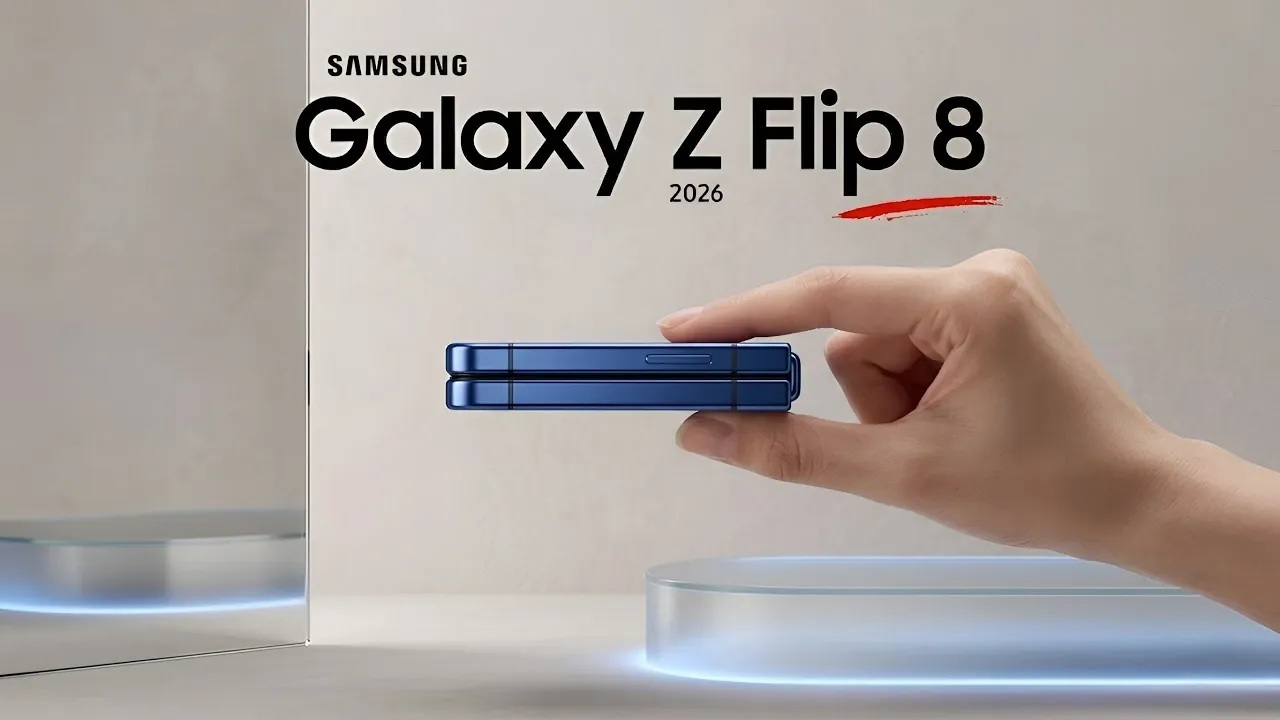
The Samsung Galaxy Z Flip 8, one of the most anticipated foldable smartphones of 2026, represents a continuation of Samsung’s strategy of incremental refinement rather than bold innovation. Early reports and leaks suggest that the device will closely resemble its predecessor, the Galaxy Z Flip 7, with only subtle updates to its design and features. In a market that thrives on innovative advancements, this cautious approach raises a pivotal question: Can small, deliberate improvements sustain Samsung’s dominance in the foldable phone segment?
Rumored Samsung Galaxy Z Flip 8 Specifications
| Feature Category | Rumored Galaxy Z Flip 8 Specification |
| Main Internal Display | 6.9-inch Dynamic AMOLED 2X panel with a 120Hz refresh rate and up to 2,600 nits peak brightness. Rumors suggest an upgraded M13 material stack. |
| Cover External Display | 4.1-inch “FlexWindow” Super AMOLED display (120Hz refresh rate) wrapping around the camera modules, mimicking the prior generation’s footprint. |
| Processor & Node | Samsung Exynos 2600 chipset (built on a highly anticipated 2nm process node), bringing enhanced thermal management to the clamshell body. Note: Select regional markets may see a Snapdragon equivalent. |
| Memory & Storage | 12GB LPDDR5X RAM baseline paired with non-expandable 256GB or 512GB of rapid UFS 4.0 flash storage. |
| Main Camera Setup | Dual-sensor system: 50MP main camera ($f/1.8$ aperture, Dual Pixel autofocus, and Optical Image Stabilization) paired with a 12MP ultra-wide camera ($f/2.2$). |
| Selfie Camera | Centered punch-hole 10MP sensor ($f/2.2$) integrated into the main internal folding screen. |
| Battery Capacity | 4,300 mAh split-cell configuration. Samsung is leaning on the 2nm processor efficiency rather than scaling up physical battery size. |
| Charging Speeds | 25W wired fast charging, 15W wireless charging. Dummy units point to added internal alignment magnets, suggesting native Qi2 magnetic wireless charging support. |
| Hinge & Build | Refined “Armor FlexHinge” that manages to drop the phone’s folded thickness by 0.5mm down to 13.2mm (resulting in a tighter closure and an even less noticeable screen crease). Built with an aluminum frame and Gorilla Glass Victus 2. |
| Weight | Slashed down to a lighter 180 grams (dropping roughly 8 grams from its predecessor). |
| Operating System | Android 17 layered with Samsung’s One UI 9, backed by Samsung’s standard 7-year commitment for software updates. |
| Expected US Pricing | Tipped to hold steady starting at $1,099 for the 256GB base model, keeping it highly competitive in the premium foldable space. |
Design: Familiarity Over Freshness
The Galaxy Z Flip 8 appears to embrace a design philosophy of continuity rather than reinvention. Reports indicate that the device will retain the same core design language as the Galaxy Z Flip 7, with minimal changes to its overall aesthetic. The most notable adjustment is a slight reduction in thickness, approximately 0.5mm, when folded. While this change may enhance portability and comfort, it is unlikely to significantly alter the user experience.
The hinge mechanism and foldable display technology are also expected to remain largely unchanged. This suggests that Samsung is prioritizing the refinement of its existing design to improve durability and reliability, rather than introducing new features. While this approach may appeal to users who value consistency and dependability, it risks alienating those who crave bold, innovative designs.
Wireless Charging: A Mixed Bag
One of the more notable updates to the Galaxy Z Flip 8 is its support for the Qi2 wireless charging standard. This new standard promises improved charging efficiency through magnetic alignment, potentially reducing energy loss and improving charging speeds. However, there is a significant caveat: the device itself will not include built-in magnets for wireless charging. Instead, users will need to purchase a compatible case to take full advantage of this feature.
This accessory-dependent approach is not new for Samsung, as it has been employed in previous models like the Galaxy S25 and S26 series. While this strategy may simplify manufacturing and reduce costs, it could frustrate users who expect seamless wireless charging functionality without the need for additional purchases. Interestingly, even Apple, known for its integrated MagSafe technology, is rumored to be considering a similar approach for its upcoming foldable iPhone Ultra. This trend suggests that manufacturers are increasingly balancing cost efficiency with user expectations in the evolving wireless charging landscape.
Industry Trends: Playing It Safe
The foldable phone market has become a battleground for innovation, with competitors like Huawei, Oppo and Google introducing devices that push the boundaries of design and functionality. Against this backdrop, Samsung’s decision to focus on incremental updates rather than bold innovations could be seen as a missed opportunity. However, it also highlights the company’s commitment to reliability and long-term usability, two critical factors for foldable devices that are still maturing as a product category.
Interestingly, the industry as a whole appears to be shifting toward a more cautious approach. If Apple adopts a similar strategy with its foldable iPhone Ultra, it could signal a broader trend of prioritizing practicality over headline-grabbing features. This shift may reflect the challenges of balancing innovation with the need to deliver products that are both reliable and cost-effective.
Consumer Appeal: Is Refinement Enough?
The Galaxy Z Flip 8’s incremental updates raise an important question: Are small refinements enough to keep consumers engaged in a market that thrives on novelty? For loyal Samsung users, the device’s focus on durability and consistency may be appealing. However, for potential new customers or current Galaxy Z Flip 7 owners, the lack of significant design changes and the reliance on accessory-dependent features could make the device feel less compelling.
Competitors like Huawei and Oppo are offering foldable phones with innovative features and bold designs, which may attract consumers looking for something new and exciting. In this context, Samsung’s cautious approach could risk losing market share to brands that are more willing to take risks and experiment with new technologies.
Looking Ahead: Samsung’s Long Game
Samsung’s strategy with the Galaxy Z Flip 8 suggests a deliberate focus on gradual improvement rather than immediate innovation. Features like built-in magnets for wireless charging may not appear until future models, such as the Galaxy S27 series, which could debut around 2027. This timeline indicates a long-term approach aimed at making sure product reliability and user satisfaction, even if it means delaying the introduction of more advanced features.
As the foldable phone market continues to evolve, the Galaxy Z Flip 8 serves as a case study in balancing refinement with innovation. Whether this strategy will resonate with consumers remains uncertain. What is clear, however, is that the stakes in the foldable phone market are higher than ever. Manufacturers must carefully navigate the fine line between delivering reliable products and meeting the demand for new features. Samsung’s ability to maintain its leadership in this competitive landscape will depend on how well it can adapt to these shifting dynamics while staying true to its core values of quality and dependability.
Learn more about Samsung Galaxy Z Flip 8 with other articles and guides we have written below.
- Samsung’s 2026 Foldable Strategy: Why the Galaxy Z Flip 8 is All About Ergonomics
- Samsung Patent Unveils a Galaxy Z Flip 8 with Dual Outer Displays
- Galaxy Z Flip 8: Samsung’s “Featherweight” Redesign is a Game Changer
- Samsung Z Fold 8 & Flip 8: Every Leak and Rumor So Far
- Samsung Galaxy Z Flip 8: Everything We Know About the 2026 Foldable
Source & Image Credit: Demon’s Tech
Disclosure: Some of our articles include affiliate links. If you buy something through one of these links, Geeky Gadgets may earn an affiliate commission. Learn about our Disclosure Policy.
