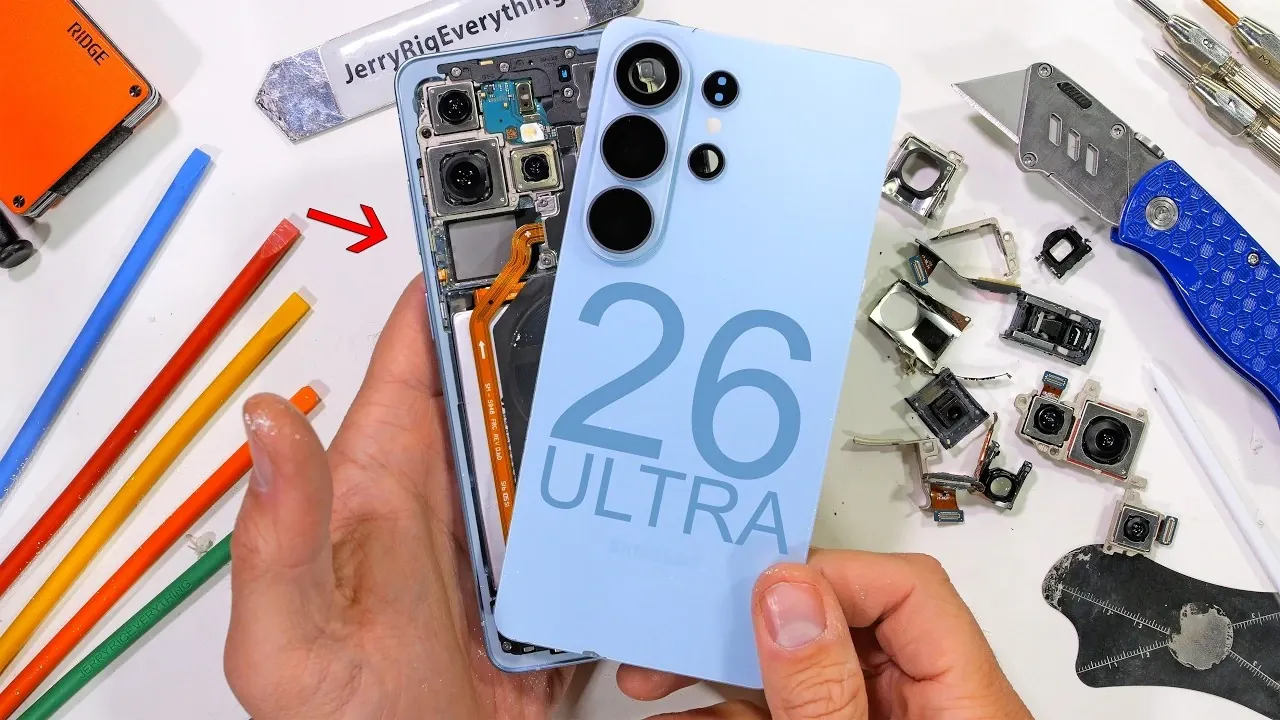
The Samsung Galaxy S26 Ultra teardown reveals a blend of notable hardware advancements and subtle design adjustments, reflecting Samsung’s strategy of incremental innovation. While the device introduces improvements in areas such as camera technology, thermal management, and charging, it also makes compromises, such as removing the anti-glare coating to accommodate a privacy screen. These changes highlight Samsung’s effort to refine its flagship device, but they may not be compelling enough to persuade users of recent models to upgrade. The video below from Zack at JerryRigEverything gives us a look at how the new Galaxy S26 Ultra is designed and constructed, let’s find out what is inside the device.

Camera Enhancements: Compact Design Meets Advanced Performance
The camera system of the Galaxy S26 Ultra is one of its standout features, showcasing significant upgrades aimed at enhancing both performance and design. A new 50MP telephoto lens improves light capture by 37%, enabled by a wider aperture (f/2.9 compared to the previous f/3.4). This improvement is complemented by the innovative “All Lenses on Prism” (ALOP) design, which reduces the overall camera length by 22%, allowing for a more compact and streamlined device without compromising image quality. Key advancements include:
- Enhanced optical image stabilization for sharper, clearer photos.
- Prism technology that significantly boosts low-light photography capabilities.
These features cater to users who prioritize professional-grade photography in a smartphone, making the Galaxy S26 Ultra a strong contender for photography enthusiasts.
Privacy Screen: Security at the Cost of Usability
Samsung introduces a privacy screen in the Galaxy S26 Ultra, designed to limit visibility from side angles and enhance user security. While this feature is appealing for privacy-conscious users, it comes with notable trade-offs:
- Reduced screen brightness, which can hinder usability in outdoor or brightly lit environments.
- The removal of the anti-glare coating, further impacting screen clarity under direct sunlight.
Although the privacy screen adds a layer of security, these compromises in display performance may deter users who prioritize screen quality and outdoor usability over privacy.
Charging and Battery: Faster, Smarter and More Repairable
The Galaxy S26 Ultra introduces significant advancements in charging technology, making it more efficient and user-friendly. The device now supports 60W fast charging through dual power plugs, allowing faster charging times. Additional enhancements include:
- A 25W wireless charging coil for quicker wireless charging sessions.
- A 5,000mAh battery designed for easier removal, simplifying repairs and replacements.
However, reverse wireless charging remains unchanged at 4.5W, which may disappoint users expecting an upgrade in this area. These updates reflect Samsung’s focus on improving charging convenience while addressing repairability, a growing concern among environmentally conscious consumers.
Thermal Management: Improved Cooling for Demanding Tasks
The Galaxy S26 Ultra addresses heat dissipation with a vapor chamber that is 15% larger than its predecessor. This enhancement results in a 21% improvement in thermal performance, making sure the device remains cool even during resource-intensive activities such as gaming or video editing. By improving thermal management, Samsung not only enhances performance but also extends the device’s lifespan by reducing the risk of overheating. This focus on efficient cooling demonstrates Samsung’s commitment to delivering a reliable and durable flagship device.
Design Refinements: Practical Adjustments for Modern Users
The Galaxy S26 Ultra incorporates several design refinements aimed at improving durability, functionality and user experience. Key updates include:
- A redesigned S Pen slot that enhances waterproofing, though it renders older S Pens incompatible.
- A USB-C 3.2 port that supports 60W fast charging, aligning with modern connectivity standards.
- A compact, double-stacked motherboard layout that optimizes internal space for better performance and durability.
Despite these updates, some elements remain unchanged, such as the water damage indicator near the SIM tray, which continues to provide reliable safeguards against liquid exposure. These practical adjustments reflect Samsung’s effort to balance innovation with reliability.
Balancing Upgrades with Familiarity
The Galaxy S26 Ultra strikes a balance between introducing meaningful upgrades and retaining familiar features from its predecessor. For instance:
- Reverse wireless charging remains at 4.5W, offering continuity for users accustomed to this feature.
- The water damage indicator is unchanged, maintaining its proven reliability.
This approach ensures that the device meets user expectations while offering incremental improvements that enhance its overall functionality.
A Refined Flagship for Select Users
The Samsung Galaxy S26 Ultra delivers noteworthy advancements in camera technology, thermal management and charging capabilities. However, these improvements are largely incremental rather than innovative. The compromises in display performance, coupled with the absence of new features, may not justify an upgrade for users of recent devices. For those seeking a well-rounded flagship with practical enhancements, the Galaxy S26 Ultra offers a compelling option. However, for others, it may feel like a refinement rather than a bold leap forward.
Source & Image Credit: JerryRigEverything
Disclosure: Some of our articles include affiliate links. If you buy something through one of these links, Geeky Gadgets may earn an affiliate commission. Learn about our Disclosure Policy.
