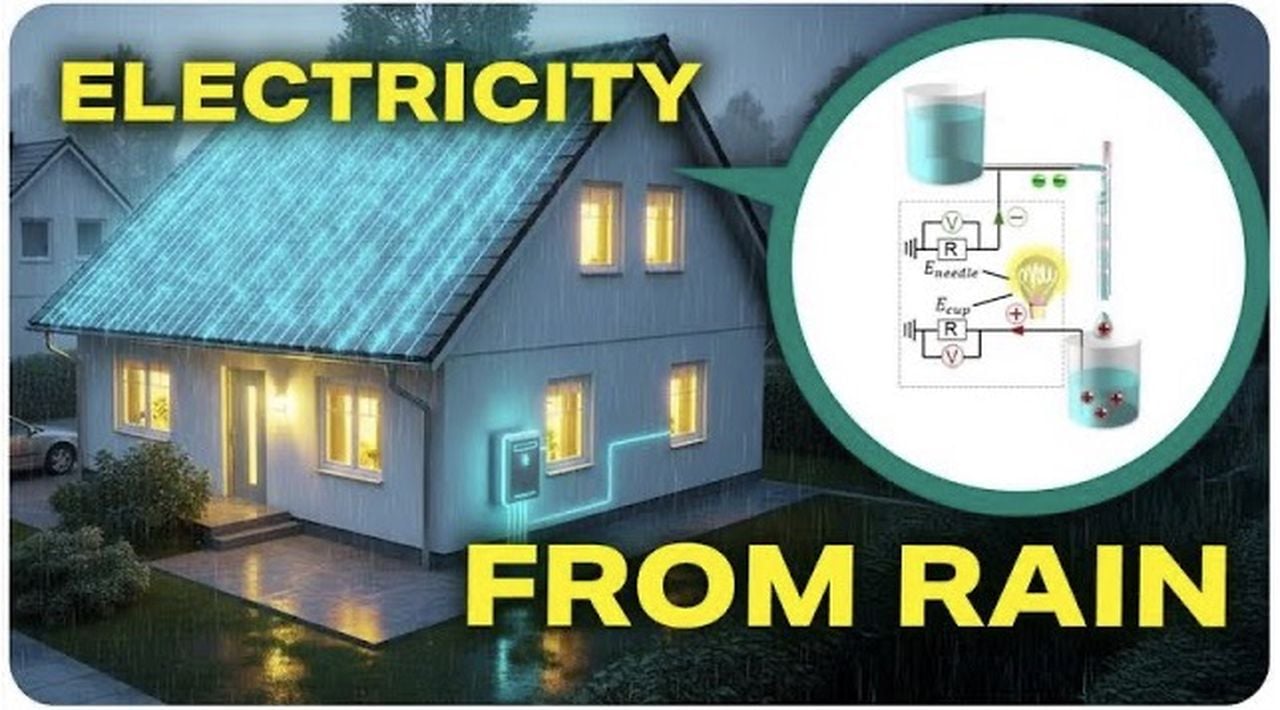
What if the rain falling outside your window could do more than water your garden or fill storm drains? Imagine a world where every drop of rain generates electricity, enough to power homes, cities, and beyond. Thanks to a new innovation from researchers in Singapore, this vision is no longer just a dream. By using a innovative “plug flow” principle, scientists have developed a system capable of producing up to 100,000 times more electricity from raindrops than previously thought possible. This discovery not only challenges the limits of renewable energy but also reimagines how we might harness nature’s most abundant resources in ways that were once unimaginable.
In this overview, the German Science Guy explains how this innovative technology works, the science behind its remarkable efficiency, and its potential to transform urban energy systems. You’ll discover how the plug flow system overcomes long-standing physical barriers, making it a viable solution for regions with frequent rainfall. But it’s not without challenges, questions about scalability, durability, and cost remain. Could this innovation become the missing piece in the renewable energy puzzle, complementing solar panels and wind turbines to create a more resilient energy future? Let’s uncover the possibilities and the hurdles that lie ahead.
Generating Electricity from Rain
TL;DR Key Takeaways :
- Researchers in Singapore have developed a novel “plug flow” system to generate electricity from falling raindrops, achieving energy conversion efficiency over 10% and a power density of up to 100 W/m².
- The plug flow principle uses vertical tubes to create a “string of pearls” flow pattern, overcoming physical constraints like the Dubai length limitation and allowing efficient charge separation.
- The system operates solely on gravity, requires no external energy input, and can be easily integrated into urban infrastructure, such as rooftops and rain gutters.
- Challenges include maintaining flow consistency, addressing size limitations, improving durability, and reducing high initial costs to enhance scalability and adoption.
- While not as powerful as solar panels, the plug flow system complements them by generating electricity during rainfall, offering a more consistent and diversified renewable energy solution.
Rainwater as a Renewable Energy Opportunity
Hydropower has long been a cornerstone of renewable energy, relying on large-scale dams and reservoirs to generate electricity. However, its expansion is constrained by environmental concerns, geographical limitations, and the need for extensive infrastructure. Rainwater, in contrast, is a widely available yet underutilized resource. Harnessing energy from individual raindrops presents an opportunity to complement existing renewable systems, particularly in regions with frequent rainfall. This approach could provide a localized and sustainable energy solution, especially for urban areas where space for traditional renewable energy systems is limited.
The Science Behind the Plug Flow Principle
At the heart of this innovation is the plug flow principle, which employs vertical tubes to create a distinctive “string of pearls” flow pattern. In this system, water droplets alternate with air bubbles, enhancing charge separation at the water-air interface. This design effectively overcomes the Dubai length limitation, a physical constraint that previously hindered the generation of energy from raindrops.
Under optimal conditions, the plug flow system achieves an energy conversion efficiency exceeding 10% and a power density of up to 100 W/m². Unlike conventional hydropower systems, it operates solely on gravity, eliminating the need for pumps or complex machinery. This simplicity allows for seamless integration into existing infrastructure, such as rooftops and rain gutters, making it a versatile and practical option for urban environments.
How Raindrops Could Soon Light Up Entire Cities

Learn more about the latest advancements in energy by reading our previous articles, guides and features :
- How Regenerative Tech is Reducing Energy Waste and Costs
- How MGA Thermal’s Alloy is Changing the Future of Energy
- How China’s Energy Infrastructure is Dominating the AI Race
- Onshore Wave Energy: A Sustainable Solution to Harness Ocean
- Wave Energy : The Future of Clean, Reliable Renewable Energy
- Samsung Unveils Cutting Edge Energy Efficient Appliances
- Samsung SmartThings Energy manages energy usage
- Why Sodium-Ion Batteries Are the Future of Energy Storage
- Dyson Energy
Advantages of the Plug Flow System
The plug flow system offers several distinct benefits that position it as a promising addition to the renewable energy landscape:
- Gravity-driven operation: The system requires no external energy input to move water, significantly reducing operational energy costs.
- Environmental resilience: It maintains consistent performance even in the presence of water contaminants or temperature fluctuations, making sure reliability.
- Ease of integration: The design can be retrofitted into existing structures, such as rain gutters and rooftops, minimizing installation complexity and costs.
These features make the plug flow system particularly appealing for densely populated urban areas with limited space and abundant rainfall, where traditional renewable energy solutions may face challenges.
Challenges and Areas for Improvement
Despite its potential, the plug flow system faces several challenges that must be addressed to enable widespread adoption:
- Flow consistency: Maintaining the plug flow pattern is critical, as disruptions caused by continuous water flow can significantly reduce efficiency.
- Size limitations: The system’s effectiveness is currently restricted to tube lengths of up to 32 cm, necessitating the use of multiple modules for higher energy output.
- Durability concerns: Issues such as clogging, UV degradation of materials like FEP tubing, and weather resistance need to be resolved to ensure long-term reliability.
- High initial costs: The materials and installation expenses are currently higher than those of established technologies, such as solar panels, posing a barrier to adoption.
Addressing these challenges will require further research and development to enhance the system’s scalability, durability, and cost-effectiveness, paving the way for broader implementation.
Complementing Solar Panels and Other Renewable Technologies
Solar panels remain a dominant force in renewable energy, with power densities exceeding 200 W/m². While the plug flow system does not match solar panels in terms of raw power output, it offers a unique advantage: the ability to generate electricity during rainfall. This capability makes it an ideal complement to solar panels, particularly in regions where frequent rain disrupts solar energy production. By combining these technologies, it is possible to create a more consistent and reliable energy supply, reducing dependence on any single source.
Future Prospects and Emerging Innovations
To fully realize its potential, the plug flow system will require advancements in material science, cost reduction, and durability. Researchers are exploring ways to improve the efficiency and scalability of the technology, addressing its current limitations. Additionally, competing innovations, such as triboelectric nanogenerators, are investigating alternative methods to harness energy from raindrops. These parallel developments highlight the growing interest in rainwater as a renewable energy resource.
Continued innovation in this field will be essential to overcoming technical and economic barriers. By integrating rainwater energy harvesting with existing renewable systems, such as solar panels and wind turbines, it may be possible to create a more resilient and diversified energy future.
Media Credit: German Science Guy
Disclosure: Some of our articles include affiliate links. If you buy something through one of these links, Geeky Gadgets may earn an affiliate commission. Learn about our Disclosure Policy.
