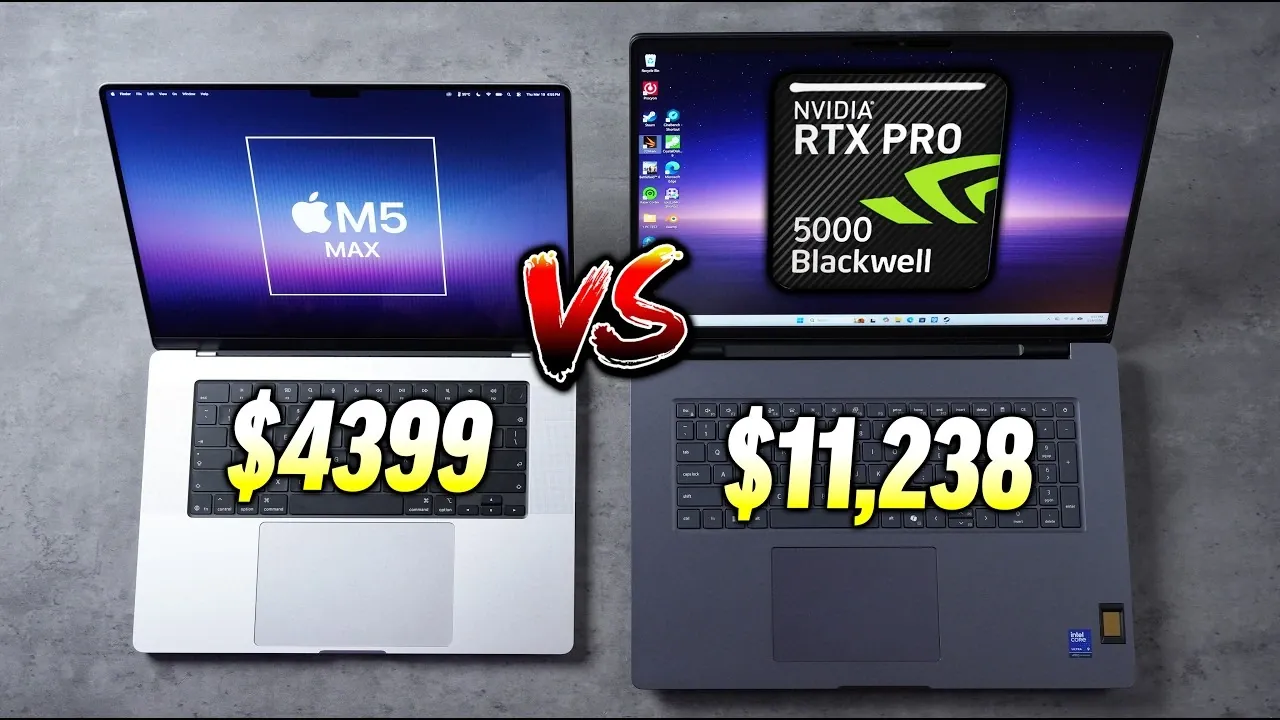
When comparing Apple’s 16-inch M5 Max MacBook Pro, priced at $4,400, to Dell’s 18-inch Pro Max 18 Plus, which costs $11,238, the differences in performance, design, and price highlight two distinct approaches to high-end laptops. Apple focuses on delivering a balance of performance and efficiency, while Dell emphasizes raw power and workstation-grade capabilities. This detailed analysis explores key metrics to help you determine which laptop best suits your specific needs. The video below from Max Tech compares the new M5 Max MacBook Pro to Dell’s $11,000 laptop.

Price and Build Quality
The M5 Max MacBook Pro offers a more affordable and compact option, featuring a sleek, minimalist design that prioritizes portability. Its aluminum unibody construction ensures durability while maintaining a lightweight profile, making it ideal for users who are frequently on the move.
In contrast, the Dell Pro Max 18 Plus is a significantly larger and heavier machine, designed with workstation-grade components such as 128GB of ECC RAM and an RTX Pro 5000 GPU. Its robust build quality caters to professionals who require maximum computing power for demanding tasks. However, this comes at the expense of portability, as its bulkier design is better suited for stationary setups. While Dell’s premium materials and industrial design reflect its high price point, Apple’s M5 Max strikes a balance between aesthetics, portability, and durability.
Performance: Storage, CP,U and Graphics
Storage Performance
Storage speed is a critical factor for tasks like file transfers and application loading. Dell’s SSD offers 24% faster read speeds, making it an excellent choice for accessing large datasets or running data-intensive applications. However, the M5 Max excels in write speeds, nearly doubling Dell’s performance in this area. This advantage is particularly beneficial for workflows such as video editing, where high write speeds are essential for smooth performance during large file exports.
CPU Performance
In multi-core CPU benchmarks, the M5 Max demonstrates 30% higher performance compared to the Dell Pro Max, as evidenced by Cinebench tests. Its single-core performance is also superior, making it a better option for tasks requiring high single-thread efficiency, such as coding, light photo editing, and general productivity. While Dell’s workstation-grade CPU is powerful, Apple’s silicon architecture showcases superior efficiency and real-world performance, particularly in scenarios where both power and energy efficiency are critical.
Graphics and AI Processing
For GPU performance, Dell’s RTX Pro 5000 outperforms the M5 Max by 8% in graphics benchmarks and 21% in AI processing tasks. This makes Dell a more suitable choice for professionals working with AI models, machine learning, or GPU-intensive applications. However, Apple has made significant strides with its GPU capabilities, narrowing the performance gap compared to previous models. While the M5 Max may not match Dell’s raw GPU power, it remains a viable option for users who prioritize efficiency and portability over maximum graphical output.
Specialized Use Cases: Gaming, 3D Rendering and Editing
Gaming Performance
For gaming enthusiasts, Dell’s Windows x86 platform and RTX GPU deliver 42% higher frame rates and broader compatibility with popular gaming titles. The Pro Max 18 Plus is clearly optimized for high-performance gaming, offering a superior experience for those who prioritize this use case. On the other hand, the M5 Max, while capable of running some games, is not designed with gaming as a primary focus. Its macOS ecosystem and hardware optimizations cater more to professional workflows than gaming.
3D Rendering
In 3D rendering tasks, the M5 Max excels in handling complex Blender projects, particularly when running on battery power. Its efficiency allows it to maintain consistent performance even when unplugged, a significant advantage for professionals who need flexibility. Dell, however, performs better in simpler rendering tasks, using its GPU and RAM to deliver quick results when connected to a power source. This distinction makes Dell a better choice for stationary rendering workflows, while the M5 Max is ideal for mobile professionals.
Photo Editing Optimization
For photo editing, Dell’s higher RAM capacity and optimization provide an edge in tasks like Lightroom Classic exports and denoising high-resolution images. These features make it a strong contender for photographers managing large image libraries or working with detailed files. While the M5 Max is capable of handling photo editing, it falls slightly behind Dell in scenarios that demand extensive memory resources.
Video Editing Performance
Video editors will find the M5 Max particularly appealing for demanding tasks such as 8K RAW to H.265 conversions, where it outpaces Dell in performance. Its superior write speeds and optimized architecture make it a reliable tool for professionals working on high-resolution video projects. Dell’s capabilities, while strong, are less optimized for video editing workflows, making the M5 Max the better choice for this specific use case.
Thermal Management, Power Efficiency, and Portability
Thermal Management and Power Efficiency
The M5 Max operates at a peak power consumption of just 70W, compared to Dell’s 150W. This lower power draw translates to better battery life and cooler operation, making it more comfortable for extended use. Additionally, the M5 Max maintains consistent performance when unplugged, a key advantage for users who need reliable performance on the go. In contrast, Dell’s higher thermal output and reliance on a constant power source limit its portability and comfort during prolonged use.
Portability
Portability is a defining factor that sets these laptops apart. The M5 Max’s compact design and lighter weight make it an excellent choice for users who prioritize mobility. Its slim profile and efficient performance allow it to excel in both professional and casual settings. On the other hand, Dell’s larger size and heavier build are better suited for stationary workstation setups, making it less practical for users who frequently travel or work in different locations.
Final Thoughts: Choosing the Right Laptop
The M5 Max MacBook Pro emerges as a compelling option for those seeking a balance of performance, portability, and efficiency at a significantly lower price point. Its strengths in CPU performance, video editing, and power efficiency make it an excellent choice for professionals who value versatility and mobility.
Meanwhile, the Dell Pro Max 18 Plus excels in areas such as gaming, AI processing, and photo editing, offering unparalleled power for users with highly specialized needs. However, its higher cost and bulkier design may limit its appeal to those who prioritize portability or budget-conscious solutions. Ultimately, the decision between these two laptops will depend on whether you prioritize raw power or a balanced, efficient experience tailored to a variety of professional workflows.
Discover other guides from our vast content that could be of interest on the M5 Max MacBook Pro.
- Apple’s M5 Pro & M5 Max MacBook Pros: Coming Next Week?
- Apple M5 Pro and M5 Max MacBook Pros Launch Wednesday
- Apple M5 Pro and M5 Max MacBook Pros Coming Soon
- 2026 MacBook Pro Rumors: M5 Pro & M5 Max Updates Explained
- MacBook Pro M5 Max Release Date, Features and More
Source & Image Credit: Max Tech
Disclosure: Some of our articles include affiliate links. If you buy something through one of these links, Geeky Gadgets may earn an affiliate commission. Learn about our Disclosure Policy.
