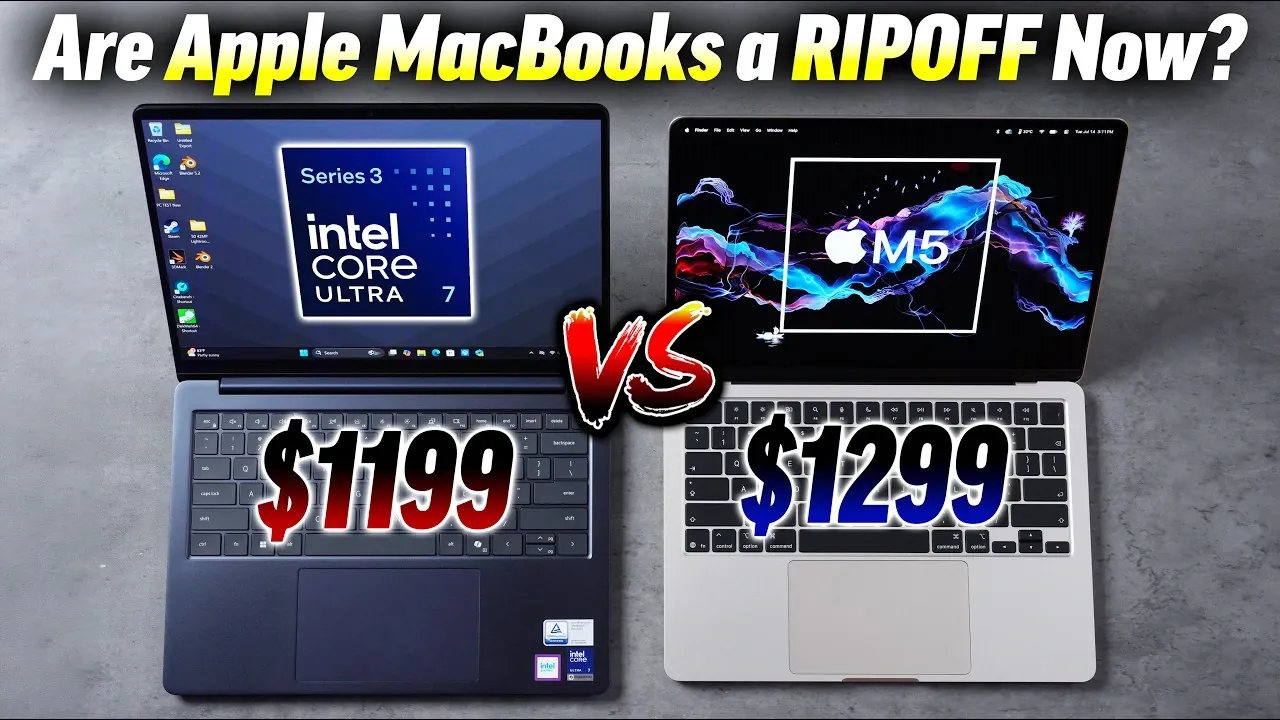
Apple’s decision to increase the price of the M5 MacBook Air to $1,300 has sparked debate about its value in a highly competitive laptop market. Positioned against the Dell 14S, which is priced slightly lower at $1,200, the comparison between these two devices becomes essential for potential buyers. The viodeo below from Max Tech provides more insights into their design, performance, and features to help you determine which laptop better suits your needs.

Price and Build Quality
When evaluating price and build quality, both laptops offer premium aluminum designs, but their design philosophies cater to different user preferences:
- MacBook Air: Known for its sleek and lightweight design, the MacBook Air is ultra-portable, making it an excellent choice for users who prioritize mobility and aesthetics. Its seamless hinge and larger, highly responsive trackpad enhance usability, particularly for those frequently on the move.
- Dell 14S: While slightly bulkier, the Dell 14S features a sturdier build, appealing to users who value durability and a robust feel. Its added weight and thickness may be a trade-off for those seeking a more rugged device.
For users who prioritize portability and a refined design, the MacBook Air stands out. However, the Dell 14S offers a solid, premium feel at a slightly lower price, making it a compelling option for those who value durability over portability.
Display Technology
The display is a critical factor in choosing between these laptops, as each caters to different visual preferences and usage scenarios:
- Dell 14S: Equipped with a 300-nit OLED touch display, the Dell 14S delivers vibrant colors, deep contrasts and an immersive viewing experience. However, its reflective surface can pose challenges in brightly lit environments, potentially limiting its usability outdoors.
- MacBook Air: Features a 500-nit LCD display that excels in brightness and clarity, making it ideal for outdoor or well-lit settings. While it lacks the vivid contrast of OLED, its superior brightness ensures excellent visibility in various lighting conditions.
Your choice here depends on your priorities. If you value vivid colors and deep contrast, the Dell 14S is the better option. Conversely, if brightness and outdoor usability are more important, the MacBook Air is the clear winner.
Ports and Expandability
Connectivity and expandability are areas where the Dell 14S holds a distinct advantage, offering more versatility for users with diverse needs:
- Dell 14S: Includes a wide range of ports, such as HDMI, USB-A and USB-C, along with an upgradeable SSD. This makes it a versatile choice for users who require legacy ports or the ability to expand storage in the future.
- MacBook Air: Adopts a minimalist approach with two Thunderbolt 4 ports and a MagSafe charging port. While this design complements its sleek profile, it lacks legacy ports and does not support storage upgrades, which may limit its appeal for users needing more connectivity options.
If you require diverse port options or future expandability, the Dell 14S is the better choice. For those who prefer a minimalist setup and rely on wireless peripherals, the MacBook Air offers a streamlined experience.
Performance
Performance is a defining factor in this comparison, and the MacBook Air takes the lead with its innovative hardware:
- MacBook Air: Powered by Apple’s M5 chip, the MacBook Air delivers exceptional CPU and GPU performance. It excels in demanding tasks such as video editing, graphic design, and software development, making it a top choice for professionals and creatives.
- Dell 14S: Runs on the Intel Panther Lake Ultra 7355 processor, which, while capable, struggles to match the MacBook Air’s performance in graphics-intensive applications. It is better suited for general productivity tasks and casual use.
For users who need high performance and efficiency, particularly in resource-intensive workflows, the MacBook Air is the superior option.
Battery Life
Battery life is another area where the MacBook Air demonstrates its efficiency and reliability:
- MacBook Air: Retains 73% of its charge after two hours of use, showcasing its excellent energy efficiency. Despite its smaller battery size, it provides extended usage on a single charge, making it ideal for users who are frequently on the go.
- Dell 14S: Drops to 68% in the same timeframe, indicating slightly lower energy efficiency. While still respectable, it falls short of the MacBook Air’s longevity, which could be a deciding factor for users prioritizing battery life.
If long-lasting battery performance is a priority, the MacBook Air is the better choice for extended, uninterrupted use.
Audio and Webcam
Audio and webcam quality can significantly influence the overall user experience, particularly for remote work and entertainment:
- Dell 14S: Features louder speakers, which are beneficial for presentations or media playback. However, the sound quality lacks depth, particularly in bass and midrange tones. Its webcam delivers slightly better image quality, making it a strong contender for video conferencing.
- MacBook Air: Offers a more balanced audio profile, providing clear and rich sound, though it is not as loud as the Dell 14S. Its webcam includes the Center Stage feature, which uses AI to keep you in focus during video calls, enhancing the overall experience.
Your decision here depends on whether you prioritize louder audio (Dell 14S) or balanced sound and advanced webcam features (MacBook Air).
Value Proposition
Ultimately, the choice between the M5 MacBook Air and the Dell 14S depends on your specific needs and priorities:
- Dell 14S: Appeals to users seeking affordability, an OLED display, and versatile connectivity. It is a practical choice for those who value flexibility and cost-effectiveness without compromising on essential features.
- MacBook Air: Justifies its higher price with superior performance, portability, and battery efficiency. It is particularly well-suited for macOS users or those who need a laptop that excels in productivity, creative tasks, and longevity.
Both laptops offer compelling features, but they cater to different audiences. The Dell 14S provides strong value with its robust design, OLED display, and diverse port selection. However, the M5 MacBook Air delivers a more refined experience, excelling in performance, portability, and battery life. If you prioritize affordability and flexibility, the Dell 14S is a reliable choice. On the other hand, if you value power, efficiency, and a seamless macOS experience, the MacBook Air remains a worthwhile investment despite its higher price.
Discover other guides from our vast content that could be of interest on the M5 MacBook Air.
- MacBook Air M5 & OLED: What Apple’s Really Planning (Leaks & Rumors)
- MacBook Air M5: Is the 15-inch Really Worth the Extra $200?
- M5 MacBook Air: Is the 512GB Base Storage Worth the New $1,099 Price?
- MacBook Air M5: FINALLY Getting an OLED Screen?! (BIGGEST Upgrade Leak
- The Ultimate 2026 MacBook Buyer’s Guide: Neo, Air, or Pro?
Source & Image Credit: Max Tech
Disclosure: Some of our articles include affiliate links. If you buy something through one of these links, Geeky Gadgets may earn an affiliate commission. Learn about our Disclosure Policy.
