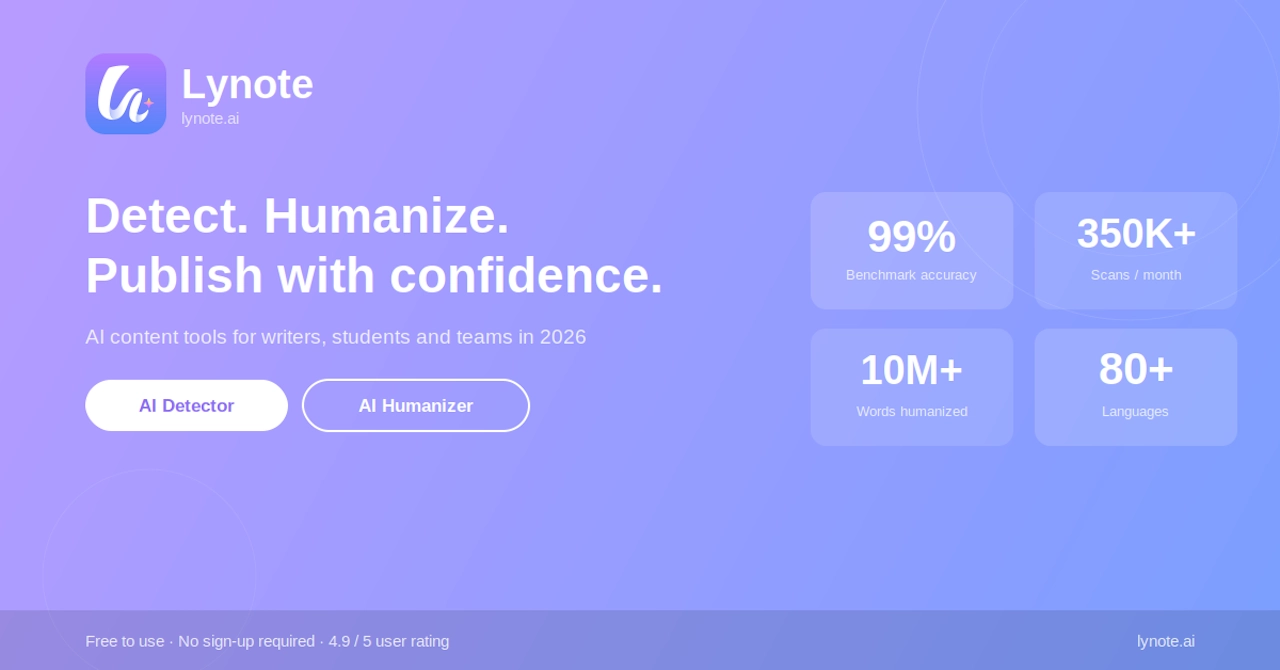
Artificial intelligence has fundamentally changed how content is produced. Developers, marketers, students, and business owners now generate first drafts with tools like ChatGPT, Claude, and Gemini in seconds. But two questions have emerged alongside this shift: how do you know whether a piece of text was written by AI, and what do you do when raw AI output sounds too robotic to publish?
These are not niche concerns. Publishers need to verify content authenticity. Educators need transparent tools for evaluating student work. Marketing teams need AI-assisted copy that still sounds human. In 2026, the answer to both questions increasingly points to the same category of tool: AI detection and humanization platforms.
This guide covers how both technologies work, what separates the reliable tools from the unreliable ones, and how Lynote AI approaches both problems in a single platform.
Why AI-generated content is harder to detect than you think
Early AI detection was relatively simple. First-generation language models produced text with obvious tell-tale patterns: consistent sentence lengths, predictable transition words, and a certain flatness in vocabulary. Detectors trained on those patterns worked reasonably well against those models.
That era is over. GPT-5, Claude, Gemini, LLaMA, and DeepSeek now generate content with substantially more variation than their predecessors. Sentence structures shift naturally. Vocabulary diversifies. In many cases, a skilled reader cannot reliably tell whether a piece was AI-written or human-written.
Modern detection systems compensate by analyzing deeper signals:
- Perplexity — how predictable each word choice is relative to what precedes it. AI models are trained to minimize perplexity, producing fluent but statistically safe text. Humans make more surprising lexical choices.
- Burstiness — the variation in sentence length. Human writing tends to alternate between short punchy sentences and longer, more complex ones. AI output often maintains a narrower rhythm.
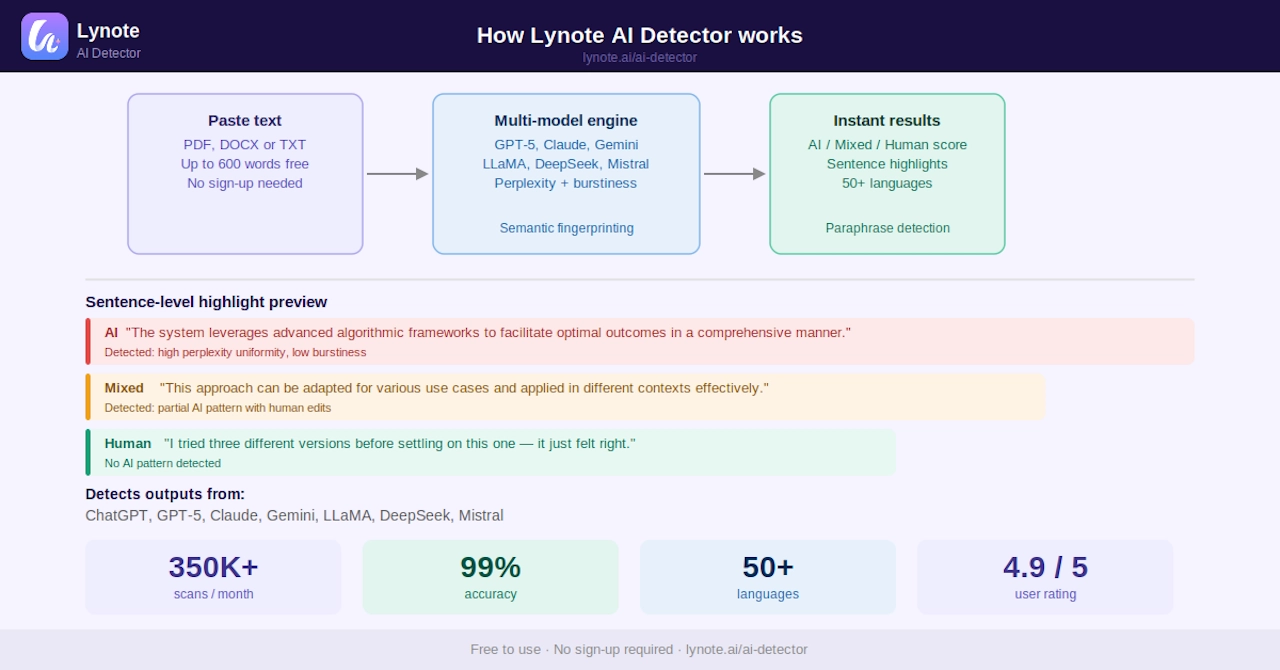
- Semantic fingerprinting — each major AI model has characteristic patterns in how it builds arguments, structures paragraphs, and links ideas. Advanced detectors cross-reference text against these model-specific signatures.
- Paraphrase detection — the ability to spot AI-generated text that has been manually edited or run through a rewriting tool. This is where many first-generation detectors fail.
Lynote AI performs over 350,000 scans per month with a 99% benchmark accuracy rate, covering outputs from GPT-5, Claude, Gemini, LLaMA, Mistral, and DeepSeek simultaneously. Rather than returning a single percentage score, it highlights results at the sentence level — flagging individual lines as AI-generated (red), human-written (green), or mixed (amber) — so users understand exactly which parts of a document need closer review or rewriting.
The false positive problem
Any honest discussion of AI detection has to acknowledge its limitations. These systems are probabilistic, not definitive. They estimate the likelihood that text was machine-generated — they do not know for certain.
False positives are a documented problem. Highly structured writing, formal academic prose, and text produced by non-native English speakers following consistent grammar rules can all score high on AI detection systems even when written entirely by humans. Several studies have found that essays by international students are flagged at disproportionately high rates.
This is precisely why sentence-level transparency matters. A tool that returns “73% AI” with no further information leaves the user guessing. A tool that highlights the specific sentences driving that score — and distinguishes between AI-generated, paraphrased, and genuinely human-written content — gives users something they can act on.
Lynote supports detection across 50+ languages, which also matters in global teams and academic environments where English is not the primary language of instruction.
What AI humanization actually involves
Detection solves one half of the problem. The other half is what to do with AI-generated content once you have it.
Raw AI output has recognizable weaknesses even when it passes a basic quality check. Sentence lengths cluster in a narrow range. Transitions recur predictably. The vocabulary, while accurate, lacks the personality and specificity that reflect genuine expertise or lived experience. Readers notice this, even when they cannot articulate why — the text feels slightly hollow.
AI humanization is the process of addressing these weaknesses without losing the content’s original meaning or factual accuracy. The term is often misunderstood as simple synonym replacement or word-level text spinning. That description fits basic rewriting tools, not genuine humanization technology.
The distinction matters enormously in practice. Word-level spinners change vocabulary without understanding context. The result is text that may score differently on a detection tool but reads incoherently in places — because the synonym swap broke the logical relationship between two adjacent sentences.
Effective humanization operates at the sentence and paragraph level. It analyzes the meaning, intent, and logical flow of a passage before generating revisions. The goal is not to change what the text says, but to change how it says it — in a way that introduces the natural variation and contextual specificity that human writing tends to have.
Three modes for different use cases
Not every piece of content requires the same level of transformation. Lynote’s best AI humanizer tool reflects this with three distinct rewriting modes, each targeting a different point in the content production workflow:
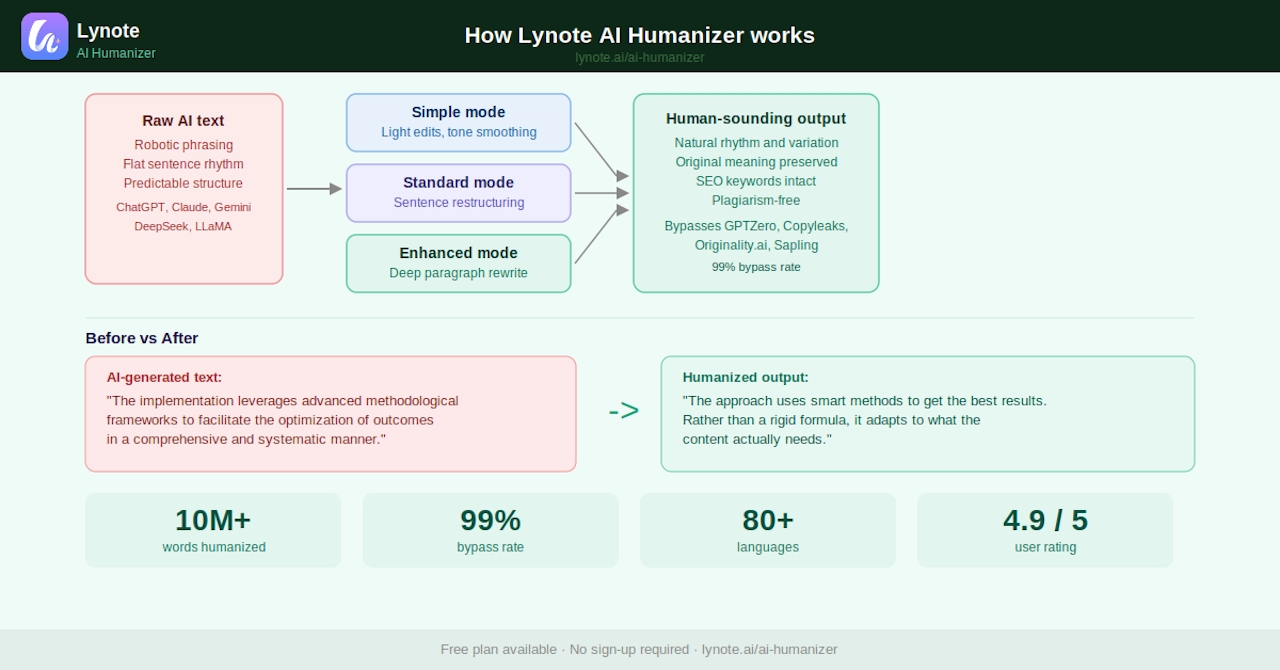
- Simple mode — light-touch editing that adjusts phrasing, smooths transitions, and reduces repetition while keeping the original sentence structure mostly intact. This works well for content that has already been partially edited by a human and just needs the remaining AI artifacts cleaned up.
- Standard mode — moderate restructuring that shifts sentence construction, diversifies vocabulary, and adjusts rhythm. This is the right setting for most marketing copy, blog posts, and product descriptions where the goal is content that reads naturally and passes standard detection platforms.
- Enhanced mode — deep restructuring at the paragraph level, with significant sentence reordering and substantial vocabulary transformation. This is appropriate for high-stakes content that needs to satisfy the most rigorous detection standards, or where the original AI draft was particularly formulaic.
Lynote has processed over 10 million humanized words with a 99% bypass rate across major detection platforms including GPTZero, Copyleaks, Originality.ai, and Sapling. The platform also preserves SEO keywords during rewriting — a non-trivial technical challenge, since naive text transformation tends to disrupt keyword density.
Multilingual support
One frequently overlooked dimension of both AI detection and humanization is language coverage. The majority of AI-generated content is produced in English, but global content teams routinely work across Spanish, French, Portuguese, German, Arabic, and dozens of other languages.
Lynote supports AI detection across 50+ languages and humanization across 80+ languages. This addresses a genuine operational gap: AI text does not only sound robotic in English. The same statistical patterns that make GPT-5 output detectable in English appear in its Spanish and French outputs as well. A detection or humanization tool that only handles English creates a two-tier workflow for global teams.
How the detection and humanization workflow fits together
The most efficient content workflow in 2026 is not “generate and publish” — it is “generate, detect, humanize, verify.”
Detection first identifies which sections of a draft carry the statistical signature of AI-generated text. Humanization then transforms those sections. A second detection pass confirms the result. This four-step loop takes a few minutes with the right tools and produces content that is both accurate and genuinely readable.
Lynote is available free without sign-up for basic usage, with a 4.9 average user rating. For teams managing large content volumes, the platform handles both the detection and humanization steps within a single interface, removing the need to manage multiple subscriptions and workflow handoffs.
Practical takeaways
- AI detection is probabilistic, not binary. Sentence-level highlights give more actionable feedback than single percentage scores.
- False positives are a real risk, particularly for non-native English speakers and formally structured writing. Transparency in reporting matters.
- Humanization is not text spinning. Word-level synonym replacement breaks logical flow. Context-aware rewriting at the sentence and paragraph level is what produces durable, readable results.
- The right humanization mode depends on how heavily the original draft needs transformation — not every piece of content needs deep restructuring.
- Multilingual support is a meaningful differentiator for global teams. Check whether a tool actually supports the languages your team works in, not just English.
As AI becomes a standard part of content production, the organizations that produce the most trustworthy, readable output will be those with a clear, repeatable process for verification and refinement — not those that avoid AI entirely, and not those that publish raw AI output without review.
Disclosure: Some of our articles include affiliate links. If you buy something through one of these links, Geeky Gadgets may earn an affiliate commission. Learn about our Disclosure Policy.
