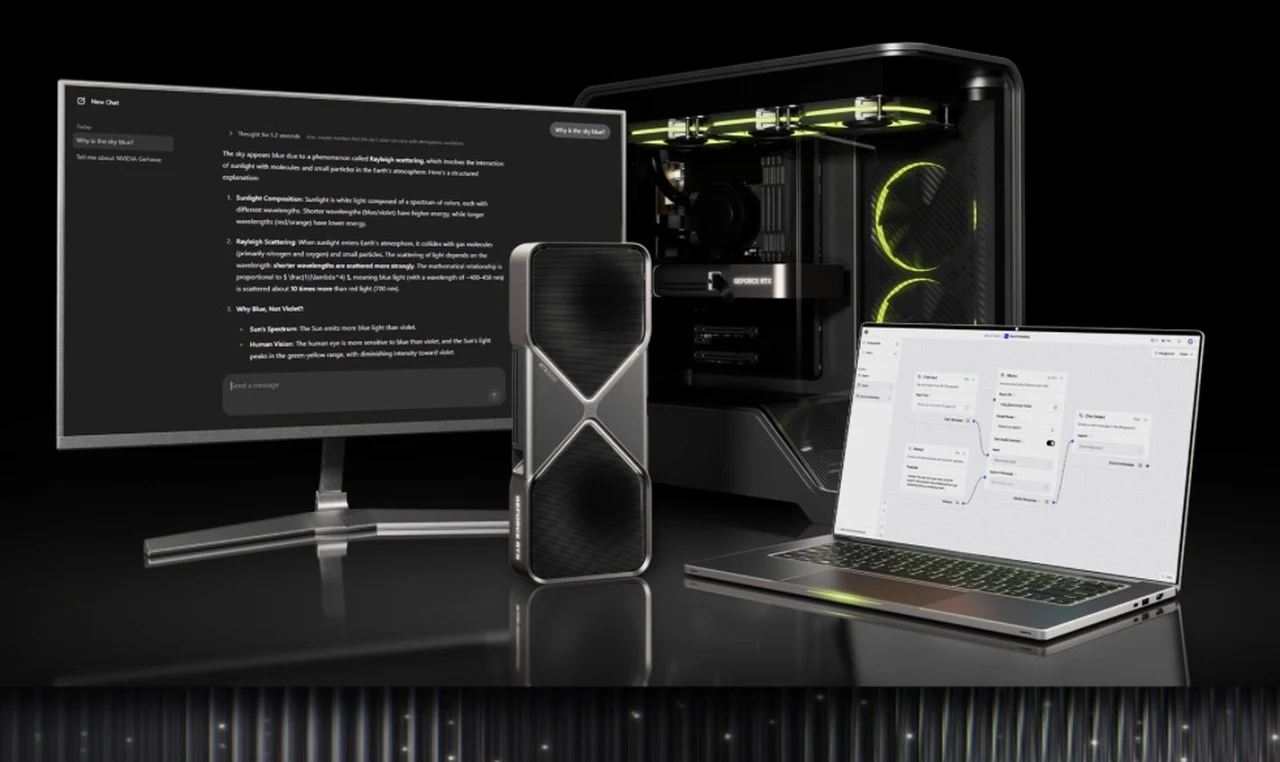
NVIDIA and OpenAI have collaborated to release the gpt-oss family of open-source AI models, optimized for NVIDIA RTX GPUs. These models, gpt-oss-20b and gpt-oss-120b, bring advanced AI capabilities to consumer PCs and workstations, enabling faster and more efficient on-device AI performance.
OpenAI, has unveiled its gpt-oss family of open-weight AI models, specifically optimized for NVIDIA RTX GPUs. These models—gpt-oss-20b and gpt-oss-120b—are designed to deliver advanced AI capabilities to both consumer-grade PCs and professional workstations. By using NVIDIA’s innovative GPU technology, the models provide faster on-device performance, enhanced efficiency, and greater accessibility for developers and AI enthusiasts. The latest OpenAI models feature cutting-edge architecture, extended context lengths, and support for various AI applications, making them accessible to developers and enthusiasts through tools like Ollama, llama.cpp, and Microsoft AI Foundry Local.
Key Highlights of GPT-OSS Models
TL;DR Key Takeaways :
- OpenAI and NVIDIA introduced the gpt-oss models, optimized for NVIDIA RTX GPUs, offering faster performance and accessibility for developers.
- The gpt-oss-20b targets consumer-grade GPUs, while the gpt-oss-120b is designed for professional-grade GPUs, both supporting extended context lengths of up to 131,072 tokens.
- Technological advancements include MXFP4 precision, mixture-of-experts architecture, and chain-of-thought reasoning for enhanced efficiency and problem-solving.
- The models support versatile applications like coding, document analysis, and multimodal input processing, with customizable context lengths for tailored use cases.
- Developer tools, such as the Ollama app and llama.cpp framework, simplify integration, while open-source collaboration fosters innovation and accessibility.
Two Models, Tailored for Performance
The easiest way to test these models on RTX AI PCs, on GPUs with at least 24GB of VRAM, is using the new Ollama app. Ollama is fully optimized for RTX, making it ideal for consumers looking to experience the power of personal AI on their PC or workstation. The gpt-oss family consists of two distinct models, each tailored to meet specific hardware requirements and performance needs:
- gpt-oss-20b: Designed for consumer-grade NVIDIA RTX GPUs with at least 16GB of VRAM, such as the RTX 5090. This model achieves processing speeds of up to 250 tokens per second, making it suitable for individual developers and small-scale projects.
- gpt-oss-120b: Optimized for professional-grade RTX PRO GPUs, this model caters to enterprise and research environments requiring higher computational power and scalability.
Both models support extended context lengths of up to 131,072 tokens, allowing them to handle complex reasoning tasks and process large-scale documents. This capability is particularly advantageous for applications such as legal document analysis, academic research, and other tasks requiring long-form comprehension and detailed analysis.
Technological Innovations Driving Efficiency
The gpt-oss models incorporate several technological advancements that enhance their performance and functionality. These innovations include:
- MXFP4 Precision: The gpt-oss models are the first to support this precision format on NVIDIA RTX GPUs. MXFP4 improves computational efficiency while maintaining output accuracy, reducing resource consumption without compromising performance.
- Mixture-of-Experts (MoE) Architecture: This architecture activates only the necessary components of the model for specific tasks, minimizing computational overhead while maintaining high performance. This design ensures efficient resource utilization, particularly for complex or specialized tasks.
- Chain-of-Thought Reasoning: This feature enables the models to perform step-by-step logical analysis, improving their ability to follow instructions and solve intricate problems. It enhances their effectiveness in real-world applications, such as troubleshooting, decision-making, and problem-solving.
These innovations collectively contribute to the models’ ability to deliver high-speed, accurate results across a variety of use cases, making them versatile tools for developers and organizations alike.
Versatile Applications and Use Cases
The gpt-oss models are designed to support a wide range of applications and industries, making them highly adaptable tools for diverse needs. Key use cases include:
- Web Search and Information Retrieval: The models can process and summarize vast amounts of information, making them ideal for search engines and knowledge management systems.
- Coding Assistance: Developers can use the models for code generation, debugging, and optimization, streamlining software development workflows.
- Document Comprehension: With their extended context lengths, the models excel at analyzing lengthy documents, such as legal contracts, research papers, and technical manuals.
- Multimodal Input Processing: The ability to handle both text and image inputs broadens their applicability, allowing tasks like image captioning, data analysis, and content generation.
The customizable context lengths allow users to tailor the models to specific requirements, whether summarizing extensive documents or generating detailed responses to complex queries. This adaptability makes the gpt-oss models suitable for both general-purpose use and specialized applications, from enterprise workflows to individual projects.
Developer Tools for Seamless Integration
To assist adoption and integration, OpenAI and NVIDIA have provided a comprehensive suite of developer tools. These resources simplify the deployment and testing of the gpt-oss models, making sure accessibility for developers of varying expertise levels. Key tools include:
- Ollama App: An intuitive interface for running and testing the models on NVIDIA RTX GPUs, allowing quick experimentation and deployment.
- llama.cpp Framework: An open-source framework that supports collaboration and optimization, allowing developers to fine-tune the models for specific hardware configurations.
- Microsoft AI Foundry Local: A set of command-line tools and software development kits (SDKs) designed for Windows developers, allowing seamless integration into existing workflows.
These tools empower developers to experiment with advanced AI solutions without requiring extensive expertise in AI infrastructure, fostering innovation and accessibility.
NVIDIA’s Role in Advancing AI
The gpt-oss models were trained on NVIDIA H100 GPUs, using NVIDIA’s state-of-the-art AI training infrastructure. Once trained, the models are optimized for inference on NVIDIA RTX GPUs, showcasing NVIDIA’s leadership in end-to-end AI technology. This approach ensures high-performance AI capabilities on both cloud-based and local devices, making advanced AI more accessible to a broader audience.
Additionally, the models use CUDA Graphs, a feature that minimizes computational overhead and enhances performance. This optimization is particularly valuable for real-time applications, where speed and efficiency are critical.
Open-Source Collaboration and Community Impact
The gpt-oss models are open-weight, allowing developers to customize and extend their capabilities. This openness encourages innovation and collaboration within the AI community, allowing the development of tailored solutions for specific use cases.
NVIDIA has also contributed to open-source frameworks such as GGML and llama.cpp, further enhancing the accessibility and performance of the gpt-oss models. These frameworks provide developers with the tools needed to optimize AI models for a variety of hardware configurations, from consumer-grade PCs to enterprise-level systems.
Empowering the Future of AI Development
The release of the gpt-oss models highlights a pivotal moment in the evolution of AI technology. By harnessing the power of NVIDIA RTX GPUs, these models deliver exceptional performance, flexibility, and accessibility. Their open-source nature, combined with robust developer tools, positions them as valuable assets for driving innovation across a wide range of applications. Whether for individual developers or large organizations, the gpt-oss models offer a practical and efficient solution for advancing AI-driven projects.
Browse through more resources below from our in-depth content covering more areas on AI models.
- Exploring the Power of Small LLM AI Models Like Qwen 3
- OpenAI Horizon Alpha: Open Source ChatGPT-5 AI Model Details
- OpenRouter Review : Easily Access Over 450 AI Models
- Kimi K2 : The Open-Weight AI Model Transforming Coding
- OpenAI moves further away from open source AI
- ChatGPT vs DeepSeek R1 vs Qwen 2.5 Max: AI Models Compared
- Openrouter : 300+ Models in One the Ultimate AI Model Hub
- Google & OpenAI AI Models Won Gold at the 2025 Math Olympiad
- Mistral Small 3 vs Larger AI Models: Efficiency Meets Performance
- Every AI Model Tested for Coding & Cursor’s Secret Prompt
Disclosure: Some of our articles include affiliate links. If you buy something through one of these links, Geeky Gadgets may earn an affiliate commission. Learn about our Disclosure Policy.
