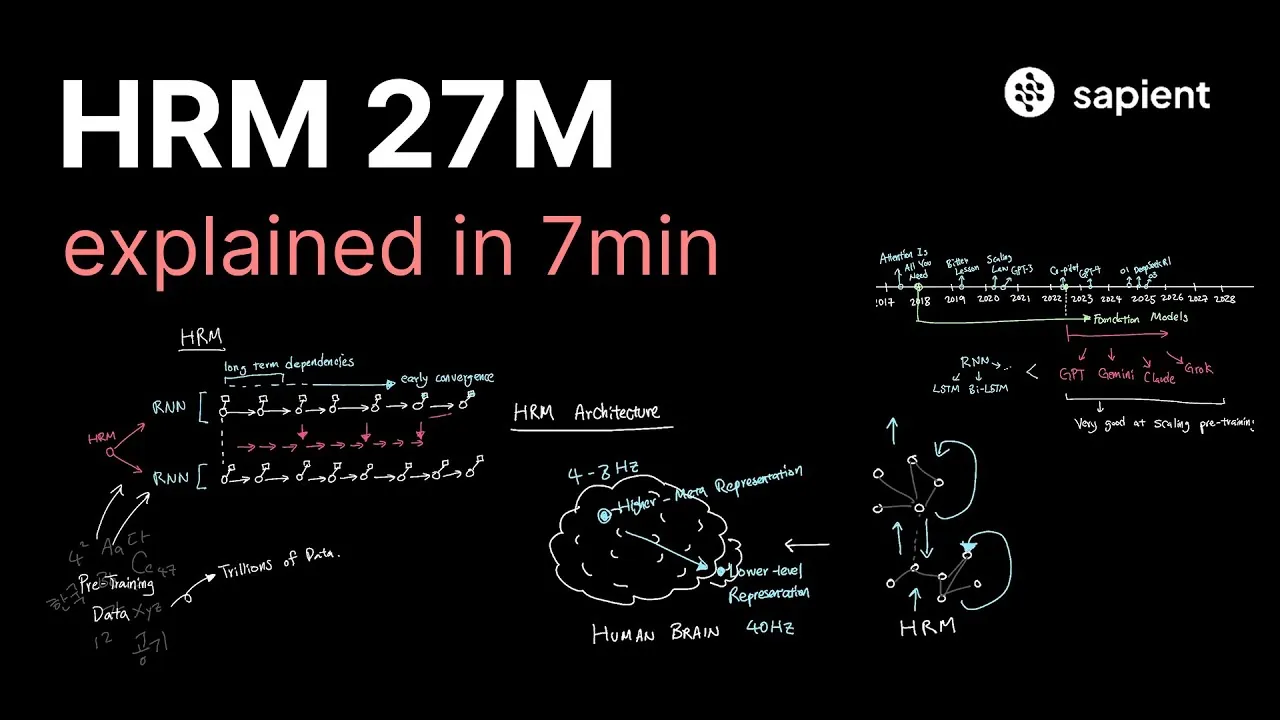
What if the future of artificial intelligence didn’t hinge on size but on ingenuity? In a world dominated by massive transformer models boasting hundreds of billions of parameters, the HRM 27M AI model stands as a bold contradiction. With just 27 million parameters—a fraction of the scale of its competitors, HRM challenges the assumption that bigger is always better. Developed by Sapion Research Lab, this new model employs a dual recurrent neural network (RNN) architecture inspired by the human brain, unlocking surprising capabilities in reasoning and problem-solving without relying on pre-training. Could this minimalist approach redefine the path to artificial general intelligence (AGI)?
Caleb Writes Code explores how HRM’s innovative design disrupts the norms of AI development, offering a fresh perspective on what it means to build intelligent systems. From its brain-inspired architecture to its rejection of pre-training, HRM raises profound questions about efficiency, scalability, and the future of AGI research. You’ll discover how this compact model achieves results that punch well above its weight, why it challenges the dominance of transformer-based systems, and what it means for the future of AI innovation. By the end, you may find yourself rethinking the very foundations of intelligence, both artificial and human.
HRM 27M: Rethinking AGI
TL;DR Key Takeaways :
- The HRM 27M AI model, developed by Sapion Research Lab, employs a dual recurrent neural network (RNN) architecture inspired by human brain activity, challenging the dominance of transformer-based models in AI research.
- Despite its compact size of 27 million parameters and lack of pre-training, HRM demonstrates notable reasoning and problem-solving capabilities, showcasing the potential of small, efficient models in AGI development.
- HRM operates without pre-training, emphasizing iterative reasoning and problem-solving, which challenges the traditional reliance on massive datasets and computational resources in AI training.
- The model’s dual-loop system, inspired by human brain oscillatory patterns, enhances problem-solving by mimicking interactions between fast cognitive processes and slower abstract reasoning.
- HRM highlights the untapped potential of RNN-based architectures as an alternative to transformer models, focusing on reasoning and efficiency over brute-force scalability, signaling a shift in AGI development priorities.
A Minimalist Approach to AI Innovation
HRM’s design stands in stark contrast to the prevailing trend of scaling up transformer-based models. While leading transformers such as GPT-4 and Gemini rely on hundreds of billions or even trillions of parameters, HRM achieves significant results with a mere 27 million parameters. For instance, it scored 32% on the ARC AGI 1 benchmark and 2% on ARC AGI 2, achievements that are particularly remarkable given its compact size and lack of pre-training. This minimalist approach underscores the potential of small, efficient models to drive innovation in AGI research. By focusing on efficiency rather than brute computational power, HRM challenges the assumption that bigger models are inherently better.
Challenging the Pre-Training Paradigm
Traditional AI models rely heavily on pre-training, often processing trillions of tokens from massive datasets to develop their capabilities. HRM, however, operates without pre-training or transfer learning, marking a significant departure from this paradigm. Instead, it emphasizes iterative reasoning and problem-solving, demonstrating that intelligence can emerge without exhaustive data exposure. This approach suggests that future AI systems could be designed and trained with greater efficiency, reducing the need for vast computational resources. By proving that pre-training is not an absolute requirement for achieving meaningful results, HRM opens the door to alternative methods of developing AI systems.
HRM 27M AI Model Overview

Advance your skills in AI models by reading more of our detailed content.
- DeepSeek R1 AI Model Hardware Requirements Guide 2025
- What OpenAI’s GPT-OSS AIK Models Means for the Future of AI
- Exploring the Power of Small LLM AI Models Like Qwen 3
- How Infinite AI Memory Will Transform Industries by 2025
- Why OpenAI’s GPT-OSS Models Are the Future of Accessible AI
- New AI Absolute Zero Model Learns without Data
- Google’s Secret AI Model Dragontail : Features & Benefits Explored
- Openrouter : 300+ Models in One the Ultimate AI Model Hub
- Horizon by OpenAI: Exploring the Future of Open-Weight AI Models
- New Google Gemma 3: Advanced AI Models for Text and AI Vision
Inspired by the Human Brain
At the heart of HRM’s innovation lies its dual recurrent loop system, which is modeled after the oscillatory patterns of the human brain, particularly theta and gamma waves. This architecture mimics the interaction between fast, lower-level cognitive processes and slower, abstract reasoning, allowing the model to engage in iterative cycles of analysis. The dual-loop system not only enhances problem-solving capabilities but also addresses long-standing challenges in RNNs, such as early convergence and difficulty retaining long-term dependencies. By drawing inspiration from the human brain, HRM introduces a novel approach to AI architecture that prioritizes cognitive processes over sheer computational scale.
RNNs vs Transformer Models: A New Perspective
Transformer models have dominated AI research due to their scalability and ability to generalize across diverse tasks. However, they often struggle with tasks that require deep reasoning and contextual understanding. HRM’s success highlights the untapped potential of RNN-based architectures to address these limitations. By prioritizing reasoning and iterative problem-solving over brute-force scalability, HRM offers a compelling alternative to the transformer-centric approach. This shift in focus could lead to the development of AI systems that are not only more efficient but also more aligned with human-like cognitive processes.
Overcoming Challenges in RNN-Based Architectures
Despite its achievements, HRM’s approach is not without challenges. RNNs have historically faced difficulties in maintaining long-term dependencies, and their iterative nature can result in computational inefficiencies. Additionally, the absence of pre-training, while advantageous in some respects, limits the model’s ability to generalize across a wide range of tasks. Addressing these challenges will be essential for advancing RNN-based architectures and making sure their viability in AGI research. Future developments may focus on enhancing the efficiency of iterative processes and improving the model’s ability to handle diverse and complex tasks.
Shifting Priorities in AGI Development
HRM’s success signals a potential shift in the priorities of AGI research. Rather than focusing exclusively on scaling transformer models, researchers may increasingly explore alternative architectures inspired by human cognition. HRM demonstrates that smaller, more specialized models can achieve meaningful progress in AGI by emphasizing reasoning and learning mechanisms over computational power. This shift could pave the way for the development of AI systems that are not only more efficient but also more capable of human-like reasoning and adaptability. By challenging conventional approaches, HRM encourages a broader exploration of what is possible in AGI development.
Media Credit: Caleb Writes Code
Disclosure: Some of our articles include affiliate links. If you buy something through one of these links, Geeky Gadgets may earn an affiliate commission. Learn about our Disclosure Policy.
