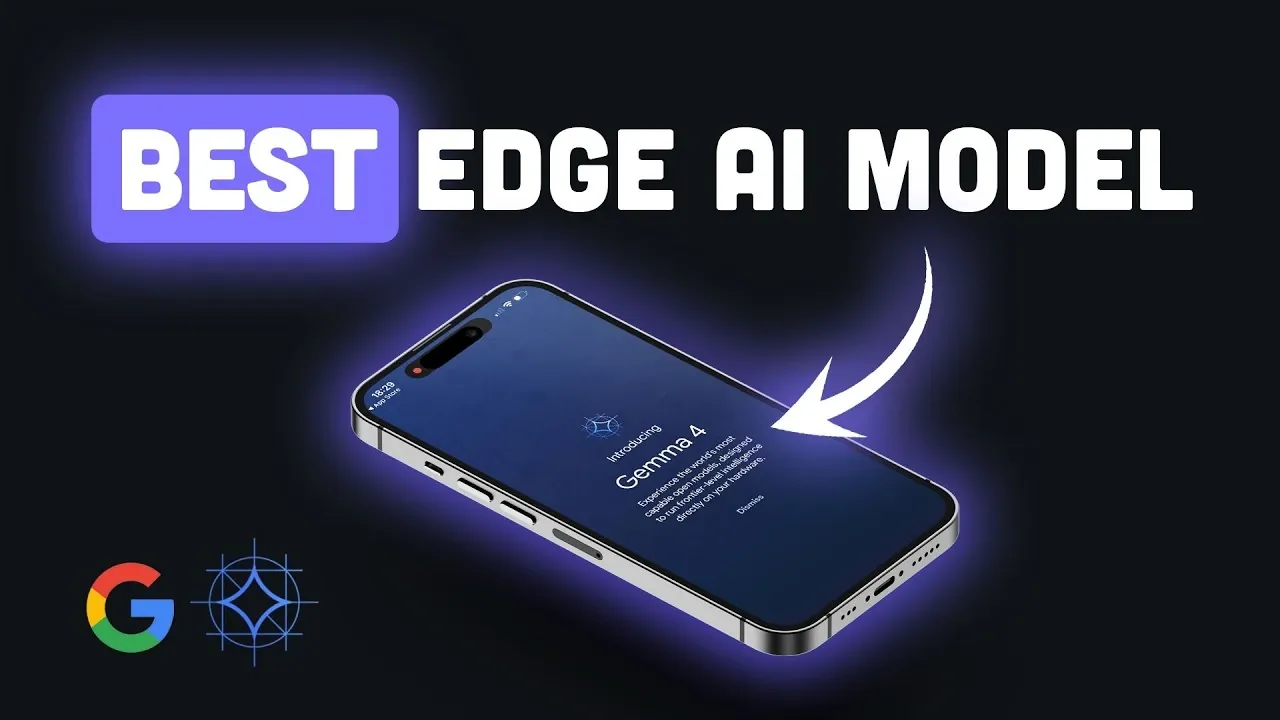
Google’s newly released Gemma 4 challenges conventional assumptions about AI model size and performance. With just 2.3 billion parameters, this compact model rivals the capabilities of much larger systems, such as those with 70 billion parameters, while operating efficiently on low-power hardware. According to Better Stack, Gemma 4’s offline functionality and lightweight design make it particularly suited for edge devices like smartphones, allowing high-performance AI applications without relying on cloud infrastructure. Its open source Apache 2.0 license further enhances accessibility, empowering developers to adapt and deploy the model across diverse use cases.
Explore how Gemma 4 achieves its remarkable efficiency through innovations like per-layer embeddings and a multimodal architecture that handles text, vision and audio inputs seamlessly. You’ll also gain insight into its practical applications, from multilingual support across 140 languages to its ability to process extended datasets with a 128K context window. Whether you’re interested in its benchmark performance or its potential for resource-constrained environments, this guide provides a comprehensive look at what sets Gemma 4 apart.
Why Gemma 4 Stands Out
TL;DR Key Takeaways :
- Google’s Gemma 4 is a compact AI model with only 2.3 billion parameters, rivaling much larger models (e.g., 70 billion parameters) in performance, emphasizing efficiency over size.
- Designed for offline operation, Gemma 4 is ideal for edge devices like smartphones and low-power hardware, making sure privacy and accessibility in remote or resource-constrained environments.
- Key technical innovations include per-layer embeddings, multimodal architecture (text, vision, audio), and a reasoning chain for enhanced logical consistency and efficiency.
- Gemma 4 supports over 140 languages, operates with less than 1.5 GB of RAM and features a 128K context window, making it versatile for global and resource-limited applications.
- While excelling in multimodal tasks and mathematical reasoning, challenges remain in coding tasks, creative outputs and platform compatibility (e.g., iOS integration). Community contributions aim to address these limitations.
Gemma 4 distinguishes itself in the AI landscape through a combination of unique features that prioritize usability and efficiency. These attributes make it a versatile tool for a wide range of applications:
- Open source Accessibility: Developers can freely access, modify and deploy the model, fostering innovation across industries and allowing customized solutions.
- Offline Operation: The ability to function without internet connectivity makes it ideal for remote environments or privacy-sensitive applications, where data security is paramount.
- Compact Yet Powerful: Despite its relatively small size, Gemma 4 delivers high performance, reducing the need for expensive hardware or cloud-based computational resources.
These features collectively position Gemma 4 as a practical and efficient AI model, particularly for scenarios where resource constraints or privacy concerns are critical.
Technical Innovations Behind Gemma 4
The impressive capabilities of Gemma 4 are the result of several technical advancements that enhance its performance while maintaining a compact design. These innovations include:
- Per-Layer Embeddings: This optimization improves the model’s reasoning processes, allowing it to deliver accurate results with greater efficiency.
- Multimodal Architecture: Gemma 4 processes text, vision and audio inputs, allowing seamless integration into diverse applications such as image recognition, speech processing and natural language understanding.
- Reasoning Chain: This feature enhances logical consistency, reducing errors and improving decision-making capabilities in complex tasks.
These advancements not only contribute to the model’s robust performance but also ensure its adaptability across various industries and use cases.

Unlock more potential in Google’s Gemma 4 by reading previous articles we have written.
- Easily Install Google Gemma 4 Locally on Windows, Mac & Linux
- Google Gemma 4 : Specs, Benchmarks & Cloud Pricing
- Gemma 4 Models: 31B and 26B MoE with 256K Context Window
- Meet Gemma 4 : Google’s Powerful New Offline AI
- Google Gemma 4 Review : Testing the New Local Multimodal AI
- Google Gemma 4, Anthropic’s Secret Al Agent, Qwen 3.6 & More
- Replace Paid AI Subscriptions With Google’s Local Gemma 4
- Gemma 4 and Falcon Perception: A New Agentic Loop System
Performance Metrics: Small but Mighty
Gemma 4’s performance is remarkable, particularly given its compact size. Its design prioritizes efficiency without compromising on capability, as demonstrated by the following key metrics:
- Parameter Efficiency: With only 2.3 billion parameters, Gemma 4 rivals models with 70 billion parameters in reasoning depth and accuracy.
- Low Resource Requirements: The model operates with less than 1.5 GB of RAM, making it suitable for devices with limited computational power, such as smartphones and embedded systems.
- Extended Context Window: A 128K context window enables the processing of large datasets, making it ideal for applications requiring extensive contextual understanding.
- Multilingual Support: Supporting over 140 languages, Gemma 4 ensures broad applicability across global markets and diverse linguistic needs.
These features make Gemma 4 a practical and scalable solution for developers working in resource-constrained environments or seeking to deploy AI on edge devices.
Benchmark Performance and Versatility
Gemma 4 has demonstrated strong results across a variety of benchmarks, showcasing its versatility and reliability in different domains. Key highlights include:
- Mathematics: Achieved a 42.5% score on the AIME 2026 benchmark, reflecting its advanced problem-solving capabilities in mathematical reasoning.
- Tool Use Accuracy: Excels in tasks requiring precision, such as optical character recognition (OCR) and data extraction from structured documents.
- Multilingual Tasks: Performs effectively in localized language identification and multilingual communication, making it a valuable tool for global applications.
These results underline Gemma 4’s ability to handle a wide range of tasks, from technical problem-solving to multilingual communication, with consistent accuracy and efficiency.
Strengths and Areas for Improvement
While Gemma 4 offers numerous strengths, testing has also revealed areas where further refinement could enhance its utility. Key observations include:
- Strengths: The E4B variant excels in multimodal tasks such as image recognition and OCR, outperforming earlier iterations and demonstrating its adaptability across different input types.
- Weaknesses: Coding tasks remain a challenge for the model and occasional inaccuracies in image recognition and language grammar were observed during testing.
These findings highlight the model’s potential for growth, particularly in areas requiring higher precision or creative problem-solving.
Challenges and Limitations
Despite its impressive capabilities, Gemma 4 is not without its challenges. Some limitations include:
- Platform Limitations: The absence of MLX bindings for iOS restricts its integration into native iOS applications, limiting its usability in certain ecosystems.
- Creativity Constraints: The model’s performance in creative tasks, such as web design or artistic content generation, remains limited compared to larger, more specialized models.
These challenges underscore the importance of ongoing development and community contributions to address existing limitations and expand the model’s capabilities.
Looking Ahead: The Future of Gemma 4
The future of Gemma 4 is bright, driven by its open source nature and the active involvement of the developer community. Potential areas for growth and improvement include:
- Platform Compatibility: Efforts are already underway to create native bindings for broader usability, including iOS and other platforms.
- Community Contributions: The open source model invites developers to address limitations, introduce new features and expand its applicability across industries.
These developments have the potential to further solidify Gemma 4’s position as a compact yet powerful AI solution, capable of meeting the evolving needs of users worldwide.
Media Credit: Better Stack
Disclosure: Some of our articles include affiliate links. If you buy something through one of these links, Geeky Gadgets may earn an affiliate commission. Learn about our Disclosure Policy.
