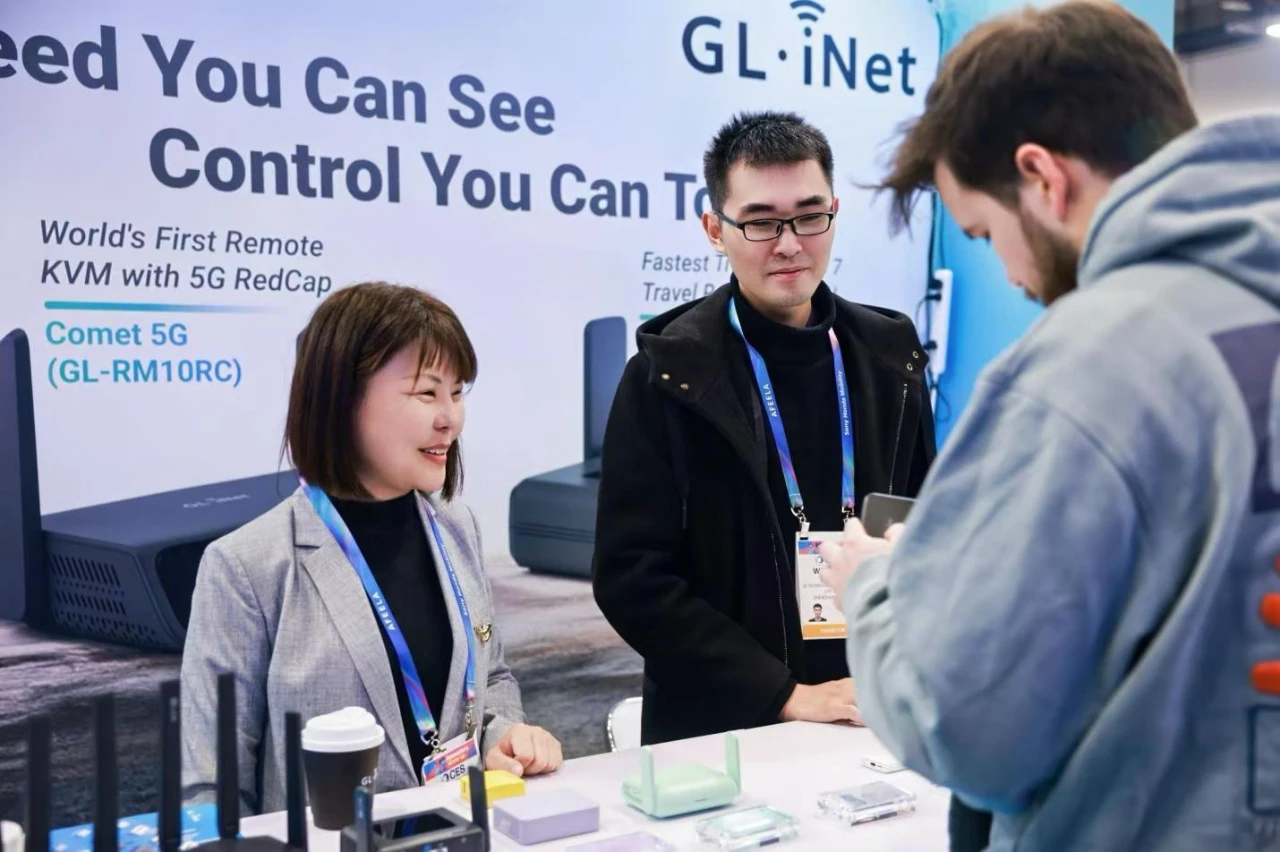
At CES 2026, GL.iNet is showing that it has ambitions well beyond travel routers. Known for its enthusiast-friendly networking gear built on open platforms, the company is now taking aim at one of the most stubbornly outdated hardware categories in IT: the KVM. With the Comet Pro and the newly announced Comet 5G, GL.iNet is effectively rebuilding remote machine control from the ground up.
These devices are designed for developers, IT professionals, homelab operators, and power users who need reliable, low-latency access to systems that may be thousands of miles away—or sitting in the next room.
A Modern KVM for Modern Workflows
The Comet Pro immediately stands out by discarding many of the assumptions baked into traditional KVM hardware. Instead of bulky rack-mount units and proprietary software, GL.iNet delivers a compact desktop device with dual-band Wi-Fi 6, HDMI passthrough, USB support, and a built-in touchscreen.
That touchscreen is more than a status display. Users can connect the device to Wi-Fi, enable or disable cloud access, switch operating modes, and monitor system activity directly from the device itself. This makes initial setup and troubleshooting significantly easier, especially in environments where a keyboard and mouse may not be readily available.
Video performance is another strong point. The Comet Pro supports 4K@30FPS HDMI passthrough, allowing the local display to operate normally, while simultaneously encoding a remote H.264 stream with reported latency as low as 30–60 milliseconds. For remote BIOS access, OS installation, or real-time troubleshooting, that balance of clarity and responsiveness is critical.
Browser-Based Control and Self-Hosted Security
GL.iNet has also prioritized accessibility. Remote access works entirely through a web browser on Windows, macOS, or Linux—no client software required. This makes the Comet Pro especially appealing for mixed-OS environments or IT teams supporting users with varying levels of technical expertise.
Equally important is how the device handles security. The Comet Pro supports self-hosted deployment, allowing users to run their own remote access servers on Linux or Ubuntu. For privacy-focused users, this means no mandatory reliance on third-party cloud services and full control over where data flows.
Two-way audio support further expands use cases, enabling live communication during remote support sessions or collaborative troubleshooting.
Comet 5G: KVM Without Network Assumptions
While the Comet Pro modernizes the KVM experience, the Comet 5G goes a step further by removing network dependencies altogether. Featuring a built-in 5G RedCap module with global 4G LTE fallback, it can operate independently of local Ethernet or Wi-Fi networks.
This makes it particularly well-suited for air-gapped systems, remote installations, disaster recovery scenarios, or mobile deployments where network access is unpredictable. A multi-network failover system automatically prioritizes Ethernet, then Wi-Fi, then cellular, ensuring the management channel stays alive even if primary connectivity fails.
The Comet 5G also doubles onboard storage to 64GB eMMC, allowing users to store multiple OS images and ISO files locally—reducing downtime when remote recovery is required.
A Natural Expansion for GL.iNet
Seen in context, GL.iNet’s move into KVM hardware feels like a natural extension of its philosophy: empower users with flexible, transparent tools that don’t hide behind closed ecosystems. By combining modern networking, touchscreen control, and self-hosted security, the Comet series brings remote system management into line with how people actually work in 2026.
For readers who run homelabs, manage remote servers, or simply want more control over their hardware, the Comet Pro and Comet 5G are shaping up to be some of the most intriguing infrastructure devices to come out of CES this year.
Disclosure: Some of our articles include affiliate links. If you buy something through one of these links, Geeky Gadgets may earn an affiliate commission. Learn about our Disclosure Policy.
