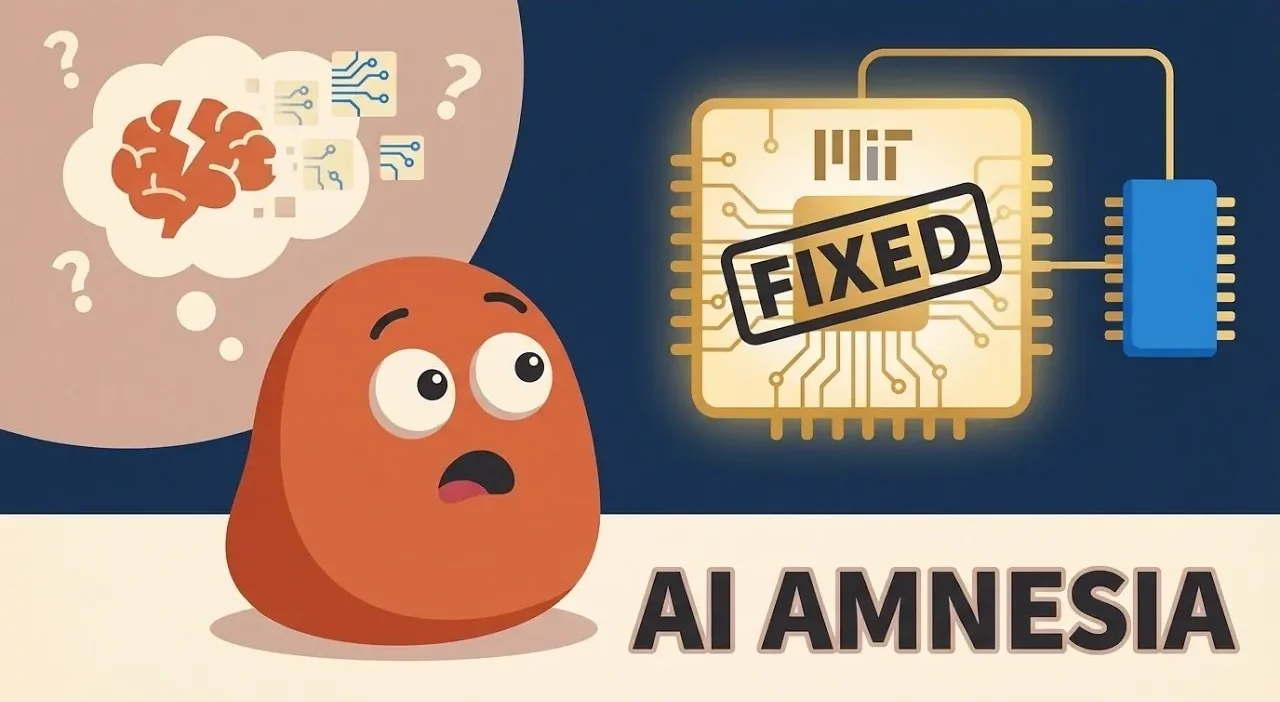
Artificial intelligence systems have long struggled with a limitation known as catastrophic forgetting, where learning new tasks causes models to lose previously acquired knowledge. This issue has significant implications for applications requiring sequential learning, such as medical diagnostics or scientific research, where retaining earlier insights is critical. In a recent exploration, Claudius Papirus highlights MIT’s development of Self-Distillation Fine-Tuning (SDFT), a method designed to address this challenge. By dividing a single AI model into distinct “teacher” and “student” roles, SDFT enables the model to refine its reasoning while preserving prior knowledge, offering a more adaptable approach to continuous learning.
In this breakdown, you’ll uncover how SDFT improves knowledge retention and enhances reasoning by focusing on the learning process rather than rote memorization. It also examines the method’s computational demands and its performance across tasks like medical diagnostics and scientific reasoning. Whether you’re interested in how AI can evolve to meet complex, real-world challenges or the practical constraints of implementing SDFT, this guide provides a clear look at its potential and limitations.
Solving Catastrophic Forgetting
TL;DR Key Takeaways :
- MIT researchers developed Self-Distillation Fine-Tuning (SDFT) to address catastrophic forgetting, allowing AI models to learn new tasks without losing prior knowledge.
- SDFT splits the AI model into “teacher” and “student” roles, focusing on reasoning processes rather than rote memorization to retain and integrate knowledge.
- Compared to traditional methods, SDFT improves knowledge retention, enhances reasoning and delivers better performance in tasks requiring adaptability and continuous learning.
- Experimental results show SDFT models retain reasoning capabilities, achieve higher accuracy and outperform conventional approaches, though they require more computational resources.
- SDFT represents a significant advancement in AI training, paving the way for adaptive systems in fields like healthcare, education and scientific research, despite some remaining challenges.
Understanding Catastrophic Forgetting
Catastrophic forgetting is a critical limitation in traditional AI training methods, particularly in supervised fine-tuning (SFT). When AI models are updated with new tasks, they often overwrite the parameters associated with earlier tasks, effectively “forgetting” what they previously learned.
This issue is especially problematic in scenarios requiring sequential learning, where models must retain knowledge over time. For example, an AI system trained to diagnose medical conditions might lose its ability to recognize earlier diseases when updated with new diagnostic criteria. This limitation hinders the development of AI systems capable of long-term adaptability and continuous learning, which are essential for applications in fields like healthcare, education and scientific research.
How SDFT Addresses the Problem
MIT’s Self-Distillation Fine-Tuning (SDFT) introduces a novel approach to mitigate catastrophic forgetting. The method involves splitting a single AI model into two distinct roles: a teacher and a student.
- Teacher Role: The teacher provides demonstrations and guidance based on its existing knowledge, serving as a reference point for the learning process.
- Student Role: The student learns from the teacher’s reasoning style and generates its own outputs, aligning with the teacher’s thought process rather than merely copying its answers.
This dynamic interaction between the teacher and student enables the model to refine its skills while preserving previously acquired knowledge. Unlike traditional methods, SDFT emphasizes the reasoning process rather than rote memorization, allowing the model to integrate new insights without compromising its existing capabilities.

Browse through more resources below from our in-depth content covering more areas on AI models.
- Which Claude 3 AI model is best? All three compared and tested
- Stability AI unveils TripoSR AI image to 3D model generator
- Minimax 2.5 Preview: Stronger Tools for Front-End Work & Research
- Gemini 3.5 Models Tested on Alamarina and Google AI Studio
- LLAMA 5 Leak : Meta Avocado AI Model What We Know so Far
- VLJ and JEPA, Yann LeCun’s Path to Real-World Machine Sense
- NVIDIA Open AI Models Released at CES 2026 & Faster Platform
- Run Local AI Models on Your PC or Mac for Coding, Study & More
- Gemini 3.1 vs ChatGPT vs Claude : Strategy & Feature Differences
- ChatGPT 5.2 Garlic : Release Window, Features & OpenAI Code Red
The Advantages of SDFT
SDFT offers several key benefits over conventional training methods like SFT, making it a significant advancement in AI development. These advantages include:
- Reduced Forgetting: Models trained with SDFT retain prior knowledge even when exposed to new tasks, addressing one of the core challenges of sequential learning.
- Enhanced Reasoning: By focusing on the reasoning process, SDFT improves the model’s ability to integrate new information into its broader understanding.
- Improved Performance: In tasks requiring complex reasoning or knowledge retention, SDFT has consistently outperformed traditional methods, demonstrating its effectiveness in real-world applications.
These benefits make SDFT particularly valuable for fields such as medical diagnostics, scientific research, and other domains where continuous learning and adaptability are critical.
Experimental Results and Challenges
MIT researchers tested SDFT across a variety of sequential tasks, including tool use, scientific reasoning and medical diagnostics. The results were highly encouraging:
- Knowledge Retention: Models trained with SDFT demonstrated the ability to retain reasoning capabilities even when exposed to new datasets.
- Higher Accuracy: When trained on datasets containing only final answers, SDFT models achieved better accuracy in integrating new facts compared to traditional methods.
Despite its promise, SDFT is not without challenges. Its effectiveness depends on factors such as model size and in-context learning ability. Smaller models tend to underperform compared to larger ones and the method requires approximately 2.5 times more computational resources than traditional approaches, making it resource-intensive. Additionally, some residual forgetting persists and quirks such as the model adopting the teacher’s verbal habits have been observed.
Implications for the Future of AI
The development of SDFT marks a significant step forward in addressing the challenges of catastrophic forgetting. By using in-context learning as a training mechanism, SDFT repurposes existing model capabilities to enable continuous learning and adaptability. This approach underscores the importance of designing AI systems that can grow and evolve over time, much like human learners.
While SDFT is not a complete solution, it represents a promising direction for improving AI training methodologies. Its ability to balance knowledge retention with the acquisition of new skills highlights its potential to transform fields that rely on adaptive AI systems. As researchers continue to refine SDFT and explore complementary approaches, the vision of creating truly adaptive and continuously learning AI systems becomes increasingly achievable.
For now, SDFT stands as a critical milestone in overcoming one of AI’s most persistent challenges, offering a glimpse into a future where AI systems can learn, adapt and thrive in dynamic environments.
Media Credit: Claudius Papirus
Disclosure: Some of our articles include affiliate links. If you buy something through one of these links, Geeky Gadgets may earn an affiliate commission. Learn about our Disclosure Policy.
