
Google has updated its Android distribution figures, and the latest data covers the seven-day period up to the 5th of February 2018.
In the latest Android distribution figures, Android Nougat has now overtaken Android Marshmallow for the first time. Android Nougat is now on 28.5 percent of devices, while Android Marshmallow is on 28.1 percent of devices.
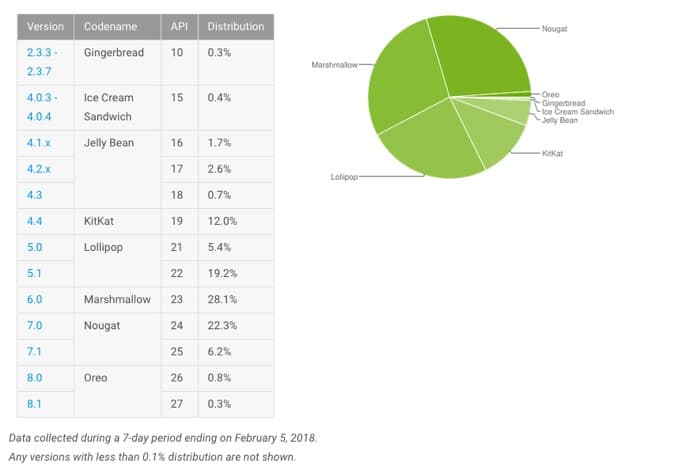
The latest version of Google’s mobile OS, Android Oreo, is just on 1.1 percent of Android devices. This figure is expected to increase as more smartphone and tablet manufacturers release the update. Android Oreo brings a host of new features and improvements, including enhanced battery life, picture-in-picture mode, and notification dots, which are likely to encourage more users to upgrade as it becomes available on more devices.
Older Android Versions
The rest of the versions include Android Lollipop on 24.6 percent of devices, Android KitKat on 12 percent, and Android Jelly Bean on 5 percent of devices. These older versions, while still in use, are gradually declining as users upgrade to newer versions of the OS. Android Lollipop, for instance, introduced the Material Design language, which significantly improved the visual aesthetics and user experience of Android. However, it lacks many of the security and performance enhancements found in later versions.
Android KitKat, which was released in 2013, brought features like the “OK Google” voice search and a more immersive mode for apps. Despite its age, it still holds a significant share of the market, particularly in regions where older devices are more prevalent. Android Jelly Bean, on the other hand, introduced Project Butter, which aimed to make the user interface smoother and more responsive. However, its market share has been steadily decreasing as newer versions offer more advanced features and better performance.
Future Trends and Updates
As we look to the future, it’s clear that Google’s efforts to streamline updates through initiatives like Project Treble are starting to pay off. Project Treble, introduced with Android Oreo, aims to make it easier for manufacturers to update their devices to newer versions of Android. This could lead to faster adoption rates for future versions of the OS.
Moreover, the upcoming Android P (now known as Android Pie) is expected to bring even more improvements, such as adaptive battery and brightness, new gesture navigation, and a revamped user interface. These features are designed to enhance the overall user experience and make Android devices more efficient and user-friendly.
It’s also worth noting that Google’s Android One program, which provides a pure Android experience with timely updates, is gaining traction. Devices under this program are guaranteed to receive updates for at least two years, which could help reduce fragmentation in the Android ecosystem.
In conclusion, while older versions of Android still hold a significant share of the market, the trend is clearly moving towards newer versions with better features and improved performance. As manufacturers continue to roll out updates and new devices come pre-installed with the latest versions of Android, we can expect to see a gradual shift towards more recent versions of the OS.
You can find out more details about the latest distribution figures for Google’s Android OS at the link below.
Source Android Developers
Disclosure: Some of our articles include affiliate links. If you buy something through one of these links, Geeky Gadgets may earn an affiliate commission. Learn about our Disclosure Policy.
