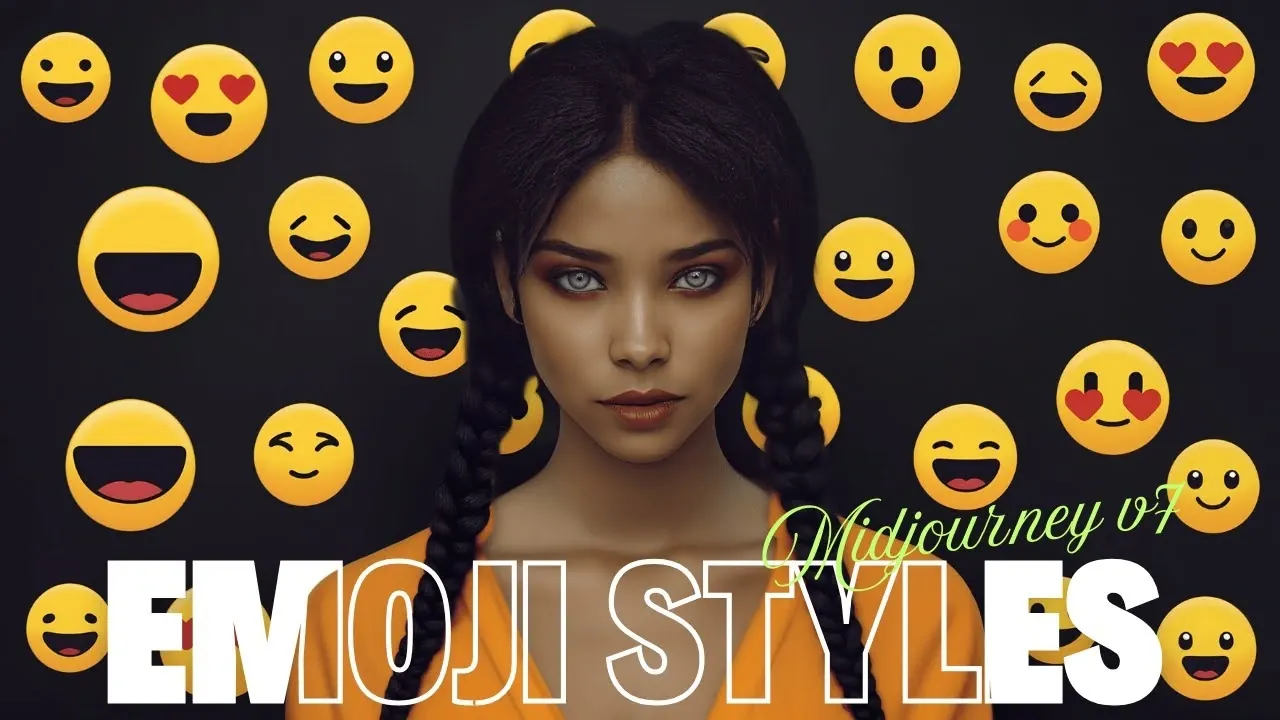
What if the emojis you use in Midjourney could unlock entirely new creative dimensions, but not in the way you’d expect? Below, Thaeyne breaks down how Midjourney’s Style Explorer interprets emojis in a way that defies their literal meanings, grouping them into a single aesthetic category rather than treating them as unique symbols. This surprising uniformity might seem limiting at first glance, but it actually opens the door to a fascinating world of artistic experimentation. By understanding how the system processes these tiny visual prompts, you can tap into a hidden layer of creative potential that’s both accessible and endlessly intriguing.
In this interesting guide, you’ll discover how emojis transform into a gateway for exploring visually distinct styles like neon broadcast or wet chrome futurism, regardless of the emoji you choose. You’ll also gain insight into the algorithm’s mysterious logic and how it prioritizes aesthetic consistency over semantic accuracy. Whether you’re curious about how a ghost emoji can lead to surreal chromatic blooms or why a simple star produces textured, analog-inspired grit, this guide will challenge your assumptions and inspire you to rethink how you approach creative inputs. The possibilities might be more expansive, and surprising, than you think.
Midjourney Emoji Style Insights
TL;DR Key Takeaways :
- Midjourney’s style search processes emojis uniformly, grouping them into a single “emoji bucket” of styles, regardless of their literal meanings or cultural associations.
- Despite uniform categorization, the generated styles are visually diverse, including unique aesthetics like “Analog grit,” “Neon broadcast,” “Chromatic ghost bloom,” and “Wet chrome futurism.”
- Testing revealed no significant variation in outputs across different emoji prompts, highlighting the system’s focus on aesthetic consistency over semantic accuracy.
- The algorithm’s inner workings remain opaque, but its design prioritizes creative flexibility and streamlined style generation for users.
- Using emojis as prompts simplifies creative exploration, allowing users to uncover unique styles and experiment with unconventional inputs without needing precise selections.
How Emojis Behave as Prompts
When you use emojis as prompts in Midjourney’s style search, the system processes them in a surprisingly uniform manner. Whether you choose a star, a fruit, or a ghost emoji, the results typically fall into a single “emoji bucket” of styles. This suggests that the algorithm does not interpret emojis based on their literal meanings or cultural associations. Instead, it categorizes them under a shared umbrella, producing consistent outputs regardless of the specific emoji used.
This uniformity, while unexpected, offers a practical advantage. It simplifies the process of style discovery, allowing you to experiment freely without needing to select a specific emoji to achieve a desired result. By treating emojis as interchangeable within this broader category, the system encourages creative exploration without the constraints of semantic precision.
What Makes the Styles Unique
Although the algorithm groups emojis into a single category, the styles it generates are far from repetitive. Each output is visually distinct, showcasing a diverse range of high-quality aesthetics. Examples of these styles include:
- Analog grit, characterized by textured, vintage-inspired visuals.
- Neon broadcast, featuring vibrant, glowing hues reminiscent of retro-futuristic designs.
- Chromatic ghost bloom, blending ethereal light effects with surreal color palettes.
- Wet chrome futurism, emphasizing sleek, reflective surfaces and a futuristic aesthetic.
For you, this means that emojis can serve as a creative shortcut to uncovering styles that might not emerge through traditional text-based prompts. The variety of outputs underscores the tool’s potential as a resource for artistic experimentation, even when the input prompts are categorized similarly.
What Emojis Reveal in Midjourney’s Style Explorer

Dive deeper into Midjourney with other articles and guides we have written below.
- New Midjourney 6 prompts and commands explained
- Midjourney 2025 Video Roadmap Overview and Plans
- New Midjourney Video AI : Turn Photos into Stunning Animations
- New Midjourney Style Creator Beta, First Look and Review
- Midjourney Version 7: New Features, Improvements and Limitations
- Master Midjourney Mood Boards: A Complete Guide for Creatives
- How to use Midjourney’s new Image Editor
- How to Use Midjourney AI for Stunning Visual Creations in 2025
- New Midjourney Niji 6 anime AI art generator
- Midjourney Logo Design Guide : Free Vector Apps & What Actually
How the Testing Was Conducted
To better understand how Midjourney interprets emojis, a structured testing approach was employed. The process began with a period symbol as a baseline, providing a neutral reference point to observe the raw style outputs without thematic influence. This initial step established a foundation for comparison.
Next, four specific emoji prompts were tested:
- A person, representing human-centric imagery.
- A landscape, symbolizing environmental or scenic visuals.
- An object, focusing on tangible, inanimate items.
- A brain, reflecting abstract or conceptual themes.
These emojis were chosen to represent a mix of literal and abstract concepts. Interestingly, the results revealed no significant variation between the prompts. This finding reinforced the idea that emojis are grouped into a single category within the system, regardless of their individual meanings or symbolic associations.
The Algorithmic Mystery
The inner workings of Midjourney’s emoji categorization remain an intriguing mystery. The system’s criteria for grouping emojis and generating styles are not immediately transparent, leaving room for speculation about the factors influencing its decisions. This opacity adds an element of curiosity to the tool’s behavior, inviting further exploration.
One plausible explanation is that the algorithm prioritizes aesthetic consistency over semantic accuracy. By treating emojis as part of a broader category, the system may aim to streamline the style generation process while making sure visually coherent results. This approach allows for a balance between creative flexibility and algorithmic efficiency, allowing you to achieve high-quality outputs without needing to decode the system’s internal logic.
What This Means for You
For users like you, the emoji-based styles in Midjourney offer a practical and innovative way to experiment with creative inputs. By using emojis as prompts, you can access unique aesthetics that might be difficult to discover through standard text-based inputs. This approach encourages you to think beyond conventional methods, exploring unconventional prompts to unlock new creative possibilities.
Additionally, the system’s consistent behavior across emojis simplifies the exploration process. You don’t need to invest time in selecting the “perfect” emoji; instead, you can focus on experimenting with the styles themselves and identifying what aligns with your artistic vision. This streamlined approach makes it easier to navigate the tool’s capabilities and uncover outputs that resonate with your goals.
Opportunities for Future Exploration
As generative AI tools like Midjourney continue to evolve, there are numerous opportunities to further investigate and expand upon its style search feature:
- Test style codes as character references instead of style references to observe how the system interprets them differently.
- Monitor updates to the tool to identify changes in its behavior, improvements in its categorization logic, or new features that enhance its functionality.
- Experiment with emoji combinations to determine whether layering inputs produces more nuanced or unexpected results.
By staying curious and actively engaging with features like emoji prompts, you can remain at the forefront of this rapidly evolving field. Generative AI tools are likely to become increasingly sophisticated in their ability to interpret unconventional inputs, offering even greater potential for creative expression. Through continued experimentation, you can discover innovative ways to harness these tools, pushing the boundaries of what’s possible in digital artistry.
Media Credit: Thaeyne
Disclosure: Some of our articles include affiliate links. If you buy something through one of these links, Geeky Gadgets may earn an affiliate commission. Learn about our Disclosure Policy.
