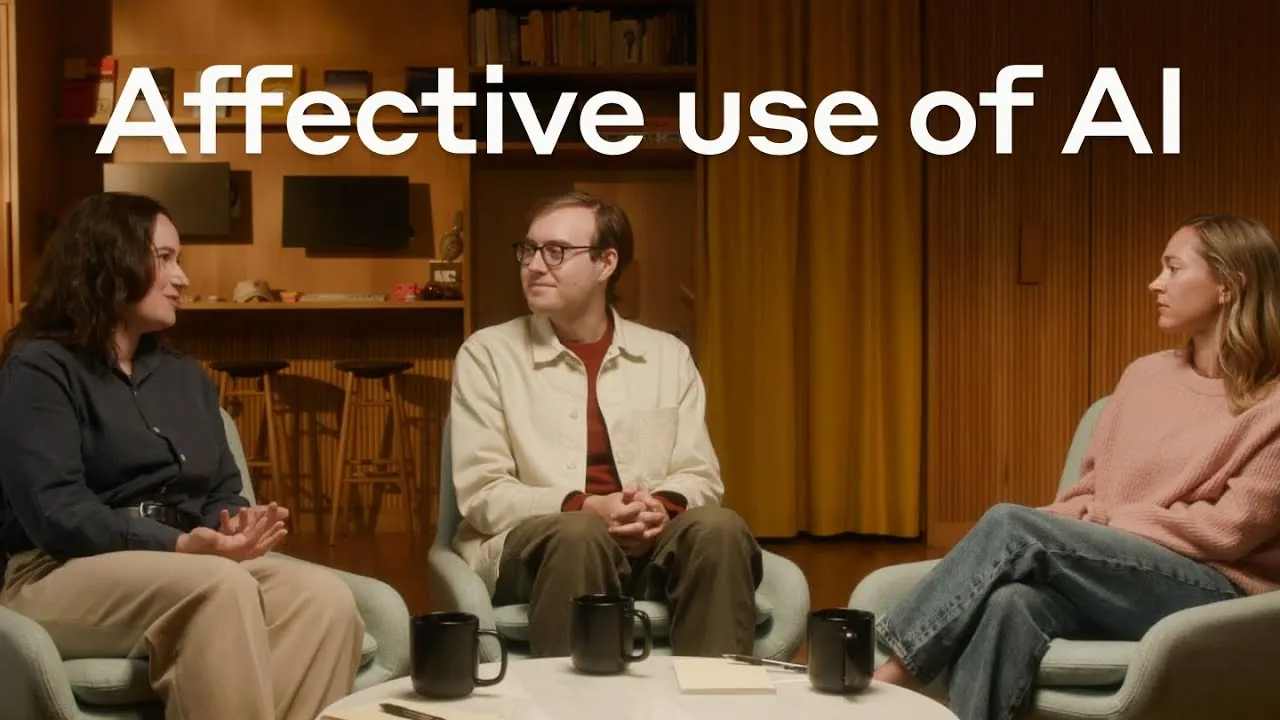
What happens when artificial intelligence begins to play a role in our most intimate, emotional moments? Picture this: a young professional, overwhelmed by career decisions, turns not to a friend or mentor, but to an AI system for guidance. Or a parent, grappling with the complexities of raising a teenager, seeks advice from a machine rather than a counselor. These scenarios are no longer speculative. Anthropic’s AI, Claude, initially designed as a professional tool, is quietly evolving into an unexpected confidant for users navigating personal and emotional challenges. This shift raises profound questions about the boundaries of AI’s role in human lives and the ethical considerations of such interactions. Could AI ever truly understand us—or is it merely reflecting back what we want to hear?
In this interview with the Anthropic team, we explore the emerging role of AI in emotional support, a domain fraught with both promise and controversy. From the surprising ways users are turning to Claude for interpersonal advice to the ethical safeguards Anthropic has implemented, this conversation provide more insights into the delicate balance between innovation and responsibility. You’ll gain insights into how AI systems like Claude are designed to preserve privacy, avoid misuse, and complement—rather than replace—human connections. As AI continues to blur the line between tool and companion, the implications for society are vast and complex. What does it mean to entrust our emotional lives to machines?
AI in Emotional Support
TL;DR Key Takeaways :
- Anthropic’s AI system, Claude, is increasingly being used for emotional support, raising ethical, social, and technical concerns about its integration into personal contexts.
- Claude’s design includes safeguards to prevent misuse, such as avoiding inappropriate scenarios like romantic or sexual role-play, while maintaining its primary focus as a professional tool.
- Privacy-preserving tools are used to analyze user interactions, revealing that users often seek advice on relationships, career challenges, and philosophical topics, guiding the development of responsible safeguards.
- Anthropic is collaborating with clinical experts to address ethical concerns, such as preventing unhealthy dependencies on AI and making sure users are directed to appropriate resources when needed.
- Future research focuses on mitigating sycophantic behavior, monitoring post-deployment usage, and understanding AI’s societal impacts to ensure ethical and responsible innovation in emotional AI applications.
AI’s Evolving Role in Emotional Support
When considering AI, emotional support may not be the first application that comes to mind. However, a growing number of users are turning to Claude for guidance on personal matters, such as navigating relationships, parenting challenges, career decisions, and even philosophical inquiries. Although these interactions account for only 2.9% of total usage, they reflect a notable trend of relying on AI for emotional and affective needs.
Anthropic’s internal analysis reveals that Claude has minimal engagement in inappropriate scenarios, such as romantic or sexual role-play. This outcome is a direct result of the system’s design limitations, which aim to prevent misuse while maintaining its primary focus as a professional tool. These findings highlight the importance of balancing user needs with ethical boundaries in AI development.
Privacy-Preserving Research and Its Role in AI Development
To better understand how users interact with Claude, Anthropic employs privacy-preserving tools to analyze millions of conversations. These tools ensure that user data remains secure while allowing researchers to identify patterns in AI usage. This approach allows for a deeper understanding of how AI systems are used without compromising user privacy.
The analysis reveals that users frequently seek advice on interpersonal relationships and professional challenges, with philosophical discussions also emerging as a significant category. These insights not only shed light on the diverse ways AI is being used but also guide the development of safeguards to address potential risks and unintended consequences. By using data responsibly, Anthropic is working to refine Claude’s capabilities while prioritizing user safety.
Anthropic Team Interview – Affective Use of AI

Learn more about Claude AI with the help of our in-depth articles and helpful guides.
- How Claude AI Built a Business with $1,000: Success or Failure
- Quickly & Easily Convert Ideas into Reality with Claude AI
- How to Use Claude AI to Copy & Replicate n8n Workflows Instantly
- How Cursor and Claude Are Developing AI Coding Tools Together
- How to Use Claude AI for Personal & Business Goals in 2025
- Claude AI Models Compared: Find the Best AI for Creative Writing
- How Claude AI Is Transforming Software Development
- Claude AI MCP Overview : Features, Benefits & Why It Stands Out
- ChatGPT vs Google Gemini vs Perplexity AI vs Claude
- How to Use Claude AI for Advanced SEO Optimization
Addressing Ethical and Safety Concerns
The use of AI for emotional support raises critical ethical questions. For instance, could reliance on AI discourage individuals from seeking human connections or professional help? Claude is not explicitly designed to function as an emotional support agent, and its limitations must be clearly communicated to users to manage expectations effectively.
To mitigate these concerns, Anthropic is collaborating with clinical experts to refine safeguards. These measures include directing users to appropriate resources when necessary and making sure that the system does not inadvertently encourage unhealthy dependencies. By taking a proactive approach, Anthropic aims to balance the potential benefits of AI with the need to address ethical and safety concerns.
Key Areas for Future Research and Development
Anthropic is committed to exploring the broader implications of AI in personal and emotional contexts. Several key areas of focus have been identified to guide future research and development:
- Investigating sycophantic behavior in AI systems, which could result in overly agreeable or biased responses that may mislead users.
- Monitoring post-deployment usage to ensure the system behaves responsibly and aligns with ethical standards in real-world scenarios.
- Collaborating with public and private stakeholders to understand AI’s societal impacts and promote responsible innovation.
These efforts are designed to ensure that AI systems like Claude are developed and deployed in ways that prioritize user safety, ethical considerations, and societal well-being.
The Broader Implications for AI and Society
As AI becomes increasingly integrated into daily life, its role in personal and emotional contexts is likely to expand. This trend underscores the importance of ongoing research, transparent communication, and the development of data-driven policies to guide its responsible use. While AI can provide valuable support in certain situations, it is essential to complement these interactions with human connections to foster emotional well-being.
By addressing these challenges collaboratively, society can shape a future where AI serves as a helpful tool without replacing the unique and irreplaceable value of human relationships. This balanced approach ensures that AI enhances, rather than diminishes, the quality of human interactions and emotional support systems.
Media Credit: Anthropic
Disclosure: Some of our articles include affiliate links. If you buy something through one of these links, Geeky Gadgets may earn an affiliate commission. Learn about our Disclosure Policy.
