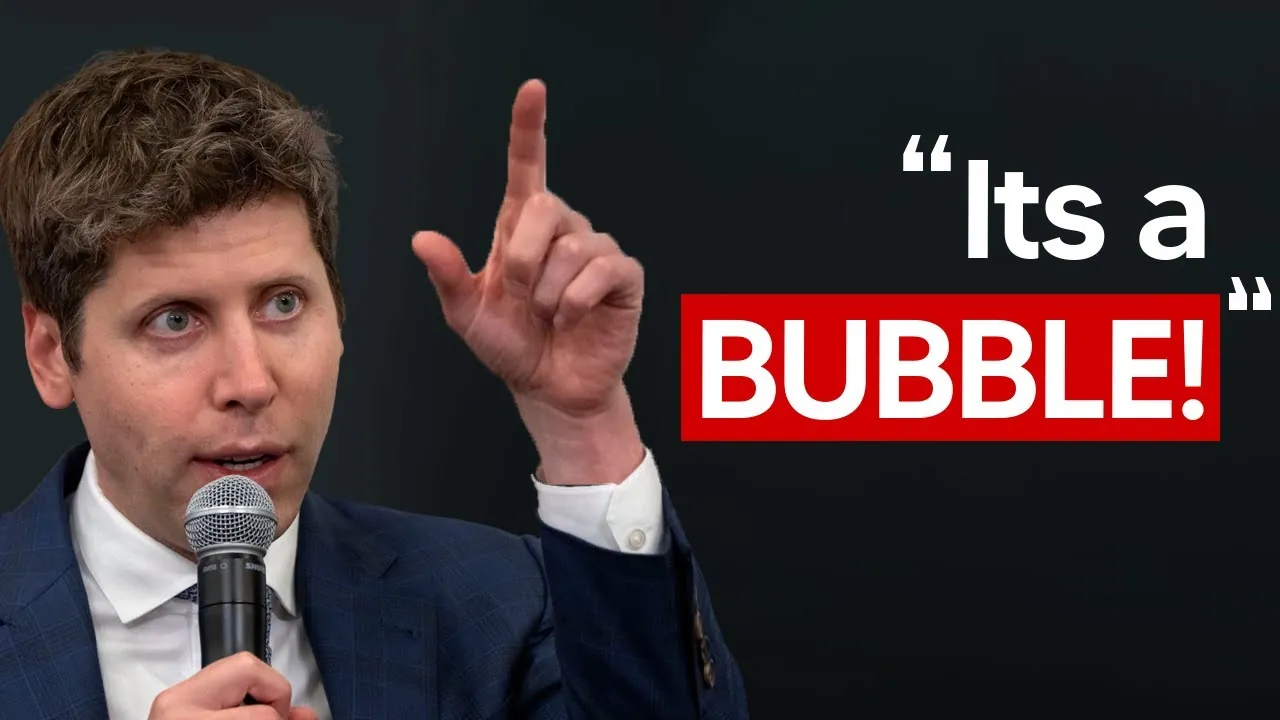
What happens when the world’s most hyped technology faces the possibility of a crash? That’s the question rattling the AI community after Sam Altman, CEO of OpenAI and one of the field’s most influential figures, issued a stark warning about a looming AI bubble. Altman’s concerns, coming from someone at the helm of a generative AI revolution, have sent shockwaves through an industry riding on sky-high valuations and seemingly boundless optimism. Comparisons to the infamous dot-com bubble of the early 2000s are already surfacing, raising uncomfortable questions: Is the AI boom built on solid ground, or is it teetering on the edge of unsustainable speculation?
In this news breakdown, AI Grid explore why Altman’s remarks have struck such a nerve and what they reveal about the fragility of the AI industry’s meteoric rise. From the staggering influx of venture capital to the unproven promises of generative AI, the sector’s vulnerabilities are becoming harder to ignore. But is a market correction a looming disaster, or could it be the reset the industry desperately needs? By the end, you’ll gain a deeper understanding of the forces shaping AI’s future and why balancing ambition with realism may be the key to its survival.
AI Industry Faces Speculative Bubble
TL;DR Key Takeaways :
- Sam Altman, CEO of OpenAI, warns of a potential speculative bubble in the AI industry, drawing comparisons to the dot-com bubble of the early 2000s.
- Soaring AI company valuations, often unsupported by tangible products or proven revenue streams, raise concerns about overvaluation and market instability.
- Generative AI, despite its potential, faces criticism for high failure rates, inconsistent outputs, and limited financial returns, challenging its scalability and profitability.
- The broader AI ecosystem, including robotics and autonomous vehicles, holds fantastic potential but faces hurdles like scalability, reliability, and adoption barriers.
- A potential market correction could strengthen the industry by eliminating overhyped ventures, fostering sustainable growth, and prioritizing practical, achievable goals.
Altman’s cautionary statements highlight the growing tension between the promise of AI and the risks of overvaluation. As the industry continues to attract significant investment, the possibility of a market correction looms large, prompting stakeholders to consider the long-term implications of their strategies.
Are AI Valuations Detached from Reality?
The surge in AI company valuations has raised concerns about whether these figures reflect genuine potential or speculative hype. Many startups, including high-profile names like Thinking Machines and Safe Super Intelligence, have secured billions in venture capital funding despite offering limited tangible products or proven revenue streams. This trend has led to skepticism that the industry may be prioritizing bold promises over measurable outcomes.
Investors, captivated by the allure of superintelligence and exponential growth, are pouring resources into ventures that often lack clear paths to profitability. This speculative behavior mirrors the patterns seen during the dot-com era, where inflated expectations ultimately led to widespread market collapse. The question remains whether the current enthusiasm for AI is sustainable or if it risks destabilizing the industry in the long term.
Investor Optimism and Market Vulnerabilities
The unprecedented levels of venture capital flowing into AI reflect a deep optimism about the technology’s potential. However, this enthusiasm is not without significant risks. Many AI startups operate with high cash burn rates and rely on untested business models, raising doubts about their ability to achieve long-term viability. These vulnerabilities have drawn increasing comparisons to the dot-com bubble, where overconfidence in emerging technologies led to a dramatic market correction.
While some companies promise new advancements, the lack of consistent financial returns from generative AI pilots has amplified concerns about the sector’s stability. The industry’s reliance on speculative investments creates a precarious environment, where a loss of investor confidence could trigger widespread disruption. This dynamic underscores the need for a more cautious and measured approach to AI development and funding.
Sam Altman Warns of AI Bubble

Expand your understanding of OpenAI with additional resources from our extensive library of articles.
- OpenAI Reveals How to Use GPT-4o More Effectively
- New OpenAI Swarm Framework Designed to Simplify Multi-Agent AI
- OpenAI ChatGPT Codex 2.0 : Features, Benefits & Challenges
- How OpenAI Codex Transforms Natural Language into Code
- How to use OpenAI Assistants API
- Different OpenAI models and capabilities explained
- The Complete ChatGPT Artificial Intelligence OpenAI Training
- OpenAI GPT-OSS 120B : The Future of Open-Source Artificial
- OpenAI GPT-5 vs GPT-6 : Key Features and Future Impacts
Generative AI: A Double-Edged Sword
Generative AI has emerged as one of the most publicized and controversial areas within the broader AI industry. While it holds immense potential for creative and innovative applications, its current limitations have raised significant concerns. Reports suggest that up to 95% of generative AI projects fail to deliver measurable financial returns, highlighting the challenges of translating technological advancements into profitable outcomes.
Critics argue that generative AI systems are often costly, unreliable, and prone to producing inconsistent or low-quality outputs. These shortcomings have led to skepticism about the technology’s immediate scalability and profitability. Despite these challenges, generative AI continues to attract attention for its potential to transform industries ranging from content creation to customer service. However, realizing this potential will require addressing the technology’s current limitations and aligning its development with practical, achievable goals.
Beyond Generative AI: The Broader AI Ecosystem
The AI industry encompasses a wide range of technologies beyond generative AI, including robotics, autonomous vehicles, and AI-powered tools. These fields hold immense potential to transform industries and societies, offering solutions to complex challenges and driving innovation across sectors. However, they also face significant hurdles, such as scalability, reliability, and adoption barriers.
One of the most ambitious goals within the AI community is the pursuit of superintelligence, a concept that envisions machines surpassing human cognitive abilities. While this idea has captured the imagination of researchers and investors alike, it remains speculative and far from realization. The gap between the industry’s aspirations and its current capabilities underscores the need for a more grounded approach to AI development, one that prioritizes tangible outcomes over lofty ambitions.
Could a Market Correction Strengthen the Industry?
The prospect of an AI market correction is a source of concern for many stakeholders, but it could also present an opportunity for the industry to recalibrate. A correction might eliminate overhyped companies that fail to deliver on their promises, allowing the sector to refocus on sustainable growth and practical applications. By weeding out speculative ventures, the industry could create space for smaller, more agile teams to emerge and drive innovation.
Key infrastructure and tools developed during the current wave of investment are likely to remain intact, providing a foundation for future advancements. These resources could enable the development of AI solutions that prioritize profitability and scalability, fostering a more stable and resilient ecosystem. While the path forward may be challenging, a market correction could ultimately strengthen the industry by aligning its trajectory with realistic expectations and achievable goals.
Balancing Optimism with Realism
The AI industry’s future depends on its ability to balance optimism about its potential with a realistic assessment of its limitations and risks. While the promise of fantastic breakthroughs remains compelling, the current environment of inflated valuations and speculative investments poses significant challenges. To ensure sustainable growth, the industry must focus on achievable goals, measurable outcomes, and practical applications.
Critics have called for a more measured approach to AI development and investment, emphasizing the importance of tangible results over speculative hype. By adopting this perspective, the industry can navigate its current challenges and position itself for long-term success. As AI continues to evolve, its trajectory will be shaped by the decisions and strategies of its stakeholders, who must carefully weigh the risks and rewards of their actions.
Media Credit: TheAIGRID
Disclosure: Some of our articles include affiliate links. If you buy something through one of these links, Geeky Gadgets may earn an affiliate commission. Learn about our Disclosure Policy.
