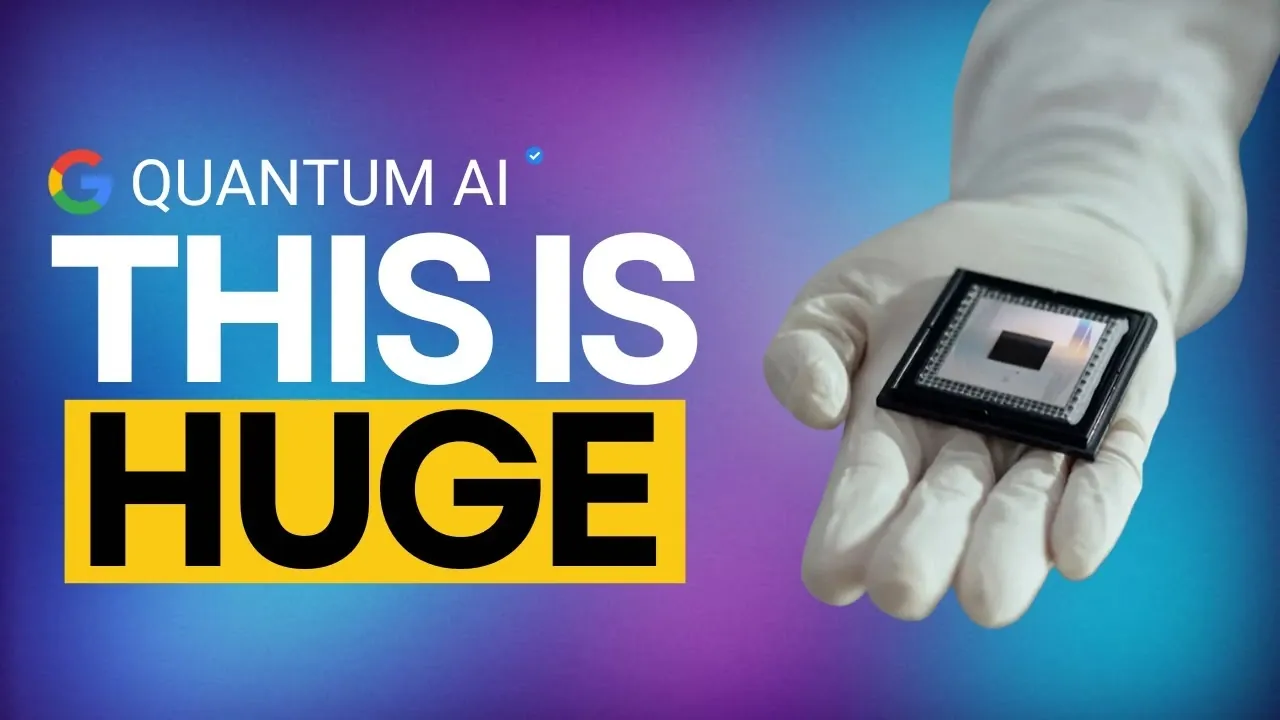
What if the most complex problems in science, medicine, and technology could be solved in mere moments? With Google’s latest quantum AI chip, “Willow,” this once-distant dream is now a tangible reality. Capable of performing tasks up to a staggering 13,000 times faster than the world’s most advanced classical supercomputers, Willow marks a seismic shift in the computing landscape. This breakthrough isn’t just about speed, it’s about unlocking possibilities previously deemed impossible. From transforming drug discovery to tackling climate change with unprecedented precision, Willow’s capabilities signal the dawn of a new era in problem-solving. But what exactly makes this chip so extraordinary, and how does it overcome the challenges that have long plagued quantum computing?
In this exploration of Willow’s new achievements created by Google Quantum AI team, you’ll discover how Google’s innovative “quantum echoes” algorithm has redefined the concept of quantum advantage, allowing it to solve real-world problems with unmatched efficiency. We’ll delve into the mechanics of this innovative chip, its advancements in error correction, and the profound implications for industries ranging from healthcare to renewable energy. But Willow’s story is more than just a technological leap, it’s a glimpse into the future of computation itself, where the boundaries of what machines can achieve are being rewritten. Could this be the tipping point that brings quantum computing into everyday life? Let’s unravel the possibilities.
Google’s Willow Quantum Breakthrough
TL;DR Key Takeaways :
- Google’s new Willow chip achieves quantum advantage, performing tasks up to 13,000 times faster than classical supercomputers using the “quantum echoes” algorithm.
- Willow significantly improves error correction, addressing a key challenge in quantum computing and advancing toward scalable, reliable quantum systems.
- The chip demonstrates fantastic potential in real-world applications, including drug discovery, clean energy, climate modeling, and material science.
- Willow represents Milestone 3 in Google’s quantum roadmap, focusing on the development of long-lived logical qubits and paving the way for fully error-corrected quantum systems.
- The synergy between quantum computing and AI is accelerating advancements, with AI optimizing quantum technologies and quantum systems enhancing AI capabilities.
Understanding Quantum Advantage
Quantum advantage signifies a pivotal milestone in the evolution of computing. Unlike quantum supremacy, which Google’s earlier chip, Sycamore, achieved in 2019 by solving a problem that classical computers could not, quantum advantage focuses on outperforming classical systems in solving practical, real-world tasks. Willow exemplifies this concept through its use of the “quantum echoes” algorithm, which enables it to complete computations that would take classical supercomputers exponentially longer to process. This advancement highlights the unique capabilities of quantum bits, or qubits, which use the principles of superposition to exist in multiple states simultaneously. By exploring numerous possibilities at once, qubits allow quantum computers to tackle problems that are infeasible for classical systems.

Breakthroughs in Error Correction
One of the most persistent challenges in quantum computing has been error correction. Qubits are inherently fragile and highly susceptible to environmental noise and decoherence, which can disrupt computations and compromise results. Willow builds upon the foundation laid by its predecessor, Sycamore, by significantly reducing error rates. This improvement addresses a longstanding obstacle in the field and brings researchers closer to achieving long-lived logical qubits, a critical component for building scalable and reliable quantum systems. By enhancing error correction techniques, Willow represents a major step toward the development of quantum processors capable of handling complex, real-world problems with precision and consistency.
Google’s Quantum AI Chip “Willow” Just Changed EVERYTHING (13,000× Faster!)

Browse through more resources below from our in-depth content covering more areas on Quantum Computing.
- Microsoft’s Majorana 1 Chip: A Quantum Computing Breakthrough
- Quantum Computing Breakthroughs in 2025 Explained
- How Quantum Computers Threaten to Break Modern Encryption
- Quantum computing Hype vs Reality explained
- Intel Quantum Computing SDK released
- Artificial Intelligence vs Quantum Computing
- Quantum computing in 2023
- What can a DIY homemade quantum computer do?
- Rigetti Ankaa-3 Quantum Computer: 84 Qubits of Innovation
- Google’s Verifiable Quantum Advantage: What It Means for Science
The Mechanics of Quantum Computing
Quantum computing operates on principles fundamentally different from those of classical computing. While classical bits encode information as either 0 or 1, qubits can exist in a state of superposition, effectively being both 0 and 1 simultaneously. This property enables quantum computers to process vast amounts of data and explore complex problems far more efficiently than classical machines. Additionally, qubits can become entangled, allowing them to share information instantaneously over long distances. However, the immense power of quantum computing comes with significant challenges, such as maintaining qubit stability, minimizing errors, and scaling systems to accommodate larger computations. Willow’s advancements address some of these challenges, bringing quantum computing closer to practical implementation.
Fantastic Applications of Quantum Computing
The potential applications of quantum computing span a wide range of industries, offering solutions to problems that are currently beyond the reach of classical systems. Willow has already demonstrated its capabilities by simulating molecular structures with unprecedented precision, a breakthrough that could transform several fields, including:
- Drug Discovery: Quantum simulations can model molecular interactions at an atomic level, accelerating the development of new pharmaceuticals and personalized medicine.
- Clean Energy: Advanced quantum algorithms can aid in designing materials for renewable energy technologies, such as more efficient solar panels and batteries.
- Climate Modeling: Quantum systems can analyze complex environmental variables, improving the accuracy of climate predictions and allowing better strategies for mitigating climate change.
- Material Science: Quantum computing can assist the creation of innovative materials with unique properties, unlocking new possibilities in manufacturing and technology.
These applications underscore the fantastic potential of quantum systems to address some of the most pressing challenges facing humanity today.
Google’s Vision for Quantum Computing
Google’s roadmap for quantum computing outlines a series of ambitious milestones aimed at achieving practical, large-scale quantum systems. Willow’s achievement represents Milestone 3: the development of long-lived logical qubits. Future goals in Google’s quantum roadmap include:
- Developing logical gates for fully error-corrected quantum systems.
- Scaling engineering solutions to build larger and more powerful quantum processors.
- Creating fully error-corrected quantum systems capable of solving real-world problems across industries.
These milestones reflect Google’s commitment to advancing quantum technology and unlocking its potential to transform fields ranging from artificial intelligence to scientific research.
The Synergy Between Quantum Computing and AI
The intersection of quantum computing and artificial intelligence (AI) holds immense promise for both fields. Quantum systems have the potential to accelerate data processing and enable more sophisticated AI models, while AI is already playing a crucial role in optimizing quantum technologies. For instance, AI algorithms are being used to stabilize qubits, enhance error correction techniques, and improve the overall efficiency of quantum systems. This symbiotic relationship highlights the complementary strengths of these technologies and their potential to drive innovation across domains such as healthcare, finance, and logistics. The integration of quantum computing and AI could redefine the boundaries of what is technologically possible.
Challenges and the Path Ahead
Despite its new achievements, quantum computing remains in its early stages. Current systems, including Willow, are limited to controlled, specific tasks and are not yet practical for widespread use. Challenges such as scaling quantum processors, further reducing error rates, and improving qubit stability must be addressed before quantum computing can reach its full potential. However, the progress made with Willow represents a foundational step toward overcoming these obstacles. As researchers continue to refine quantum technologies, the potential for quantum computing to transform industries and advance scientific discovery becomes increasingly tangible.
A New Era of Computational Possibilities
Google’s Willow chip represents a pivotal moment in the evolution of quantum computing. By achieving quantum advantage and addressing critical challenges in error correction, Willow has set a new benchmark for what is possible in this field. While practical quantum computing remains a future goal, the advancements achieved with Willow bring us closer to realizing its fantastic potential. From transforming drug discovery and clean energy to advancing climate modeling and artificial intelligence, the implications of quantum computing are poised to reshape industries and redefine the technological landscape. As quantum systems continue to evolve, they promise to unlock solutions to some of the most complex challenges of our time.
Media Credit: Universe of AI
Disclosure: Some of our articles include affiliate links. If you buy something through one of these links, Geeky Gadgets may earn an affiliate commission. Learn about our Disclosure Policy.
